

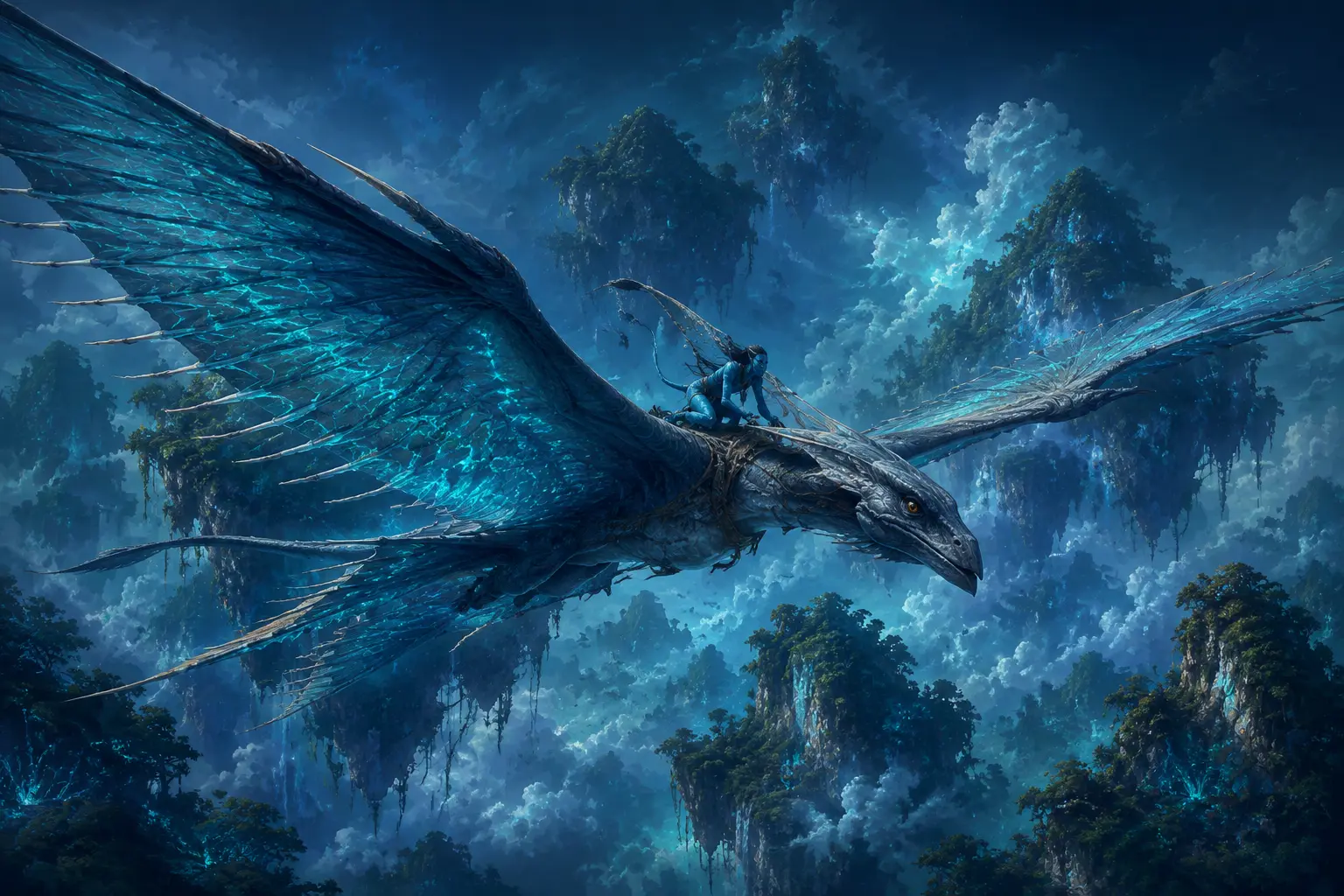
Jake is skimming low over the canopy, newly bonded to his banshee and still clumsy with it, when something enormous slides across the sun above him — and the camera does the thing it always does with the great leonopteryx, the toruk, which is to give you nothing to measure it against until it is almost too late. Then a tree goes past in the foreground, or a ridge, and the size lands all at once: the thing overhead is not a big animal. It is a piece of architecture that happens to be alive. Its wings are the span of a small aircraft's, and they are moving, sweeping through the air with the slow, deliberate authority of something that has never in its life had to hurry. The Na'vi call it the last shadow — the one you see just before you die. The first thing a biologist feels, watching it bank, is not fear. It is a flat, stubborn refusal. That should not be able to fly.
The instinct is exactly right, and that is what makes it worth a whole chapter. The toruk, and the smaller mountain banshee that the Na'vi actually break and ride, are not merely large the way a movie monster is large — large because the art department thought it would look good. They are large in a very particular way that real flying animals on Earth are forbidden to be, and forbidden not by some squeamishness of biology but by physics we can write down on a single page. There is a ceiling on the size of a flying animal. We know roughly where it sits. We know what sets it. We even know the single largest creature that ever lived and flew up against it. And Pandora's fliers sail clean past that ceiling as though it were not there at all.
So the honest question is not whether the films are allowed to put a predator with a twenty-metre-plus wingspan in the sky — plainly they are; it is their sky. The question is whether that animal can be made to make sense. What would a world have to do to its own physics to let a creature the size of a hang-glider, with a Na'vi on its back, claw its way off a cliff and stay up? And — this is the part that turns a fan's shrug into a real investigation — does Pandora, as the films and their companions actually describe it, happen to do those things?
The answer turns out to be unusually satisfying, because to make the banshee work we do not have to cheat. We do not have to invent new physics or wave a hand at "alien biology." The very same equations that pin Earth's fliers to the ground at a few hundred kilograms contain, buried inside them, exactly two terms that Pandora changes — and changing those two terms moves the ceiling in precisely the direction a banshee needs it to move. The whole chapter is really just the slow unpacking of those two terms. But to see why they matter, we have to start somewhere that feels at first like the opposite of Pandora: with the most stubborn, least romantic fact in the entire science of flight. Getting bigger makes flying harder. And it does so far, far faster than anyone's intuition expects.
The tyranny of getting bigger
Hold a sparrow in your mind. Now imagine scaling it up — keeping every proportion exactly the same — until it is the size of an eagle, a swan, a horse. Your intuition says the wings simply grow to match. Your intuition is wrong, and the precise way in which it is wrong is the reason this chapter exists.
The culprit is the square-cube law, which IV.3 — Direhorse and Banshee Up Close takes apart on the ground: weight comes from a volume and climbs with the cube of size, while a wing is only a surface and climbs with the square. Eight against four. On land that mismatch decides what a leg bone must be made of, and a thicker bone is at least an available answer. In the air there is no equivalent move — you cannot thicken a wing into more lift — and the quantity where the mismatch bites has a name worth carrying through the rest of this chapter.
Wing loading is the animal's weight divided by its wing area — how many kilograms each square metre of wing is asked to carry. Because weight outruns area, wing loading climbs relentlessly the bigger an animal gets. A sparrow carries a feather-light load on generous wings and can flutter almost lazily. A swan carries a punishing load on wings that, for its bulk, are comparatively meagre — which is why a swan does not flutter anywhere; it runs across half a lake, hammering the water with its feet, fighting for every scrap of speed before it finally heaves into the air. Scale up past the swan and the wing loading becomes so brutal that the wings cannot make enough lift to fly at any speed the animal could possibly reach, let alone survive.
You can feel exactly why this bites if you think for a moment about what lift actually is. A wing holds an animal up by one means only: it throws air downward, and the air, shoving back, holds the animal up. The amount of lift a wing makes depends on three things — how much wing there is, how fast that wing is slicing through the air, and how dense the air itself is. Now hold the wing area fixed and pile on weight, as the square-cube law forces you to. The only way left to make enough lift is to move the wing faster through the air. So the heavier the flier, the faster it must go simply to stay aloft — its minimum flying speed creeps upward and upward. A small bird can loiter, can hang almost still in a headwind. A heavy flier must commit to real speed or fall. Push the trend far enough and the minimum speed to stay airborne becomes a sprint, then a dive off a height, then a velocity no muscle and no cliff can deliver, and the animal is simply grounded for life.
So a banshee big enough for a three-metre Na'vi to sit astride is already deep inside territory where the wing loading ought to be vicious — somewhere out past the swan, out past anything alive on Earth today. And the toruk, with a wingspan the films push past twenty metres, is somewhere the law seems to say nothing whatsoever should be flying. To find out exactly where that wall stands — and it is a real wall, with an actual number bolted to it — we have to stop talking about lift, which is only the question of whether the wing can hold the animal up, and turn to the thing that truly decides the fate of large fliers: not lift, but power.
The crossing point
Lift answers a single question: can this wing hold this body up, at some speed, in principle? Power answers the harder one: can the animal's muscles keep paying for that lift, second after second, for as long as it wants to stay in the sky? And it is power, not lift, that draws the real line — the line nothing crosses.
To fly level, an animal has to pour out mechanical work without pause. Every wingbeat is a push against the air, and the animal is always, gently, falling; the beats are what replace the height that gravity is forever stealing back. Call the rate at which a flier must spend energy just to hold its position the power required. It is the cost of the ticket, paid continuously. On the other side of the ledger sits the power available: the very most that the flight muscles can actually produce, beat after beat, sustainably — not in one heroic burst, but for the long haul, without tearing the muscle or drowning it in its own waste heat.
Here is the cruelty hidden in those two phrases. As an animal gets bigger, both numbers grow — but they grow at different rates, and the difference is fatal. The power the muscles can supply scales roughly with how much muscle there is, which is to say with body mass, but it is held back by a quiet penalty: a bigger animal must beat its wings more slowly. A longer wing simply cannot be flapped as fast — the forces at the wingtip would tear it apart — and a slower beat wrings less power from each kilogram of muscle. So the supply of power rises, but grudgingly, on a gently climbing curve. The power demanded by flight, meanwhile, climbs steeply: a heavier body needs more lift, which must be flown for at higher speed, against more drag, and the bill compounds. Two curves, then, both rising with size — one gentle, one steep. They begin with clear daylight between them, the supply comfortably above the demand. But a steep line always catches a shallow one in the end. They are destined to cross.
The mass at which they cross is the ceiling. Below it, the muscles make more power than flight costs, and there is surplus left over — for climbing, for turning hard, for carrying prey, for the sheer extravagance of a courtship display. Right at the crossing, the books balance to the penny: every watt the muscles produce goes to staying merely level, with nothing whatever to spare. And above it, the accounts simply will not close — flight demands more power than the body can ever supply, and sustained flapping flight is not difficult but impossible. The physiologist Colin Pennycuick spent a long career mapping these power curves for real birds; the biologist James Marden measured how much lift animals can actually wring out at the desperate instant of takeoff. Their numbers converge on a ceiling for Earth, and it is humbling in its modesty: the heaviest a powered, flapping flier can be is somewhere around two hundred and fifty kilograms. Nothing alive today comes remotely close. The heaviest flying birds — the great bustards, the largest swans and condors — top out near sixteen kilograms, and even they get airborne like overloaded freighters, with a long graceless run and a great deal of complaint.
The wall for fliers
Toggle that figure between the two worlds and you are holding the entire thesis of this chapter in a single image, so it is worth being slow and exact about what it shows. The teal curve — the power the muscles can supply — belongs to the animal. It is a fact about physiology, about how muscle works, and it does not care in the slightest what planet it is drawn on. But the amber curve — the power that flight demands — does care, deeply, because what flight costs depends on two things that are properties of the world: how hard gravity drags the body down, and how much lift the air is willing to give back for each beat. On Earth, those two settings put the crossing at roughly two hundred and fifty kilograms. And that number, it is crucial to understand, is not a fact about Quetzalcoatlus or any other animal. It is a fact about Earth — the heaviest thing this particular planet's gravity and this particular planet's air will permit a muscle to fly.
Change the planet, and you change where the curves cross. But before we change it, we should meet the animals that lived their whole lives pressed right up against Earth's version of the wall — because Earth, in its long history, has actually run this experiment, and the results tell us precisely what a body has to do to flirt with the ceiling.
How the giants cheated
Two hundred and fifty kilograms stays an abstraction until you meet the creatures that lived at the very edge of it, and there is no better guide to Pandora than the animals Earth itself built when it pushed flight as far as flight will go.
The largest flying animal ever known was a pterosaur named Quetzalcoatlus, an azhdarchid from the last act of the age of dinosaurs. Standing on the ground it was as tall as a giraffe; in the air it unfurled a wingspan of ten to eleven metres. Estimates of its mass have swung wildly across the decades — anywhere from a flattering seventy kilograms to a crushing quarter-tonne — and that very disagreement is a kind of evidence, a sign of how genuinely hard it is to weigh a creature this size from a scatter of crushed and fossilised bone. But the better recent reconstructions cluster around two hundred to two hundred and fifty kilograms, which places Quetzalcoatlus almost exactly on Earth's flight ceiling. It may well have been the heaviest thing this planet's physics will ever allow into the air under its own power — living proof of where the wall stands, an animal built right out to the property line and not one gram further.
But knowing the wall is there only sharpens the genuinely hard question, which is not how Quetzalcoatlus stayed up but how it ever got off the ground in the first place. A bird launches with its legs. It crouches and springs, or runs, or drops from a perch, and only once it is airborne do the wings take command. The catch is brutal in its simplicity: legs powerful enough to fling a quarter-tonne animal into the sky would themselves be enormous — and once the animal is flying, those launch muscles become dead weight, useless ballast that the wings now have to carry for the entire flight. Scale a bird up and the strategy devours itself. The bigger you get, the more leg you need to leave the ground, and the more leg you carry, the harder you are to keep aloft. This is exactly why the largest flying birds — the teratorn Argentavis, with a seven-metre span, and the slender seabird Pelagornis, larger still in span but built feather-light — almost certainly could not take off from flat ground on muscle alone. They needed the world's help, and each took a different kind: Argentavis was a thermal-soaring specialist, circling up columns of warm rising air over the Andean slopes; Pelagornis, on its long narrow albatross wings, lived by dynamic soaring, harvesting the wind gradient just above the ocean surface. Either way it came down to a stiff headwind, a downhill slope, a running launch off a ridge or a cliff. They had become gliders that had quietly surrendered the power to leap into their own element.
Pterosaurs solved the problem in a completely different way, and their solution is the exact key that fits Pandora's lock. The palaeontologist Mike Habib showed that the giant pterosaurs almost certainly launched on all fours — a quadrupedal launch, vaulting into the air off their colossal forelimbs the way a pole-vaulter throws himself over the bar. And the quiet genius of it is this: the forelimbs doing the vaulting are the very same limbs that carry the wings. There is no dead weight anywhere in the design. The muscles that catapult the animal off the ground are the muscles that then fly it. A bird is forced to split its body into a launch engine and a separate flight engine and pay, in carried weight, to haul both into the sky. A pterosaur runs one engine for both jobs. That single trick — launch with the wings — is a large part of why pterosaurs could grow so monstrously larger than any bird, and why the very biggest of them were still flying powerfully while the largest birds could barely scrape themselves off a hilltop.
Now look back at the banshee with all of that in mind, and watch how neatly the film's instincts line up with the physics. The mountain banshee does not take off from flat ground. It launches off a cliff — hurling itself into open air from the high crags of the floating mountains, a downward vault into space, which is exactly the move a creature too heavy to leap from level ground would be forced to make. The toruk, larger still, does the same from higher up, where the air falls away further beneath it. The films, almost certainly without ever working through the aerodynamics, handed their giant fliers the one launch strategy that real giant fliers would actually require: start high, vault off the wing-limbs, and let the long drop buy the airspeed the wings need before they will bite. These are not eagles scaled up to the size of aircraft. They are built like Quetzalcoatlus — and then pushed clean past it. Which brings us back to the only question that matters: pushed past it by what?
The wing itself
Before we change the world, it is worth looking closely at the instrument, because the banshee's wing is a genuinely strange and clever object, and the films were unusually careful with it. A bird's wing is built from feathers; a bat's from skin stretched between long finger-bones. The Pandoran fliers do something that is neither, and the detail rewards attention.
The mountain banshee's fore-wing is an arm ending in a broad membrane — a leathery sheet of skin, the way a bat's is — but stiffened and shaped by a row of large, semi-rigid vanes along its trailing edge, more like the primary feathers of a bird than anything a bat carries. According to the companion lore, these vanes are not grown the way a feather is. The animal extrudes a liquid resin into the veins of the membrane, which then unfurls and cures in the sun into a rigid, transparent aerofoil — a wing finished, in effect, the way one might lay up a carbon panel, and shed and regrown by moulting when it wears. Whether or not that exact mechanism would work, the functional point is sound: the banshee has a membrane wing with discrete stiffened elements it can control, which is precisely the combination a large flier wants. The membrane gives it area cheaply; the vanes let it shape the airflow and resist the stall that a plain sheet of skin would suffer at low speed. And tucked at the leading edge is a small clawed thumb, free of the wing, which the animal uses to clamber about on the vertical rock of its roost — a flier that can also climb.
The toruk's wing is the same idea taken further. Its membrane is built from individual finned elements that can separate — opening into a slotted surface that bleeds off the wingtip vortices and lets it fly slowly without stalling — or seal together into a single smooth blade for a high-speed dive. It is, in other words, a wing that changes its own shape for the job at hand, broad and slotted for soaring, swept and solid for the strike. This is exactly the kind of variable-geometry trick a real giant flier would treasure, because the cruelest part of being enormous is that the speed you need to stay up and the speed you want to hunt at are so far apart. A wing that can be two wings is a wing that solves both problems. None of this, it must be said, is shown in the kind of detail that would satisfy an aerodynamicist — much of it comes from companion material and fan reconstruction rather than the films themselves — but as a design intention it is coherent, and it points the same way the physics does.
A ladder of fliers
It helps to set them all in a row, Earth's record-holders beside Pandora's everyday giants, because the gap between the two is the whole argument in one glance.
The giants, to scale
Comparing Earth's largest to Pandora's everyday fliers
Great Leonopteryx
Earth's ceiling, measured in span, sits around ten or eleven metres — Quetzalcoatlus, the single largest, with the big soaring birds trailing just behind it at six or seven. The mountain banshee, by the lore's own figures, runs to a wingspan in the low teens of metres: already level with or just past the Quetzalcoatlus line. Sit with that for a moment. The animal the Na'vi casually break and ride to school their children and hunt their meat is, in pure dimensions, the largest flying creature Earth ever produced — an animal that on our world represents the absolute furthest edge of the possible. On Pandora it is a saddle horse.
And then the toruk leaves the chart entirely. A wingspan past twenty metres — some accounts push it toward thirty — is not a modest step beyond Quetzalcoatlus. It is roughly double. If Quetzalcoatlus marks the wall, the toruk is standing well on the far side of it, in airspace that Earth's physics does not merely discourage but flatly forbids. So we have a banshee that is plausible-but-strained, sitting right on Earth's hard limit, and a toruk that is frankly over the line. Everything now turns on a single question, the one we have been circling: are these animals flying by Earth's rules at all? Because there is one more piece of flight physics we have so far skated over — and it is the piece that depends most directly on the world the wing is moving through.
The air is not the same air
Everything up to now — lift, wing loading, the power curves — has quietly assumed a fixed stage: air of a particular density, behaving in a particular way. But "how the air behaves" is not a constant of the universe. It is governed by a number that almost nobody outside fluid dynamics has ever heard of, and that turns out to dictate the entire character of flight: the Reynolds number.
The Reynolds number is, put loosely, a measure of how much the air a creature flies through behaves like a thin gas as against a thick, sticky fluid. To a tiny insect, air is effectively syrup — gluey, viscous, something to be rowed and clawed through with paddle-like strokes. This is the world of low Reynolds number, and it is why a fruit fly's frantic flight looks nothing whatever like a hawk's. To a large bird or a pterosaur, the very same air behaves like a thin, clean stream that slides smoothly over a sleek wing and lets a proper aerofoil do proper work. This is the world of high Reynolds number, where lift comes cheaply and efficiently. And the number that decides which world you live in scales with three things: how large the flier is, how fast it is going, and how dense the air is. That last term is the one Pandora reaches in and changes.
The texture of the air
Reynolds number and flow regimes
Transitional
Flow begins to attach, but unsteady.
This, incidentally, is the true source of that hoary old slander about the bumblebee — the cocktail-party claim that "science proved bumblebees can't fly." What actually happened is that an early aerodynamicist ran the numbers on a bee's wing as though it were a fixed aircraft wing operating at high Reynolds number, found it hopelessly inadequate to hold the bee up, and concluded, on paper, that the bee was impossible. The bee, of course, was entirely fine. The calculation was using the wrong rulebook — applying the physics of a thin, clean, high-speed airflow to a tiny creature living deep in the viscous, low-Reynolds world, where wings make lift not by smooth steady flow but by a roiling bag of unsteady tricks: a leading-edge vortex curled like a tiny tornado over the top of the wing, stroke reversals, wake recapture, none of which a rigid-aerofoil sum can see. The lesson is not "physics was wrong." The lesson is the opposite, and it is the one this whole chapter runs on: flight has different regimes, and you must know which one you are in before the equations mean anything at all.
So now ask the question for Pandora. Its air is dense — by the lore, on the order of twenty percent denser than Earth's at the surface, and some sources push that figure higher still. Crank air density up, and two good things happen at once to a would-be giant flier. First, lift comes more easily: a wing in denser air makes more lift at the same speed and the same size, for the simple reason that there is more air to throw downward with each beat. Second, the flier climbs into a friendlier Reynolds regime — cleaner, more efficient flow over a wing of any given size. Denser air is, for a flier, richer air. The difference is the difference between swimming in mist and swimming in water: there is far more medium to push against, and pushing against the medium is the entire game of flight.
What Pandora actually changes
Now we can put the two dials side by side and watch the ceiling move.
The first dial is gravity. Pandora's surface gravity is about eighty percent of Earth's. Gravity is the thing the power-required curve is forever fighting: every watt a flier spends, it spends holding its own weight up against the pull of the planet beneath it. Ease that pull by a fifth and you ease the weight the wings must support by a fifth — not once, but at every instant, for every gram of the animal, throughout the entire flight. The power demanded to stay aloft drops accordingly, which means the amber demand curve in that power figure slides downward. And the moment the demand curve drops, the point where it crosses the muscle-supply curve slides rightward — to a heavier animal. Lower gravity does not bend the rules of flight. It simply, literally, moves the flight ceiling to a larger mass.
The second dial is the air, and we have already seen what it does. Denser atmosphere means more lift wrung from every beat and a friendlier Reynolds regime, so a wing of a given size can hold up more weight at a given speed — or, equivalently, hold up the same weight while flapping less furiously. That, too, pushes the demand curve down and the ceiling up. And here is the quietly beautiful part: the two effects do not fight each other or cancel out. They stack. The lighter effective weight from low gravity and the richer lift from dense air both shove in the very same direction, both widening the gap between what the muscles can supply and what flight actually costs. Two independent gifts, pointing the same way.
Run that power figure once more with the worlds toggled, and you can see the size of the gift directly. Pandora's lighter gravity and heavier air, taken together, slide Earth's quarter-tonne ceiling up to a mass that sits comfortably in the range a rideable mountain banshee would need — which, read back the other way, is what pins the animal at two hundred to two hundred and fifty kilograms rather than the tonne and a half the wikis like to quote. The banshee, in other words, is not a fantasy creature at all. It is a Quetzalcoatlus-class animal flying on a world that happened to nudge both of its hardest constraints in its favour — and a world that, as a bonus, litters its own landscape with exactly the high crags and powerful updrafts that a heavy, vaulting flier wants for launch and for staying aloft once up. The films even gave the giant fliers the right body for this regime, almost in passing: a launch off the wing-limbs from a height, broad membrane wings built to exploit unsteady vortex lift in thick air, the whole pterosaur's bargain rather than the bird's compromise.
Does the gift stretch all the way to the toruk? Honestly, no — and the chapter is stronger for saying so plainly. A wingspan near thirty metres, at whatever mass a body that size implies, strains even Pandora's relaxed physics past the point a careful accounting can follow. Lower gravity and dense air buy a real, calculable margin over Earth's ceiling — enough to make the rideable banshee genuinely plausible, which is already a remarkable thing for a piece of movie biology to be. But the toruk was drawn for awe, not for a stress sheet, and its largest claimed dimensions push beyond where even a generous physics will go. That gap is not a failure of the world. It is the honest edge of it, and an honest edge is worth more than a forced answer.
Reading the seams
It is worth being clear about which parts of this chapter are solid ground, which are reasonable bridges, and which are numbers that were never built to survive a physics exam.
Toruk Flight Synthesizer
Turn on Pandora's three physical 'cheats' to get Toruk airborne
The flying giants themselves — the rideable mountain banshee, the colossal toruk, their cliff-launching, their broad membranous wings — are canon, shown directly on screen. The flight physics is all real Earth science, none of it invented for this book: the square-cube law, wing loading, the power-required-versus-available crossing that Pennycuick and Marden mapped, the Reynolds-number regimes and the bumblebee that exposed them, Habib's quadrupedal launch, and the real record-holders from Quetzalcoatlus to Argentavis to Pelagornis. What is inference — a bridge we are building, not a fact handed to us — is the central claim that Pandora's roughly eighty-percent gravity and denser air are what slide the flight ceiling up far enough to seat a banshee. It is the best physical story the available numbers support, but it is a story we are telling about the canon, not one the canon tells about itself.
And a fair amount of the Pandora-side detail that circulates — exact banshee masses of a tonne and a half, naturally occurring carbon-fibre bones, muscle that produces twice the force of any Earth tissue, a precisely xenon-laced atmosphere — comes not from the films or their official companions but from community wikis and fan reconstruction. Some of it is plausible, some genuinely clever; none of it is canon. And where a popular figure actively contradicts the physics — as the often-quoted heavy banshee mass does, since at a tonne and a half the wing loading would be flatly impossible — the better move is to trust the physics and treat the fan number as the error, not the other way round.
What the sky still won't say
Canon never says, and the community figures vary by an order of magnitude — yet mass is the one number that decides whether the flight-ceiling argument holds or collapses. A 1.5-tonne banshee is aerodynamically impossible; a 200–250 kg one is a plausible Quetzalcoatlus-class flier. Until the weight is pinned down, every physics claim about it inherits the uncertainty.
The two dials are clearly turning together, but their exact settings are never fixed on screen. Lower gravity and denser air both push the flight ceiling up, yet we can't say how the credit splits, or whether the lore's '~20% denser' figure is firm enough to carry a thirty-metre toruk.
Earth's very largest fliers were forced to soar — vault off a height, then live on rising air, flapping mainly to launch. A toruk may be the same: a glider that rides the mountains' updrafts rather than a true powered flapper. Canon shows the wings beating, but never long enough to settle it.
Fan reconstructions argue the banshee traded its middle limb-pair for a better power-to-weight ratio. But if shedding limbs helps flight, the logic runs backwards: the bigger, heavier toruk — the one that needs the advantage most — is the one that kept them all. Canon offers the anatomy but not the reason.
These are not flaws in the world. They are the places where it hands the science an open question instead of an answer — and an open question you can actually reason your way around is worth far more than a fact you simply memorise.
Back under the shadow
Return, at the end, to that shot of the toruk crossing the sun. What looked at first like a film taking outrageous liberties turns out to be a fairly disciplined piece of engineering, drawn — knowingly or not — along the exact lines a real giant flier would be forced to follow. It launches from a height, off the limbs that carry its wings, which is the pterosaur's trick and not the bird's. It rides broad wings built to wring lift from thick, swirling air. And it lives on a world that has quietly turned the two dials that matter most, lightening every gram it must lift and enriching every beat its wings can take.
The banshee gets to be big because big is not a fixed, forbidden thing waiting to be broken. It is a number — and a number that falls straight out of a planet's gravity and a planet's air. Pandora set both of those in a flier's favour, and the giants followed. Watch a heron labour up off a pond sometime, all neck and effort and barely-enough, hauling itself into the air by main force: that is Earth's ceiling, pressing down close overhead on everything that flies here. Pandora simply raised the roof. The shadow that slides across the Na'vi sky is not breaking the rules of flight. It is what the rules of flight look like when you run them on a lighter, denser-aired world — the very same physics we live under every day, finally given the room to grow.
Read next
Direhorse and Banshee Up Close
Lay a pa'li and an ikran side by side on the dissection bench and you are looking at two impossibilities. The giant horse is as heavy as an elephant, yet it gallops at 95 km/h on legs far more slender than they have any right to be - every stride should shatter the bone beneath it. The flying predator spans twelve to fourteen metres, yet it lifts off a cliff with a Na'vi on its back - a weight that would pin any Earth flyer to the ground forever. Both should collapse under the very physics that governs every body that has ever lived. And yet they do not. This whole chapter chases the reason - and the answer is not magic, but three numbers Pandora quietly set differently.
22 min read
The Forest as a Cathedral
The Na'vi enter the forest the way one enters a cathedral, and the comparison is more exact than it sounds: a cathedral is built in tiers — nave, galleries, vaulted roof — each with its own light, its own climate, its own inhabitants. So is the Pandoran forest. But a Hometree more than three hundred metres tall runs straight into a wall that every tree on Earth stops short of: the physical limit on how high a living thing can pull water. The story of how a forest sorts itself into floors, and of the line a treetop cannot cross, is one of the most honest lessons forest ecology has to teach.
24 min read
Floating Mountains, Unobtanium and the Flux Devil
A sixteen-kilometre mountain hanging in mid-air is not magic. It is a physics demonstration scaled up to planetary size - and canon picked the wrong mechanism first, then quietly corrected itself. The answer is not that a field pushes the rock away; it is that a cold disc can lock itself rigidly into empty space.
20 min read
What’s Really in the Air?
Take your mask off on Pandora and you have about twenty seconds before you lose consciousness. The strange part is that it is not for lack of oxygen - the air has oxygen to spare. This air kills by chemistry, not by suffocation; and that same lethal chemistry, read from space, is the one thing that betrays a living world.
25 min read