

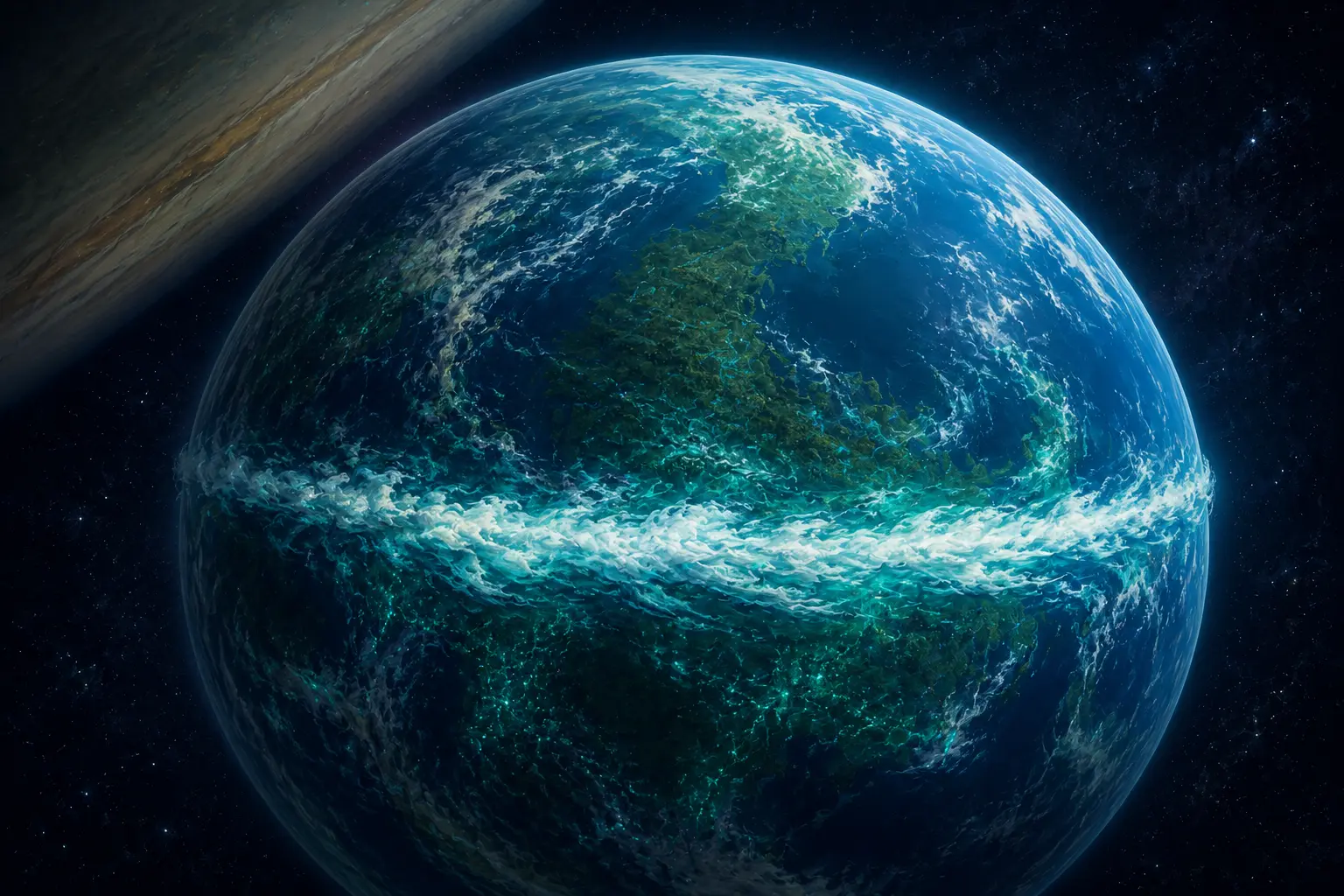
Climb high enough on the southern continent of Australis and the view does something Earth almost never offers: it refuses to change. Rainforest fills the foreground, the middle distance, and the far distance, rolling green-on-green until it meets the coast and spills into the Eastern Sea, and even there the far shore wears the same forest again. There is no brown smudge of dry country anywhere in the frame. Overhead the clouds are not scattered at random; they lie in a long level band that follows the horizon, thick and bright, as though the sky were striped.
It is a beautiful view, and it is also a strange one, and the strangeness is worth stopping on before the beauty carries you off. Because Earth does not look like this. Our planet is miserly with rainforest. It rations the deep tropics into a thin green belt clamped around the equator — the Amazon, the Congo, the islands of southeast Asia — and then, with almost brutal regularity, a short way north and south of that belt it lays down the great deserts: the Sahara, the Arabian, the Kalahari, the Australian outback. Wet stripe, dry stripe, every time. A traveller dropped blind onto Earth could guess the latitude from the vegetation alone.
So why is Pandora so lavish? Why does a whole hemisphere of Australis get to be rainforest when Earth would have spent half of it on desert?
The honest first answer is that it is not the trees' doing, and not the soil's, and not really Pandora's at all. The answer is written in the air — in a machine, made of nothing but heat and spinning gas, that every world with an atmosphere runs whether it wants to or not. Learn how that machine works and you stop seeing forests and deserts as accidents of a particular place. You start seeing them as the output of a calculation any planet performs on itself. And once you can run the calculation, you can do something that feels almost unfair: you can predict the map of a world you have never set foot on — predict where its rainforests must lie and where its deserts must hide — from a handful of numbers about how fast it spins and how thick its air is. Pandora, it turns out, is not breaking the rule that gives Earth its stripes. It is following the very same rule, with two dials turned, and the lush sameness of that ridge is exactly what the rule predicts.
Let us build the machine from the bottom.
Where the heat comes in
Everything starts with an imbalance, and the imbalance is geometric.
A star pours light on a world evenly, in straight parallel rays. But a world is a ball, and a ball meets those rays at every possible angle at once. Near the equator, where the surface faces the star nearly square-on, a given bundle of sunlight lands concentrated on a small patch of ground. Near the poles, where the surface is tilted steeply away, that same bundle smears across a long slanted footprint — the same energy, buttered over far more ground, and so far weaker per unit of it. The equator runs hot and the poles run cold for this reason and essentially this reason alone.
How much heat a world keeps from what arrives is a second, separate matter, and it turns on two things. One is how much of the light simply bounces back to space unused — the world's albedo, high for bright snow and pale cloud, low for dark ocean and dark forest. The other is what the atmosphere does to the heat on its way back out. A planet warms until it glows in infrared brightly enough to shed exactly as much energy as it absorbs from its star; that balance point is its radiative equilibrium, and the bare arithmetic of it — sunlight in, infrared out — sets a baseline temperature a world would sit at with no air at all. Give it an atmosphere full of heat-trapping gas and the real surface runs warmer than that baseline, sometimes by a little, sometimes, as on Pandora, by a great deal.
Hold onto the single fact under all of it: the tropics are handed an energy surplus and the poles are handed a deficit. Nature abhors that lopsidedness. The whole of weather, on every world, is the atmosphere and ocean trying — and never quite managing — to carry the surplus from where it lands to where it is missing. That transport has a shape, and the shape is the next piece of the machine.
The loop that makes a rainforest
Take that hot equatorial air. Warm air is buoyant, so it rises — and as it climbs into thinner surroundings it expands and cools, and cooling air cannot hold its water, so the moisture condenses into towering cloud and falls back out as rain. Heavy, daily, drenching rain. This rising, raining belt circling the equator is the Intertropical Convergence Zone, and it is no coincidence that Earth's great rainforests lie directly beneath it. The forest is simply standing where the air is forced to let go of its water.
The risen air cannot pile up forever. It spreads away from the equator at high altitude, and as it drifts poleward it sheds the last of its heat to space and grows dense and heavy, until around thirty degrees of latitude — north and south — it sinks back to the ground. Sinking air is the enemy of rain: as it descends it compresses and warms and its capacity for moisture grows, so instead of releasing water it greedily drinks it from the land below. Beneath those zones of descending air sit the planet's deserts, strung around the globe at thirty degrees with the same regularity as the forests sit at zero. The air completes the loop by flowing back along the surface toward the equator to be heated and lifted again. This overturning wheel — up at the equator, over at altitude, down at thirty degrees, back along the ground — is a Hadley cell, and it is the single most important structure in this chapter.
Two more wheels finish the set in each hemisphere — a middle one and a polar one, turning in linked succession out to the poles — and together they are the planet's general circulation, the conveyor that finally moves the tropical surplus to the starved high latitudes. But the Hadley cell is the giant, and it is the one that places the wet and the dry. Remember it as a machine with two business ends: a rainforest where it inhales at the equator, a desert where it exhales at thirty degrees.
Now — what decides where it exhales? Why thirty degrees, and not ten, or sixty? Answer that and Pandora's whole map falls open.
Why the wheel is the size it is
The Hadley cell does not reach all the way to the pole, and the reason is the planet's spin.
Picture a parcel of air leaving the equator, heading north at altitude toward the pole. As it travels it is also riding a spinning ball — and the ground beneath it is moving fastest at the equator and slower the farther north it goes, because the higher latitudes trace smaller circles around the axis. The air, carrying its fast eastward equatorial motion with it, races ahead of the slowing ground underneath, and from the surface it looks as though some invisible hand were shoving the air sideways, curving its straight path into a tightening eastward arc. That apparent shove is the Coriolis effect, and it is purely a consequence of doing your travelling on a spinning thing.
Here is the payoff. That sideways deflection is what stops the Hadley cell short. The poleward-bound high air gets bent so hard toward the east that, by about thirty degrees of latitude, it is no longer travelling poleward at all — it is racing due east as a jet, going around the world instead of toward the pole. Unable to push any farther north, it banks up and sinks. That is why the desert-making downdraft sits at thirty degrees: it is the latitude where the spin of the Earth turns the escaping tropical air sideways and brings it down. The faster a planet spins, the sooner that happens — the stronger the deflection, the shorter the poleward reach, the narrower the cell. Spin a world quickly and you get tight, early-closing Hadley cells and a thin tropical belt. Spin it slowly and the air gets farther from the equator before the weakened Coriolis can turn it, the cell stretches wider, and the rainy belt and the sinking deserts both migrate poleward.
This is the dial. Rotation rate sets the width of the wheel, and the width of the wheel sets the latitude of every forest and every desert. Now we can finally turn it, and watch Pandora appear.
Turning the dial to Pandora
Pandora spins slower than Earth. Canon is loose about the exact figure — the day runs somewhere between a little under and a little over an Earth day — but the direction is clear, and slower is all we need. A slower spin means a feebler Coriolis effect, which means the tropical air escapes farther north and south before it is turned aside, which means the Hadley cell is wider than Earth's, and so the whole pattern of wet and dry is stretched outward from the equator.
Atmospheric circulation
Spin rate sets the width of the Hadley cell
The same law, two spin speeds. A slower spin weakens the Coriolis effect and widens the Hadley cell - so the equatorial rain belt swells and the deserts are pushed to high latitudes.
Earth
Fast spin · ~24 h day
Pandora
Slow spin · ~26 h day
Watch what that stretching does to the map. On Earth the rising, raining branch is pinned tight to the equator and the desert-making descent slams down at thirty degrees, so the rainforest gets a narrow band and the deserts get a generous one. Widen the cell and two things happen at once. The rainy ascending branch is no longer a thin equatorial line — it broadens into a fat tropical belt reaching perhaps twice as far from the equator, a wide swath of the world handed over to rising, raining air. And the desert-making descent is shoved out toward forty-five or fifty degrees, into the cool high latitudes, where it is weaker and easier to overwhelm. The deserts do not vanish, but they are exiled to the margins and the rain shadows, robbed of the broad subtropical empire they hold on Earth.
Put those two changes together and you have written the description of Australis without ever looking at it: a continent so deep inside a broadened wet belt that rainforest is simply the default state of the land, coast to coast, with no room for a Sahara to form. The lush sameness that looked so strange from the ridge is not strange at all. It is precisely what a slow-spinning world's Hadley cell must produce. We turned one dial and the rainforest spread to fill the view.
Whittaker biome diagram
Temperature × rainfall decides which biome a climate grows
But the Hadley cell only places the wet and the dry. It does not, by itself, explain the other thing the ridge showed us — a world that seems gentle and temperate even far from the tropics, with no fierce extremes. For that we need the second dial, and the second dial is the air's own thickness.
The thick-air thermostat
Pandora's atmosphere is roughly a fifth denser than Earth's, weighed down with heavy gases. That heaviness is a nuisance to a walking human, but to the climate it is a gift, because a thick atmosphere is an enormous reservoir of heat and an enormous mover of it.
The thicker the air, the more heat it can carry per gust, and the more aggressively it hauls warmth out of the broiling tropics and rams it into the cold high latitudes. A thin-aired world cannot do this well and is forced to bank its heat where it lands — searing equator, frozen poles, a brutal gradient between. A thick-aired world spreads the wealth. The equator-to-pole temperature difference flattens; the high latitudes are kept far milder than their meagre sunlight could ever manage on their own. Our own solar system runs the experiment for us. Mars, with almost no air, swings through savage temperature extremes because its threadbare atmosphere can store and move nothing. Venus and the moon Titan, both wrapped in dense, heavy atmospheres, do the opposite to an almost eerie degree: their thick air smears heat so efficiently that the temperature barely changes from equator to pole, or even from day to night.
Push the density and the slow spin far enough together and a world can tip into an extreme called superrotation, where the entire atmosphere comes loose from the surface and races around the planet as a single fast-moving shell — Venus does exactly this, its air lapping the slow solid body dozens of times for each of the planet's own turns. Pandora need not go that far to enjoy the milder version of the same physics: a heavy atmosphere on a slow rotator is built to even out its temperatures.
This is the explanation for the parts of Pandora that the rainforest belt alone cannot cover. The Western Frontier's high, cool Clouded Forest — a temperate world of giant fog-wrapped trees that on Earth would belong to a cold maritime coast — sits at a latitude that ought to be harsher than it is, and it survives because the thick-air thermostat keeps warmth flowing into the high latitudes and never lets the cold dig in. The same flywheel even saves Pandora from its own astronomy. The moon is eclipsed by its giant planet daily, plunged into the planet's shadow and cut off from its star for the better part of an hour and a half at a stretch; a thin-aired world would lurch toward a nightly freeze each time. Pandora's dense atmosphere holds its heat through the shadow like a banked fire holds its warmth through the night, and the surface scarcely notices the star wink out. Thick air does not just move heat. It refuses to let it go quickly — and that patience is what makes the climate gentle.
There is one more reservoir we have left out, and on a world with an ocean the size of the Eastern Sea, leaving it out would be a crime.
What the ocean is for
Water is the most grudging substance on any world when it comes to changing temperature. It takes a tremendous amount of heat to warm it and it surrenders that heat tremendously slowly, which makes a planet's oceans its great thermal ballast — slow to boil in summer, slow to chill in winter, forever bleeding their stored warmth into the air above them and softening every climate they touch.
This is why coasts and islands are mild and the deep interiors of continents are savage. Stand in the middle of a great landmass and you are at the mercy of the bare sky: blazing days, frigid nights, scorching summers, bitter winters, because rock and soil heat and cool almost instantly and store nothing. Stand on a coast and the neighbouring ocean irons all of that flat, lending its hoarded warmth to the winter and drinking the excess in summer. A world that is mostly ocean is a world with almost no temperature extremes anywhere.
Continental — the bare interior
Maritime — the ocean's mercy
The Eastern Sea, broad enough to separate whole continents and dotted with its reef atolls and karst stacks, makes Pandora a profoundly maritime world — another reason its climate runs so even and so kind. But oceans do not only sit there storing heat; they move it, in great wheeling currents dragged into motion by the same winds and bent by the same Coriolis spin that shaped the air. Surface currents pile warm tropical water against far shores; where winds drag the surface away from a coast, cold deep water is pulled up to replace it in a process called upwelling, hauling with it the nutrients that have rained down into the dark — and feeding, wherever it surfaces, an explosion of life. Knitting the deep together is the thermohaline circulation, a slow global conveyor driven by how temperature and saltiness make water heavier or lighter, sinking it in some places and lifting it in others.
On Pandora the deep ocean has a heat source Earth's largely lacks: the moon is kneaded by the gravity of its giant planet, and that constant flexing releases tidal heating from within, warming the seafloor from below (I.8 — What Keeps Pandora Volcanically Alive? works the engine out in full). So instead of Earth's pattern, where the conveyor is driven by frigid water sinking at the poles, Pandora's seas are stirred from beneath, churning nutrient-rich water upward through vigorous local upwelling. That is a large part of why the Eastern Sea can carry the staggering biological load it does — the reefs, the kelp, the great tulkun with their enormous appetites. The same internal heat that keeps the deep from freezing keeps the larder continuously restocked.
We have one strange landmark left, and it is the one that ought, by all rights, to be a frozen rock. It is not, and the reason is the last piece of the machine.
Why the floating mountains are not bald
The Hallelujah Mountains hang kilometres above the surface, the tallest of them lifting its peak more than two and a half thousand metres into the air — and yet their summits are not the barren ice-caps that altitude should demand. They are lush. Rivers run on them; waterfalls pour off their edges and dissolve into spray before the next island catches the mist. Liquid water, thriving forest, at an altitude where an Earthly mountain would be locked in snow. How?
On Earth, air cools as it rises at a stubborn, reliable pace — very roughly ten degrees for every kilometre of dry ascent. This is the adiabatic lapse rate, and it is not arbitrary: rising air expands as the pressure around it drops, expansion saps its energy, and the lost energy shows up as falling temperature. Two and a half kilometres up an Earth mountain and you have shed twenty-odd degrees — the difference between a warm valley and a frozen peak.
But that cooling rate is not a universal constant. It is set by a tug-of-war between two planetary properties: gravity, which governs how fast pressure falls off with height, and the air's heat capacity, which governs how much temperature drop a given loss of energy actually produces. Weaken the gravity and the lapse rate eases. Fatten the heat capacity and it eases again. Pandora obliges on both counts. Its surface gravity is about a fifth less than Earth's, so its pressure thins more gently with altitude, and its dense, humid, heavy air carries far more heat capacity than our thin stuff. Both dials push the same way, and the result is an air that cools much more slowly as it climbs. The same two and a half kilometres that would strip twenty degrees from an Earth mountaintop strip far less from a Pandoran one, leaving the floating peaks warm enough, and wet enough, to stay green.
It is a satisfying closing of the loop. The very thickness of the air that gentles the climate, smears the heat from pole to pole, and holds warmth through each eclipse is also what keeps a forest breathing on a mountain that floats. One property of the atmosphere, paying off in four different places. That is what it feels like when a world is internally consistent — when its strangeness is not a pile of separate miracles but a few physical dials, turned once, ramifying everywhere.
And it pays off in a fifth place, which settles a debt this chapter has been carrying since we exiled the deserts. If the wide wet belt means Pandora has no subtropical desert band, then where does the moon keep its dry country at all? Canon insists there is some — the windswept Upper Plains of the Western Frontier are semi-arid grassland, ringed by mountains on three sides, and the official line is that Pandoran deserts survive only as narrow interior rain shadows. A rain shadow is the small, local version of the Hadley cell: instead of a planet-wide loop lifting air at the equator, a single mountain range lifts a sea wind over its crest, wrings the water out on the way up, and drops the spent air down the far side warmer and thirstier than it started. The lee plain is not dry because the ridge blocked the wind. It is dry because the air that arrived has been heated on the way down, and hot air drinks.
Which is exactly where the slow lapse rate turns around and bites. A range only makes a desert by cooling the rising air enough to force it to let go of its water — and Pandoran air, cooling half as fast, is far harder to squeeze. Put the same ridge on both worlds and watch what each lee plain gets.
Where the dry country hides
Push a mountain range across a sea wind and watch a continent split in two.
Move the same range to Earth and the lee plain gets about 2 cm/yr instead. Its air cools 9.8 °C for every kilometre it climbs, against 6.3 °C here — and a range only makes a desert by cooling the air enough to wring it out.
So the dry places on this moon are not a band you could point to from orbit. They have to be built, one ridge at a time, and the same thick air that makes the climate kind is what makes them so hard to build. Which is why the places where the consistency breaks are worth naming plainly.
Where the world does not quite close
A specimen is only honest if you read the cracks, and Pandora's geography has a few that no amount of clever climatology can paper over.
The deepest one is a contradiction at the very root of the setup, and it has nothing to do with weather. Canon insists that Pandora is tidally locked to Polyphemus — keeping one face toward the giant, its day equal to its month — and also that this day is only somewhere between about twenty-three and thirty hours long. Put those two claims together and they fight. For a moon to whip all the way around a planet as massive as Polyphemus in a mere day or so, it would have to orbit extraordinarily close in — so close that it would skim the edge of the Roche limit, the distance inside which a giant planet's tides tear a moon apart, and would sit squarely inside the lethal belts of radiation a gas giant traps around itself. A moon in that orbit should not be a lush green world at all. It should be a flexed, scorched, irradiated horror like Jupiter's moon Io — volcanism and sterilised rock, its atmosphere stripped away. The very intimacy with Polyphemus that gives Pandora its dramatic skies and its useful tidal heat, taken at the numbers canon states, ought to have killed it. The films simply ask us not to do the arithmetic.
A subtler crack follows from the locking itself. If Pandora truly keeps one face perpetually toward Polyphemus, then one hemisphere lives forever under the giant's warm, reflected, infrared-bathed presence while the far hemisphere never sees it at all. That is a permanent, planet-wide heating imbalance bolted on top of the ordinary equator-to-pole one, and it ought to drive its own enormous, fixed wind systems and a real difference between the two faces of the moon. Canon never mentions it. The near side and the far side of Pandora, climatically, should not be the same world — and yet the stories treat the moon as uniform.
None of this spoils the world. It locates it. The geography we can see is solid canon; the circulation that explains it is solid Earth science; the bridge between them — the widened cell, the exiled deserts, the predicted polar lands — is inference, honest and labelled, and the orbital contradiction is a place where story simply overruled physics and we are right to notice.
What stays open
It almost certainly can't. A day-long orbit around a giant that massive forces Pandora dangerously close in — near the Roche limit and inside the radiation belts — which should leave a scorched, atmosphere-stripped world like Io, not a forested one. The locked-but-fast day is the franchise's deepest physical contradiction, and the tidal heating that warms its seas is the same intimacy that ought to have killed it.
They should be. A permanently planet-lit near side and a never-lit far side is a fixed, hemisphere-scale heating imbalance that ought to drive its own vast wind systems and a real climatic split. Canon ignores it entirely and treats Pandora as uniform.
Unknown, because there is no global map. The physics predicts a broad equatorial rainforest belt, deserts suppressed and pushed out toward 45-50 degrees, and cold lands beyond — but those placements are inference from the circulation, not charted canon. The 'Frozen Lands' survive mostly as Na'vi oral lore.
Canon gives a loose 23-to-30-hour day. The exact figure matters, because rotation rate sets the width of the Hadley cell and therefore how far the rainforest spreads and how far the deserts retreat. Slower means an even wider wet belt; the direction is certain even if the number is not.
Back to the ridge
Go back, then, to the high place on Australis, and look again at the view that started all this.
The forest still runs unbroken to the sea, but it is no longer a mystery — it is the broad inhaling mouth of a Hadley cell stretched wide by a slow-turning world, standing exactly where rising air must drop its rain. The clouds still lie in their level band across the sky, but the band is the Intertropical Convergence Zone itself, the seam where the air goes up, made visible. The climate is gentle to the horizon because a thick atmosphere and a wide ocean carry the heat everywhere and hoard it through every eclipse. And far off, past the curve of the moon, in country no map has drawn, the same machine is quietly laying down the dry margins and the cold poles that the forest in front of you will never show.
That is what climatology buys you, and the reason it is worth more than any single planet. You did not have to walk Pandora to know it. You read the spin and the air and the starlight, ran the loop the heat is forced to run, and the forests and the deserts and the floating green mountains arranged themselves in front of you — calculable, inevitable, and almost entirely beautiful. The same arithmetic is sketching the next world you will ever wonder about, four light-years off and unvisited, waiting to be read from nothing but its numbers.