

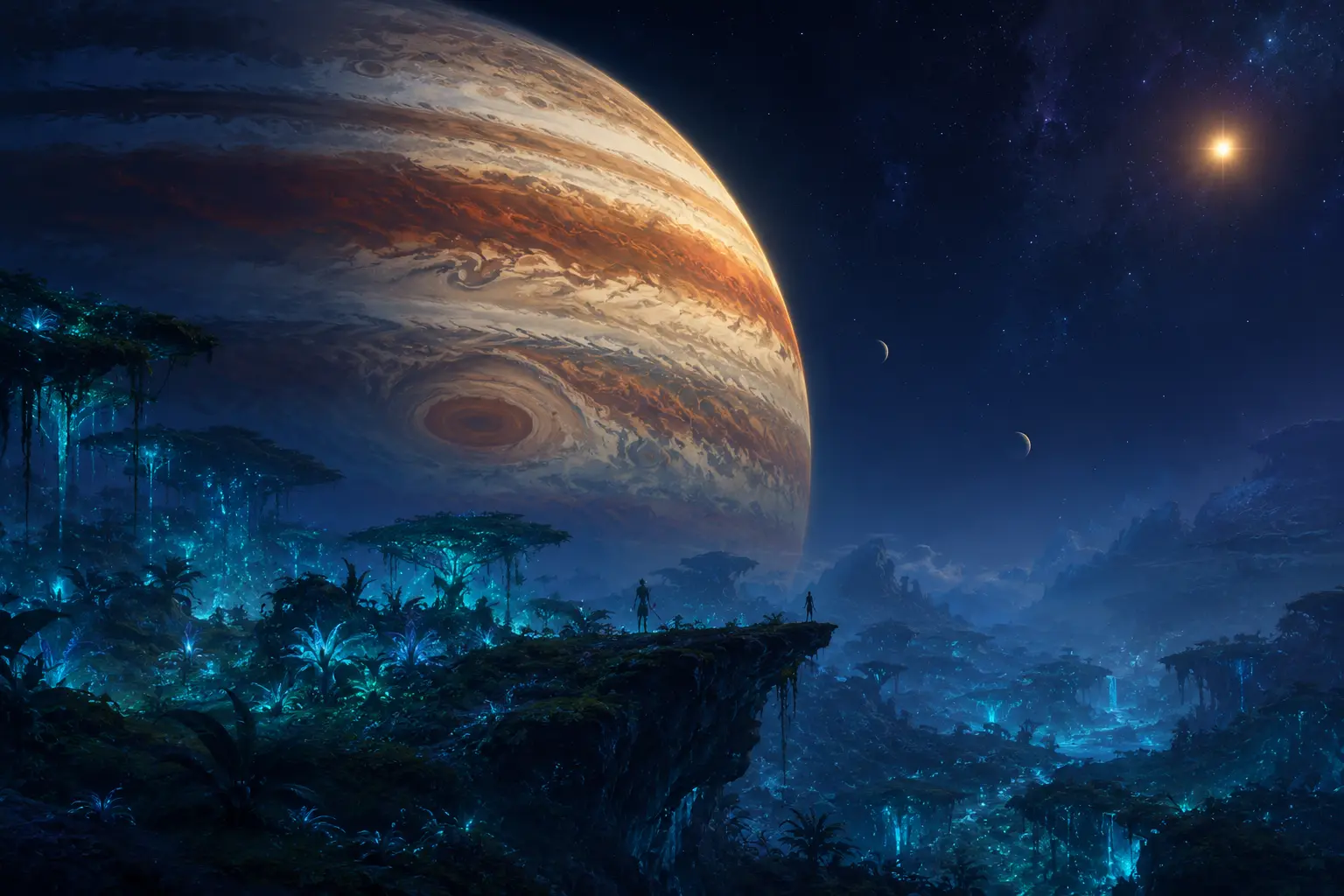
Stand on a high ridge on Pandora a little before midday and watch the sky do something the sky on Earth has never once done in four and a half billion years. The sun — a small, fierce, yellow-white point, not so different from our own — begins to slide behind a wall. The wall is banded in cream and rust and storm-grey, and it does not have an edge you can find; it simply continues, filling a third of the sky, curving away past where you can turn your head. As the point of sunlight touches it, the light on the forest goes long and amber, then thin, then blue. By the time the star is fully behind the wall, it is twilight at noon, and the wall itself is faintly glowing along its limb, lit from behind.
You are not on a planet. You can tell from the sky alone. That banded wall is a gas giant, and you are standing on something that goes around it — a moon, caught close enough that its parent fills the heavens and eclipses its sun nearly every day. The question this chapter asks is the patient one: where, exactly, is this place — and could anything like it actually be out there, close enough that we might one day point a telescope at it and know?
The address turns out to be specific, and famous, and only four light-years away. Getting there honestly — separating what the films commit to from what our own astronomy can actually verify — takes us through the single best-studied star system in the sky next to our own, and into the strange arithmetic of where a world is allowed to be warm, wet, and alive.
The address, as canon writes it
Let me start with what the official material commits to, because that is the part we are not free to invent.
Pandora orbits a star called Alpha Centauri A — specifically the brightest of the three suns in that system, which the Na'vi call Tsawke. Canon is unusually disciplined here: it does not put Pandora around some invented star. It puts it around a real one, the nearest sun-like star to Earth, about 4.37 light-years away. That distance is not a throwaway. It anchors the whole human enterprise of the films — the six-year crossings, the frozen sleepers, the entire grim economics of shipping people across the gap — to a number you can look up in any catalogue.
But Pandora does not orbit Alpha Centauri A directly. It orbits a planet that orbits the star: the gas giant Polyphemus, named by its first human surveyors for the one-eyed giant of Greek myth, because of a vast cyclopean storm that turns on its face like an eye. (The Na'vi call it Naranawm, "the Great Eye," which is the same thought arrived at from the ground.) Polyphemus is, in the canon's accounting, the fourth planet out from Alpha Centauri A, and it sits at roughly the distance Earth sits from our Sun — which is the first clue that someone building this world was paying attention, because that is exactly where you would put a planet if you wanted its moons to be warm.
And Pandora is a moon — one of fourteen, the canon says, and the only inhabited one. It is a little smaller than Earth, about three-quarters of Earth's diameter, and noticeably lighter, so that you would weigh about four-fifths of your Earth weight standing on that ridge. Its air is denser than ours and, to a human, lethal: breathable-looking but laced with enough carbon dioxide and hydrogen sulfide to kill in minutes. Its day runs to about twenty-six hours, and — the detail the opening scene turns on — that day is locked. Pandora keeps one rhythm with Polyphemus the way our Moon keeps one face toward Earth, so its day and its month are the same thing, and the great banded planet hangs in a fixed quarter of the sky while the sun marches past behind it. Hence the eclipses: most days, the disc of Polyphemus swallows the sun for a while, and the world goes briefly dark in the middle of the afternoon.
There is a sprawl of further detail in the extended material — sister moons named Cassandra and Hades and Dante, inner rocky worlds, co-orbital asteroids — much of it mined from a 2009 video game and never confirmed on film. I'll leave most of it aside. It is the kind of thing the research turns up in abundance and the chapter does not need; the address proper is the part that matters, and the address is clear. A near-twin of our Sun. A gas giant where Earth's orbit would be. A large moon, locked to that giant, in air it would kill you to breathe.
Now the real question. That is a very specific claim about where a living world can sit. Is it a possible claim? To answer that, we have to leave Pandora and ask what our own science says about where worlds are allowed to be warm — and then come back and check Pandora against it.
Where a world is allowed to be warm
The reason that banded planet sits "about where Earth sits from the Sun" is not decoration. It is the single most important fact about whether Pandora can exist at all, and it has a name: the habitable zone.
The idea is almost embarrassingly simple, and then it isn't. A star pours out heat. Close in, that heat is fierce enough to boil any ocean dry; far out, it is too feeble to keep water from freezing solid. Somewhere in between is a band — astronomers reach for "Goldilocks," and resent that they have to — where a world with the right atmosphere can hold liquid water on its surface. Liquid water is the one non-negotiable we know of for life, so the habitable zone is the first filter anyone runs when they ask whether a place could be alive.
The band's distance depends on the star. Light spreads out as it travels, thinning with the square of the distance: go twice as far from a star and each patch of ground gets a quarter of the light. So a bright star pushes its warm band far out, and a dim one pulls it close. Our Sun's band straddles Earth's orbit. Alpha Centauri A is a shade more luminous than the Sun — a little bigger, a little brighter, the same essential yellow-dwarf kind of star — so its warm band sits a touch farther out than ours. Put a planet a bit beyond one Earth-distance from Alpha Centauri A and you have put it in the temperate zone. Which is precisely where canon puts Polyphemus.
The habitable zone
Where liquid water can survive on a world's surface
The careful version of this, worked out by James Kasting and later sharpened by Ravi Kopparapu, is less a single line than a set of edges, each one a different way for a climate to fail. Too close, and water vapour — itself a greenhouse gas — builds in the air faster than the planet can shed heat, until the oceans cook off entirely in a runaway no atmosphere can stop. Too far, and not even a thick blanket of carbon dioxide can hold enough warmth; pile on more and it just freezes out as cloud and reflects the sunlight back to space. Between those failures is the survivable band.
So far, so reassuring for Pandora. But I have been quietly lying by omission, because I have been describing a system with one star. Alpha Centauri has three. And the moment you add a second sun, the question of where a world can sit stops being about heat alone and becomes about whether the world can even stay there without being flung into the dark.
Two suns, and the orbits that survive them
Alpha Centauri is not a star. It is a family: Alpha Centauri A, the bright yellow one Pandora orbits; Alpha Centauri B, a slightly smaller, cooler, orange star; and far out, Proxima Centauri, a dim red ember so distant from the other two that it takes hundreds of centuries to circle them. A and B are the close pair — they orbit each other in eighty years, swinging from about as far apart as the Sun and Neptune out to nearly three times that and back.
This is the part the films almost entirely ignore, and the part our science finds most interesting. Because a second star is not just a second light in the sky. It is a gravitational hand that reaches across the system and tugs at every orbit in it, and if it tugs hard enough, planets do not form, or do not stay, or are slowly wound up into orbits so stretched that any world on them roasts and freezes in turn.
Astronomers split the possibilities into two clean cases. A planet can orbit one star of the pair, with the other as a distant troublemaker — an S-type orbit, "circumstellar." Or it can orbit both stars at once, swinging around the whole binary from outside — a P-type orbit, "circumbinary," the real version of the twin-sunned sky from the films you're thinking of. Pandora's system, with Polyphemus going around Alpha Centauri A alone while B orbits far out, is the S-type case.
S-type — around one star
P-type — around both
The question of how well inside was answered, for practical purposes, by Matthew Holman and Paul Wiegert in the 1990s. They ran the orbits forward and found a rule of thumb with surprising bite: a planet on an S-type orbit stays stable over the long haul only if it keeps within roughly a fifth of the distance of the companion star's closest approach. Come closer to that limit and the second star's tugs accumulate, stretching and tilting the orbit until the world is lost.
Run the numbers for the real Alpha Centauri and the result is a small relief. Star B's closest approach to star A is about eleven times the Earth–Sun distance. A fifth of that is a little over two — call it the stable zone extending out to roughly three Earth-distances from star A. And the warm band, the habitable zone, sits at a bit beyond one. The temperate region is comfortably inside the region where orbits survive. There is room, around the real Alpha Centauri A, for a world to be both warm and safe — which is exactly the room canon parks Polyphemus in.
Can the world stay where it is warm?
A second star sets a hard edge on which orbits survive the long haul.
But notice what we have established and what we haven't. We have shown there is a stable, temperate slot around Alpha Centauri A — room for a planet. Pandora is not a planet. It is a moon of a gas giant. And a habitable moon is a stranger, more demanding thing than a habitable planet, with its own ways to live and its own ways to die.
The trouble and the gift of being a moon
A planet in the habitable zone has one heat source: its star. A moon in the habitable zone has four, and juggling them is the whole difficulty of being an exomoon — a moon of a planet in another star system.
The first is the same as the planet's: sunlight, the dominant source. But the moon also catches a second helping of starlight reflected off the giant it orbits — Polyphemus is an enormous pale mirror hanging in Pandora's sky. It catches a third warmth in the infrared glow the giant itself radiates, because a gas giant is still slowly contracting and leaking out the heat of its own formation. And it catches a fourth, stranger heat from inside itself: tidal heating.
Tidal heating is worth slowing down for, because it is both real and load-bearing for Pandora's story. A moon on a slightly non-circular orbit is squeezed harder by its planet's gravity when it swings close and less hard when it swings far. That rhythmic squeezing flexes the whole body of the moon, and flexing rock generates heat by friction — the same warmth you feel in a paperclip bent back and forth. In our own solar system, this is why Jupiter's moon Io is the most volcanically violent body we know, and why Europa and Enceladus, further out and colder on the surface, hide liquid oceans under their ice. The orbits of those moons are kept slightly non-circular by a gravitational tug-of-war with their sibling moons — a resonance — and the resulting flex keeps their interiors warm long after they should have frozen.
Now hold that thought and look at what canon claims for Pandora. Tidal flexing — explicitly attributed in the films' companion material to Polyphemus competing with the other moons — drives Pandora's volcanism and unusually fast continental drift. That is exactly the right physics for the right reasons. A large moon, locked to a gas giant, kneaded by its siblings into a faintly eccentric orbit, would run warm from the inside. Canon reached for the correct mechanism.
The danger is that the four heat sources can add up to too much. There is a limit — astronomers call it the habitable edge — past which the combined warmth, especially the tidal contribution, overwhelms a moon's ability to shed heat, and it tips into the same runaway greenhouse that cooks a too-close planet. A habitable moon has to thread a needle: enough tidal heat to stay geologically alive, not so much that it sterilises itself.
And there is one more way for a moon to die that has nothing to do with heat — and here canon does something genuinely clever, almost certainly by accident.
The belts, and the gap Pandora hides in
A big gas giant doesn't just have a strong magnetic field. It has a magnetic field that traps things. Charged particles from the stellar wind get caught in it and accelerated into vast, doughnut-shaped belts of lethal radiation girdling the planet — our own Jupiter has them, savage enough to kill an unshielded astronaut and to fry spacecraft electronics. Any moon orbiting inside those belts is bathed in high-energy particles that, over geological time, do something quietly fatal: they knock atmosphere off the top of the moon, atom by atom, a process called sputtering. A small moon, with weak gravity, parked in a radiation belt, will be slowly stripped naked. No air, no oceans, no life.
This is a real and serious obstacle to habitable moons, and it is the reason a small body like Pandora — lighter than Earth, weaker-gripped — has no business holding onto a thick atmosphere for billions of years. By rights, it should have been scoured bare.
Canon's answer is a single sentence in the companion material, and it is exactly right: Pandora orbits in the gap between Polyphemus's inner and outer radiation belts. The belts are not a solid wall; like Earth's own Van Allen belts, they are structured, with relative lulls between the zones of trapped particles. A moon threading one of those gaps sits in comparative shelter, shielded by the very magnetosphere that would have killed it from a different orbit.
Whether the writers worked through the magnetospheric physics or simply needed a reason their moon could breathe, the answer they wrote down is the answer the science would also reach for. It is, frankly, a better piece of worldbuilding than it had any right to be: the same enormous magnetic field that makes the region near Pandora so violent is what lets Pandora keep its air at all. The threat and the shelter are the same object, seen from different orbits.
So the picture closes up. A warm band around a sun-like star, safely inside the zone where orbits survive a second sun. A gas giant parked in that band. A large moon, locked to the giant, kneaded warm from within but not too warm, riding a sheltered gap in the giant's killing belts. Every piece is demanding; not one piece is impossible. The address checks out.
Which leaves the question we started with, and have been circling the whole time. The address checks out on paper. If a world exactly like this existed around the real Alpha Centauri A — and it might — could we, from Earth, with the instruments we actually have, ever find it?
How you find a world you cannot see
We have never photographed an Earth-sized world around another star. Almost everything we know about the four-thousand-odd known exoplanets, we learned indirectly — by watching what a planet does to the star we can see, rather than seeing the planet itself. There are four main ways to do it, and walking through them tells you precisely what we could and couldn't learn about Pandora's system.
Detecting a world you cannot see
Three windows onto the same orbiting planet
The planet tugs the star into a small wobble about their shared centre. As the star swings toward us then away, its light blue-shifts then red-shifts — a periodic wave that betrays a world we never see.
The workhorse is radial velocity. A planet does not simply orbit its star; the two orbit their shared centre of mass, so the star traces a small circle of its own — it wobbles. As it wobbles toward us its light is squeezed bluer, and as it pulls away its light is stretched redder, by the Doppler effect. Measure that rhythmic colour-shift in the star's spectrum and you have found a planet you never saw, and learned its orbital period and a minimum for its mass. The catch is in the word minimum: because you only measure the wobble along your line of sight, you can't tell a small planet seen edge-on from a big one seen at a slant. And you learn nothing about the planet's size or its air.
The second way is the transit: if the planet's orbit happens to be edge-on to us, the planet crosses the face of the star once each orbit and blocks a tiny, measurable sip of its light. The depth of that dip tells you the planet's size relative to the star; the timing tells you the period. Pair a transit with a radial-velocity measurement and the ambiguities cancel — now you have a true mass and a true size, and dividing one by the other gives you density, which tells you whether you're looking at a ball of rock, ice, or gas. The price is geometry: only a small fraction of planetary systems happen to line up edge-on to Earth, so transits find many worlds only by watching enormous numbers of stars at once.
The third way is the hardest and the most direct: direct imaging — actually capturing the planet's own light, by blocking the star's glare with a precisely shaped mask called a coronagraph, or a free-flying starshade. When it works, it is the richest method of all, because the planet's light can be split into a spectrum and read for the fingerprints of its atmosphere. But the contrast is brutal: an Earth-like world is something like ten billion times fainter than its star and sits right next to it in the sky. And a bright binary like Alpha Centauri is worse than usual, because stray light from the second star leaks across the field and floods the very region you're trying to darken.
The fourth, astrometry, watches the star's wobble as a tiny side-to-side motion across the sky rather than a colour-shift, and it pins down the true mass that radial velocity leaves ambiguous — but it demands a precision we are only now beginning to reach. (A fifth, gravitational microlensing, catches distant worlds in a one-time alignment that can never be repeated; lovely for surveys, useless for studying a particular nearby star.)
What our telescopes would actually find at Alpha Centauri A
Now point all of that at the system the films describe, and a sharp, slightly melancholy answer falls out. The big thing is trivial to find. The thing that matters is almost invisible.
Polyphemus would be easy. A gas giant nearly the mass of Jupiter, orbiting a sun-like star at about one Earth-distance, would haul that star around their common centre by tens of metres per second — a wobble so loud that the radial-velocity spectrographs we already have, instruments like ESPRESSO on the Very Large Telescope, would pick it out within weeks and map its orbit cleanly. If we genuinely shared the sky with Polyphemus, we would have known about it for years. Finding the gas giant is not the hard part.
Finding Pandora is the hard part, and it cuts to the core of why exomoons remain, as of now, essentially undiscovered. A moon doesn't orbit the star; it orbits the planet. So it produces no clean wobble of its own in the starlight — its tug is hidden inside the planet's far larger one. The way you'd catch it instead is subtler: the moon and planet orbit their shared centre of mass, so as the planet transits the star, the moon's pull makes the planet arrive at the crossing a little early or a little late, and cross a little faster or slower, from one transit to the next. Those transit-timing variations are the fingerprints of an unseen moon — and for an Earth-sized moon around a Jupiter-sized planet, the timing shift is of order seconds to minutes, sitting right down at the noise floor of our best space photometers, where it can be mimicked or swamped by the star's own freckling of starspots and flares.
Polyphemus by Doppler wobble
weeks
loud signal; detectable with today's spectrographs
Pandora by transit timing
at the noise floor
seconds-scale shift, maskable by stellar activity
Pandora by direct imaging
impossible now
~10⁻⁹ contrast, drowned in two stars' glare
And photographing Pandora directly? Out of the question with anything we can build today. At Alpha Centauri's distance, Pandora would sit a hair's breadth from Polyphemus in the sky, and Polyphemus a hair's breadth from a star ten billion times brighter — with a second bright star nearby spilling light into the frame. The glare swallows everything. Only a future observatory designed precisely for this — NASA's planned Habitable Worlds Observatory is the leading candidate — could hope to blot out Alpha Centauri A cleanly enough to tease apart the light of its planets and go hunting for the faint, smeared signatures of their moons.
There is one more rung on this ladder, and it belongs to another chapter: once you can catch a world's light, you can read its air. As a planet transits, a sliver of starlight filters through the thin ring of its atmosphere, and different gases stamp the passing light with their absorption fingerprints. That technique — transmission spectroscopy, the thing JWST now does for big, close-in worlds — is how we will eventually ask not just where a world is but what it breathes. For Pandora's poisoned, xenon-heavy air, that is the question of I.4 — What’s Really in the Air?. For now it is enough to say: the tool exists, and it is improving fast.
Where the story cheats
A specimen is only worth reading if you read all of it, including the parts that don't add up. Canon gets the big shape of Pandora's location right — better than it had to. But press on the numbers and three of them buckle.
The first is gravity. Canon gives Pandora about three-quarters of Earth's diameter and about seven-tenths of Earth's mass — and then says you'd weigh four-fifths of your Earth weight there. Those numbers cannot all be true at once. Pack seven-tenths of Earth's mass into a ball three-quarters Earth's width and the surface gravity that falls out of Newton's law is higher than Earth's, around one-and-a-quarter g, not lower. To actually get the gentle four-fifths g the films want — the low gravity that lets giant creatures fly — Pandora would have to be markedly less massive than canon claims, under half an Earth. The stated figures are internally inconsistent; pick any two and the third breaks.
The second is the day. Canon wants Pandora tidally locked to Polyphemus and turning once every twenty-six hours — which, since a locked moon's day equals its orbit, means a twenty-six-hour orbit around the gas giant. But an Earth-sized moon orbiting a Jupiter-mass planet that fast would be skimming perilously close to the giant — close enough to risk the Roche limit, the distance inside which a large planet's tides overpower a moon's own gravity and pull it apart, and close enough that the tidal heating we praised a moment ago would tip from "geologically lively" to "oceans boiled away." Run the orbital mechanics honestly and a stable, survivable orbit for such a moon takes days, not hours — which would give Pandora a day many times longer than the one we see, and rob us of those daily eclipses. The fast, dramatic day-night cycle and the safe, stable orbit cannot both be had.
The third is the trip. The films put the crossing at "about five years" at roughly seven-tenths of light-speed. But four-and-a-third light-years at seven-tenths of light-speed takes a bare minimum of just over six years even before you account for slowing down — and the time experienced on board, far from being shorter than five years, doesn't rescue the figure either. The arithmetic is simply a little off, in the way that round dramatic numbers usually are.
None of this collapses the world. It sharpens it. The location is sound where it counts — a real star, a plausible orbit, a defensible habitable zone, a clever solution to the radiation belts — and shaky exactly where storytelling always cheats: on the round numbers, the convenient day length, and the inconvenient extra sun that would have lit half the night scenes wrong.
What stays open
Unknown, and actively hunted. The stable temperate gap genuinely exists, and a Jupiter-sized planet there would already have been found by its Doppler wobble — so a true Polyphemus is ruled out. A smaller, rocky world remains possible and is exactly what current searches are straining to detect at the edge of the noise.
Not with present instruments. No exomoon has been confirmed at all. Transit-timing hints sit at the noise floor, and direct imaging is impossible at this contrast. It will likely take a purpose-built observatory like the planned Habitable Worlds Observatory — and even then, a moon is far harder than its planet.
No. The canonical diameter and mass imply a surface gravity well above Earth's, not the gentle 0.8 g the films depict. To get the low gravity, Pandora must be substantially less massive than canon states. The three figures are mutually inconsistent.
Uneasily. A locked moon's day equals its orbital period, and a 26-hour orbit places an Earth-sized moon dangerously close to a Jupiter-mass planet — near the Roche limit and into sterilising tidal heat. A genuinely safe orbit would run to days, giving a much longer day and far rarer eclipses. The dramatic short day is a concession to the camera, not the orbit.
Back on the ridge
Go back to the ridge, and to the sun going out at noon.
What you are watching, when Polyphemus swallows the star, is the single most honest thing Pandora ever tells you about itself: you are on a moon. Not a planet with a big moon, but a moon with a planet — close enough that its parent fills the sky and steals the sun most afternoons, locked into a rhythm that makes its day and its month the same turning. Everything else about the place follows from that fact and from where the whole arrangement sits: a large moon, warmed from four directions and from within, sheltering in a gap of a giant's lethal field, all of it riding the temperate band of a star almost exactly like our own, in a system whose second sun the films forgot to paint.
And the quiet marvel is that the address is nearly checkable. Alpha Centauri A is real, it is four light-years away, and it has a stable, temperate slot where a world could be both warm and safe. We cannot yet see anything sitting in that slot the size of Pandora — the gas giant would shout and the moon would whisper, and the whisper is below our hearing for now. But that is a limit of our instruments, not of the universe. The telescopes that could resolve the whisper are being designed. When one of them finally turns toward that bright point low in the southern sky and starts blotting out its glare, the question it will be asking is the one you can ask standing on the ridge, watching the light go long and blue: is anyone home, four years away, under a sun like ours?
We do not know yet. But for once, the place the story chose to ask the question is a real place — and we are very nearly able to look.