

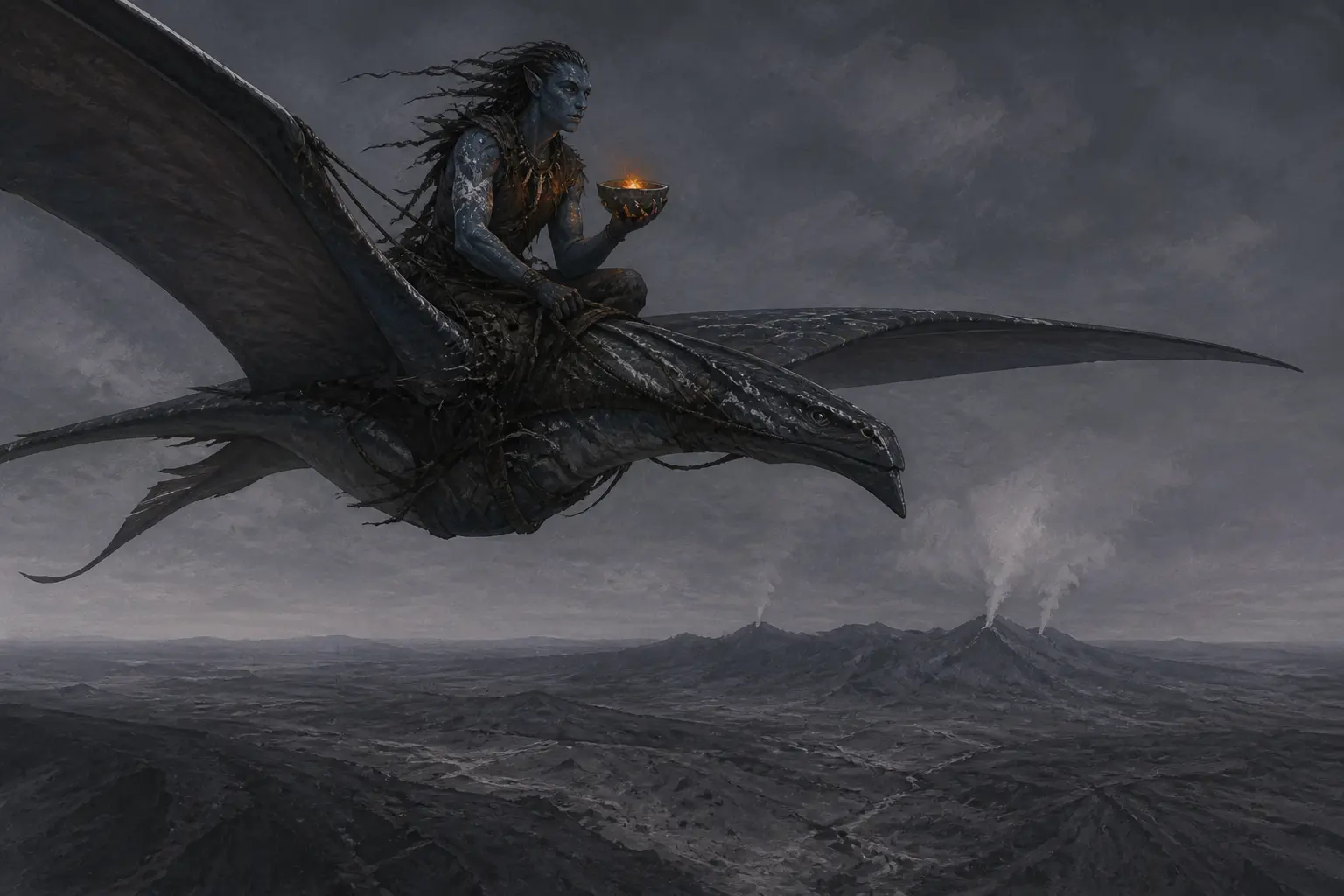
Hold out your hand and let a Mangkwan rider set the coal in it.
It comes in a cup of pumice, a grey stone bowl light enough to fly with, pierced with holes on one side and solid on the other. Inside, a lump of charcoal the size of a fist glows a dull orange, and when the rider tilts the bowl into the airstream the glow brightens for a moment before settling back. The banshee beneath you is doing thirty kilometres an hour and climbing. The air rushing past your fingers is nearly a fifth carbon dioxide.
That last detail should stop you, because carbon dioxide is what we put in fire extinguishers. It is the gas we flood a burning room with when we want the fire to stop. On Pandora it is not a suppressant sprayed from a canister; it is simply what the air is, in the same way nitrogen is what our air is. And through that air, at speed, a clan is carrying live fire on the back of a flying animal, on purpose, as a weapon.
The Mangkwan are the clan the films call the Ash People, and a generation ago a volcano took their world. Their Hometree, their territory, the forest that fed and clothed and housed them — all of it went under pyroclastic flow and metres of tephra in a single afternoon. The VII.1 — Life After the Volcano was about why that ground is still dead: the eruption did not merely kill the forest, it deleted the soil the next forest would have needed, and reset the clock to bare rock. What canon adds, and what this chapter is about, is what the survivors did next.
They did not leave. They stayed on the ruin, and under Varang — who holds both the political and the spiritual office, Olo'eyktan and Tsahìk at once — they turned toward the only thing the mountain had left them in abundance. Every other Na'vi clan we have met treats fire as the enemy: the thing that came for the Omatikaya's Hometree, the thing the RDA brings. The Mangkwan treat it as material. They carry it, throw it, cut with the glass it made, and shape the metal they scavenge over it.
That inversion is the story. But there is a physical puzzle sitting underneath it, and the puzzle is more interesting than the inversion: on a world whose air is loaded with the gas we use to smother flames, why does anything burn at all?
The air that fights fire
Start with the schoolroom triangle, because it is nearly right and its failure is instructive. Fuel, oxygen, heat: take away any one and the fire stops. It is a useful picture and it explains sand on a chip-pan and a firebreak cut through scrub.
What it misses is that a flame is not a state. It is a self-feeding chemical chain, and the chain has links. Down in the reaction zone, hydrogen atoms are colliding with oxygen molecules and coming out the other side as two separate reactive fragments where there was one — a branching step, one radical in, two out, the multiplication that makes a flame a flame rather than a slow smoulder. Interrupt that, without touching fuel or oxygen or temperature, and the fire still dies. Add the chain reaction as a fourth requirement and you have the fire tetrahedron, which is what fire scientists actually use. It is not pedantry. It is the reason the clean agents in a server-room suppression system work: they flood the space with a molecule that catches those radicals and hands back something unreactive, collapsing the chain while the room stays full of oxygen and the fuel stays hot.
Hold that fourth link in mind, because Pandora attacks it for free.
Here is what the air over the Ashlands is made of, as the book has established it: oxygen at Earth's share or a little above, a fifth or a shade more; nitrogen down around half, well below our three-quarters; carbon dioxide not as a trace but as a major constituent, sixteen to eighteen percent, hundreds of times our share; a startling five percent of heavy inert xenon; and a whisper of hydrogen sulfide. Total pressure a touch under Earth sea level, but the mixture heavier than ours, so the air is denser.
Notice what that does and does not say. The oxygen is fine. If a fire's only difficulty were finding an oxidiser, Pandora would burn about as readily as Kansas. The problem is everything the oxygen is mixed with.
Carbon dioxide hurts a flame twice, in two entirely separate ways, and it is worth separating them because they are usually run together.
The first is thermal, and it is pure bookkeeping. When fuel burns, the released energy has to go somewhere, and where it goes is into heating the product gases — including all the inert bystanders dragged along for the ride. How hot the flame gets is therefore a division problem: energy released, divided by the heat capacity of everything that has to be warmed. A carbon dioxide molecule is bent, three atoms, with modes of vibration and rotation that a straight two-atom nitrogen molecule simply does not have, and every one of those modes is somewhere to park energy. Per molecule per degree, it soaks up noticeably more than nitrogen does — the gap widens as things get hotter. Swap a sixth of the air from nitrogen to carbon dioxide and the same fuel, burning just as completely, arrives at a lower flame temperature. Something like two hundred kelvin lower, on the numbers.
Two hundred degrees sounds survivable. It is not, and the next section explains exactly why not.
The second is chemical, and it goes straight at the fourth link. Those branching collisions in the reaction zone are not the only thing radicals can do; they can also be quenched, ending up in an unreactive form, and quenching happens when a third body is present to carry off the excess energy of the collision. Carbon dioxide is an excellent third body. It does not need to react with anything. It just needs to be there, in quantity, taking reactive fragments out of circulation. There is a standard measure for how close a given atmosphere sits to not supporting fire at all — the limiting oxygen index, the least oxygen a mixture can hold and still keep a candle burning downward — and dumping a heavy quenching diluent into an atmosphere pushes it the wrong way even when the oxygen percentage has not moved.
Then there is the density, which cuts the other way from what you would guess. Thicker air pressing harder on a wing is why the great banshees can fly at all. Thicker air moving across a burning surface is a problem, because a fire loses heat to the air sweeping past it, and how fast it loses it climbs with how much mass that air carries. Denser air is a better thief.
Does This Air Want to Burn?
A flame survives only while it releases heat faster than its surroundings take it away
Push the airspeed slider and something abrupt happens that no amount of chemistry alone predicts. The flame does not fade. It stops.
The reason is a ratio between two clocks. A flame needs its reactants to stay in the reaction zone long enough to finish reacting; if the flow sweeps them through faster than the chemistry can run, the reaction never completes, the heat that would have sustained the next increment is never released, and the whole structure collapses in an instant. Combustion engineers write that ratio as a single dimensionless number, and when it drops below one you get blow-off — extinction by wind, not by lack of anything. An unshielded flame on a thin fuel blows off at only four to eight metres per second. That is a brisk walk. It is far, far less than flying speed.
So now look again at the object in your hand. A pierced stone bowl, holes on the leeward side. A lump of charcoal rather than a stick of wood — charcoal because it is nearly all carbon with the water and volatiles already driven off, so it holds heat and needs no flame to stay alive. The rim solid where the wind hits. It is not decoration and it is not ceremony. It is a windbreak with a controlled draught, which is precisely and exactly what you would design if you needed to keep fire alive at speed in an atmosphere with a heavy quenching diluent in it.
Canon, it should be said plainly, never addresses any of this. There is no line anywhere in the official material about whether Pandora's air makes fire easier or harder. The composition is canon; the consequence is physics, and the physics is unambiguous: fire on Pandora is a harder trick than fire on Earth, and the Mangkwan are the only people we have seen who had to get good at it.
Fire that reaches what it never touches
There is a mistake almost everyone makes about how fire spreads, and correcting it is the single most useful thing in this chapter.
The mistake is picturing flames licking from one thing to the next — contact, then ignition. Watch a candle touch paper and that is what you see, and for small fires close up it is true enough. But scale up to a burning tree or a burning village and contact stops being the mechanism. What actually ignites the next thing is light: infrared radiation streaming off the flame, crossing the gap at the speed of light, soaking into a surface that no flame has come anywhere near.
Everything hot radiates. How much depends on temperature, and it depends on temperature with an aggression that is easy to underestimate: the radiated power climbs as the fourth power of absolute temperature. Not proportionally. To the fourth. A flame twice as hot in kelvin radiates sixteen times as hard.
Now that two-hundred-kelvin flame-temperature penalty from the last section stops looking survivable. Take a wildland flame at around eighteen hundred kelvin and cool it by two hundred, and you have not lost eleven percent of its radiant output. You have lost closer to a third. The chemistry took a modest cut; the fourth power turned it into a large one. Pandora's carbon dioxide does not just make flames cooler. It makes them much worse at setting fire to their neighbours, which is the only thing that matters for whether a fire becomes a fire rather than an incident.
The other half of the arithmetic is geometry. What arrives at a target is not what leaves the flame; it is what leaves the flame multiplied by how much of the target's sky the flame fills. Stand a hand's breadth from a bonfire and the fire is most of your world, and you get most of what it emits. Back off ten metres and the same fire subtends a small patch of sky, and the flux falls off roughly with the square of the distance. Fire engineers call that fraction the view factor, and it is why standing behind something — anything — helps so much, and why a fire twice as wide is more than twice as dangerous at a given distance.
Put the two together and you can ask the only question that matters at a boundary: how much heat per unit area is landing here, and is it enough?
Fire Reaches What It Never Touches
Radiated heat climbs as the fourth power of temperature and thins with distance
The thresholds on that figure are worth knowing as numbers, because they are among the most practically useful quantities in all of fire science. Around two and a half kilowatts per square metre, skin starts to hurt after roughly half a minute — about twice the worst the sun can manage. Around four and a half, you have ten or fifteen seconds before blistering, which is why fire crews treat that line as the one you do not stand behind. Somewhere between ten and twelve and a half, dry wood and cloth will catch from any spark or stray ember that happens along; that value is the critical heat flux for piloted ignition, and it is the flux that carries a fire through a forest. Push past thirty-five and dry fuel bursts alight with no help at all.
Two things about that ladder. First, none of it involves flame contact. A wall igniting across a street, a stand of trees drying and browning and then catching a hundred metres ahead of a front — all radiation, all crossing empty air. Second, every rung is a rate, not a dose. Injury and ignition both need the flux to persist. A brief pulse of forty kilowatts is a flinch; four seconds of it is a hospital.
Which brings us back to the coal in the pumice cup, because the Mangkwan have arrived at a solution Earth fires found first.
The genuine long-range problem for any fire is that radiation obeys geometry, and geometry runs out. Double the distance and the flux quarters; past a certain range the flame is simply too small a patch of sky to matter, and the fire has no reach at all. Real wildfires get around this by not relying on reach. They send pieces of themselves. Convection lofts burning fragments — bark flakes, cones, twigs — high into the plume, the wind takes them, and they come down still alight kilometres downwind to start new fires from nothing. Spotting, it is called, and it is how fires cross rivers, motorways, and firebreaks that looked more than wide enough.
A firebrand is an ember that flies. The Mangkwan carry embers, on animals that fly, and choose where they land.
Set the arrow aside for a moment and consider only the delivery. Everything hard about long-range ignition — the geometry, the barriers, the reach — is solved by moving the ignition source physically to the target. A rider on a banshee is a firebrand with a navigator. And in an atmosphere that suppresses spread rates, that capability is worth disproportionately more than it would be on Earth: where a fire will not run on its own, the ability to place ignitions by hand stops being a tactic and becomes the whole strategy.
The arrows themselves follow from the same physics. Canon and the art book describe incendiary arrows lit from the carried coals — and if you were designing them, you would not choose dry tinder. Dry tinder blows off. What survives at speed is something viscous and slow-burning that stays put on the shaft and keeps a flame anchored in its own boundary layer: pitch, tallow, resin, sulfur. Precisely the class of material canon puts in Mangkwan hands. Earth's incendiary-arrow makers, working the same problem in ordinary air, converged on precisely the same recipe list.
The wing that cannot outrun its own water
The marketing material for Fire and Ash describes something the rest of this chapter has been circling: Mangkwan warriors pressing incendiary attacks so far that their own mounts and bodies burn. It is the image the trailers lead with, and it is the one place where a careful reader should stop and ask the arithmetic what it thinks.
Not to score a point. The films are not obliged to be a physics textbook, and the tactic as depicted — a dive, a delivery, a rider who does not pull off — is not the thing physics objects to. What physics has an opinion about is duration. And working out that opinion turns out to teach the single most counterintuitive result in fire science.
Begin with the wing. A banshee flies on a membrane stretched between elongated skeletal spars, the same architecture as a bat, and we know a great deal about bat wings. The membrane is a thin sheet of collagen and elastin with muscle fibres and blood vessels running through it — spanwise elastin for compliance, stiffer collagen sheets to stop it billowing under load. In a large fruit bat it is somewhere between forty and a hundred and fifty micrometres thick: a fifth of a sheet of paper. Scaled up to a seven-metre wingspan you might reasonably guess something under a millimetre, and that guess is doing real work in what follows, so hold it loosely.
Thickness matters because of a distinction that decides everything about how anything responds to heat.
Put a flame under a log and heat crawls inward. The surface chars while a centimetre in the wood is still cool, and the log survives a long time because it can hold a steep temperature gradient. Put the same flame under a leaf and there is no inside for a gradient to live in: the whole thickness comes up together, near-instantly, uniformly. Fire scientists separate the two cases with a dimensionless ratio and call the second regime thermally thin. It is why a sheet of newspaper catches in a second and a log takes minutes, and it is why time-to-ignition for a thin fuel depends on nothing but the mass per unit area that has to be heated.
A flight membrane is emphatically thermally thin. Which means the wing has almost no thermal buffer at all — except for one thing, and the exception is the whole story.
Living tissue is about seventy percent water, and water is an extraordinary heat sink. Not because of its temperature range, but because of what happens at the top of it: boiling a kilogram of water away consumes two and a quarter megajoules, an amount of energy far larger than anything spent merely warming the tissue up. So if you ask how long until the fire burns through the membrane, the answer is dominated by that one phase, and it is much longer than instinct suggests. Tens of seconds for a wing under a serious incendiary flux.
But burn-through is the wrong question. Ask the right one and the answer changes by an order of magnitude.
How Long Can a Burning Wing Fly?
The wing stops flying long before it stops existing
Collagen is a triple helix, and at fifty-eight to sixty-five degrees it comes undone. Not chars — merely unwinds, into disordered chains. And an unwinding collagen sheet does something mechanically violent: it contracts along its fibre axes, by a large fraction, irreversibly. Anyone who has watched meat pull away from a bone has seen it happen.
A flight membrane is a tensioned surface whose entire function is holding a specific shape against air pressure. Let a patch of it shrink and pucker and you have not damaged a wing; you have changed the wing's aerodynamics. The affected area stops generating its share of lift, the disturbance spreads well beyond the burn itself as flow separates, and — fatally — it happens on one side. A flyer can cope with losing lift symmetrically; that is just sinking. What it cannot cope with is one wing making less lift than the other, because that is a rolling moment nobody commanded, and the correction has to come from control authority the animal no longer has.
The numbers put that failure in the first few seconds. Two or three to reach denaturation under a serious flux, and a second or two more for enough contraction to accumulate. Call it three to five seconds from ignition to a roll the animal cannot answer — while the membrane it is flying on remains, physically, mostly intact, still holding most of its water, still forty-odd seconds from anything a person would call burnt through.
That is the lesson, and it generalises far beyond Pandora: structures do not fail when they are consumed; they fail when they stop doing their job. An aircraft in flight is lost when its control cables go, not when its airframe is gone. A rope parts at the point that yields, not when the last fibre burns. The failure threshold sits at the function, and the function is almost always the most fragile thing in the system.
So the physics does not say the tactic is impossible. It says something more specific, and more interesting: a burning rider gets one pass. A single ballistic delivery, committed to before ignition and unrecoverable after — which is not a dogfight, and reads much less like a manoeuvre than like the thing the marketing material actually describes.
What you cut with when the forest is gone
Step out of the air and back onto the ash, because the eruption took something from the Mangkwan that is easy to overlook while counting the dead: it took their entire material inventory.
Think about what a Na'vi bow actually requires. A long stave of wood with the right combination of stiffness and spring, seasoned properly. Fibre for the string. Straight light shafts, dozens of them, replaceable. Resin, cordage, bark. Every one of those things is a forest product, and the forest is gone — not felled, not burnt, but buried under metres of sterile tephra with nothing growing back. A people can rebuild a Hometree. They cannot conjure a supply chain.
What the mountain left instead was rock and bone. And one of those rocks is remarkable.
When high-silica magma reaches the surface and cools too fast for its atoms to arrange themselves into crystals, it freezes as glass — a solid with no repeating internal order, just a tangled network of silicon and oxygen locked mid-liquid. On Earth we call it obsidian. Canon's Ashlands, formed exactly this way, are described as producing an obsidian analogue, and the Mangkwan built a toolkit on it.
Here is what makes glass extraordinary, and it follows directly from the disorder. A crystal has planes: directions along which the atoms are neatly stacked and along which a crack prefers to run. A glass has none. So a crack in glass does not follow a plane — it follows the stress field, and the surface it leaves behind is smooth and continuously curved, the shell-like conchoidal fracture that lets a knapper detach a flake with a mirror for a face and, along its margin, an edge two or three nanometres across.
Two nanometres is a handful of atoms. A surgical steel scalpel manages twenty to fifty; a good razor is not much better. Obsidian is the sharpest edge that has ever existed in nature, and a person with a hammerstone can make one in seconds, having invested no fuel, no ore, and no furnace.
Then ask why we do not all carry glass knives, and the answer opens onto one of the most elegant results in materials science.
Before 1920 the strength of brittle solids was a scandal. Theory said a silica network should be enormously strong — the bonds are strong, and you can count them. Measurement said a glass rod snaps embarrassingly early. The two numbers were off by orders of magnitude and nobody could say why.
Alan Griffith resolved it by changing the question. Stop asking what force the bonds can take, he said, and ask instead whether a crack that already exists will grow. Growing a crack costs energy, because you have to create new surface and surfaces cost energy to make. Growing a crack also releases energy, because the material around it relaxes. So a crack runs exactly when the release exceeds the cost — and since the release scales with the crack's existing length, a long flaw is self-feeding while a short one is stuck. Strength is therefore not a property of the bonds. It is a property of the worst flaw present. Real glass is weak because real glass is full of tiny scratches.
Look at what that criterion has in common with everything else in this chapter. A flame runs when heat released beats heat carried away. Ignition happens when arriving flux beats the price of getting to ignition temperature. A crack runs when energy released beats the energy of new surface. Three different phenomena, one shape of argument: a threshold where one budget overtakes another. It is the same accounting all the way down, and it is why the toolkit belongs in a chapter about fire rather than in an appendix to it.
The modern form of Griffith's criterion is a single measured number per material — its fracture toughness, the stress concentration at a crack tip that a material will tolerate before the crack runs away. And on that axis volcanic glass is catastrophic. It sits near 0.8; hardened steel sits at twenty-five to forty-five. Roughly forty times better at not shattering.
The reason is the same disorder that gave us the edge. In a metal, a crack tip is blunted by atoms sliding past one another — plastic flow that absorbs energy and demands the crack be continually re-fed to keep moving. Glass has no such mechanism. A crack in glass, once it starts, is already finished.
The Sharpest Edge Is the Most Fragile
What lets a material part cleanly is what stops it surviving a second blow
So the trade is exact, and it is not a matter of degree but of direction: the property that makes an edge sharp is the property that makes it fragile. Sharpness comes from parting along a smooth, flaw-free surface, and parting along a smooth flaw-free surface is precisely what a material with no plastic give does. You cannot have both, and every weapon culture in history has had to choose a point on that line.
Which reframes the Mangkwan toolkit completely. Their glass points are not a primitive stand-in for metal ones. For an arrowhead they are the better engineering choice — an arrow strikes soft tissue once, penetration is everything, and durability past the first strike is irrelevant because you are not getting the arrow back. For a heavy blade meeting bone or armour, glass is the wrong material, spectacularly and immediately.
And for those, canon gives them the other end of the line: scavenged RDA metal. This is where the technology story gets genuinely interesting, because the obvious objection is fatal and the actual answer is better. You cannot smelt titanium at a campfire. Iron needs upwards of fifteen hundred degrees, titanium more, and neither is available to anyone working with charcoal in a stone hearth. A clan with no furnace cannot have metallurgy.
Except that melting is not the only way to shape metal, and it never was.
Hammer a metal cold and it deforms, and as it deforms the defects threading its crystal lattice multiply and snag on one another. The metal gets harder and stronger and progressively less willing to bend — work-hardening, the effect you feel when a paperclip you have flexed too many times suddenly snaps rather than bending. Push it far enough and the piece cracks.
The fix is warmth, and much less of it than melting needs. Take work-hardened metal to somewhere around half its melting temperature in absolute terms — a few hundred degrees, comfortably a charcoal brazier's reach — and atoms diffuse just enough for those tangled defects to unwind. The metal goes soft again. Then you hammer some more. Cold-work, anneal, repeat, and you can bring aerospace alloy to a shape and an edge without ever taking it near liquid.
It is a real technology with a real signature, and it produces exactly what the two ends of the toughness plot predict: no glass-fine edge, and nothing that shatters either. Glass for the arrowheads, salvage for the blades, bone for the shafts, and the clan's whole material culture reads as a set of correct answers to a set of hard constraints.
Volcanic glass
Cold-worked salvage
Fire keeps a ledger
Everything so far has treated fire as an event: something that ignites, burns, does damage, and stops. Widen the lens to a landscape and a century and that description falls apart, because at that scale fire is not an event at all. It is a process, as regular and as constitutive as rainfall, and most of the world's vegetation is shaped by it.
The idea took a while to become respectable. For most of the twentieth century, fire in a wild landscape was straightforwardly a disaster and the correct response was to put it out. Then ecologists started asking what happens if you succeed, and the answers were uncomfortable enough to overturn the whole doctrine.
The clearest way to see it is a thought experiment that has been run properly in global vegetation models. Ask what Earth's vegetation would look like if fire simply stopped. The answer is not a greener version of what we have. Closed forest expands enormously — by these estimates it would more than double its footprint — and it does so by erasing entire biomes. The great grasslands go. The savannas go. Mediterranean shrublands go. Those are not degraded forests waiting for their chance; they are systems held open by recurrent fire, and there are climates where either forest or grassland is stable and which one you get is decided by how often the place burns. Bond and Keeley made the point memorably by calling fire a global herbivore: a consumer of vegetation that eats more of the planet's plant growth than all the grazing animals combined, and shapes what grows the way a herd does.
Once that lands, the vocabulary shifts from event to regime — the characteristic frequency, intensity, seasonality and severity with which a place burns. A fire regime is a property of an ecosystem, not of an afternoon, and species do not merely survive it; they are built around it.
Intensity in that list is a measured quantity, not an adjective. Take the heat content of the fuel, multiply by how much of it the flames actually consume per unit area, multiply by how fast the front is moving, and you have the energy released each second along every metre of the fire's edge — fireline intensity, the number that decides what a fire is. Below a couple of thousand kilowatts per metre a crew with hand tools can hold a line against it. Above that, flames run longer than a person is tall and direct attack stops being an option at all. The same three inputs also explain why wind and slope matter so much more than anything else: neither changes the fuel, but both change the rate of spread, and rate of spread enters the product directly.
The evidence is written all over the plants. Thick corky bark, a poor conductor, insulating the living tissue beneath while the surface chars. Buds tucked under that bark or in swollen underground organs, ready to resprout from a stump that looks finished. Seeds that will not germinate until a specific molecule reaches them — a small compound produced only by the low-temperature pyrolysis of cellulose, which is to say a seed that waits to smell smoke. And the strangest and most elegant of them: cones and fruits sealed shut with resin that opens only when heated past sixty or eighty degrees, holding a seed crop in the canopy for years or decades, waiting. Serotiny, that one is called, and what it amounts to is a plant that has bet its entire reproductive output on the arrival of a fire.
Which is a bizarre thing to bet on, until you ask what the fire actually delivers. And that requires opening fire's books, because combustion keeps double-entry accounts.
On the debit side, elements that can leave as gas do. Nitrogen starts volatilising around two hundred degrees and above five hundred most of the ecosystem's nitrogen pool has gone up the smoke column. That is a serious loss, because nitrogen is very often the nutrient that limits how fast anything grows — it was precisely the nitrogen deficit that stalled Mount St. Helens' pumice plain for decades.
On the credit side sit the elements that cannot boil at those temperatures. Calcium, magnesium, potassium — they stay exactly where they were, converted to oxides and carbonates, deposited as a fine alkaline dust over ground the fire has just stripped of competitors. That dust neutralises acid topsoil and can lift its pH by one to three units, and it puts a pulse of immediately plant-available minerals into the surface layer. The ash-bed effect, and it is the payoff a serotinous cone is waiting for: bare ground, no competition, and a mineral windfall, all at once, for the price of a fire the parent may not survive.
There is a third entry, easy to miss and long-lived. Where combustion runs short of oxygen it does not finish — it pyrolyses, leaving aromatic black carbon behind. Charcoal resists decay on timescales of centuries to millennia, and while it sits in the soil it improves the soil's ability to hold both nutrients and water. Fires leave behind a slow structural improvement that outlasts everything else they did.
Fire's Double-Entry Ledger
Some nutrients leave as gas, some stay as ash — which side wins decides everything
Nitrogen lost above 500 °C
>80%
Volatilised into the smoke column — and nitrogen is usually what limits regrowth.
Soil pH shift from the ash bed
+1 to +3
Alkaline calcium, magnesium and potassium left behind as oxides and carbonates.
Charcoal residence in soil
10²–10⁴ yr
Aromatic carbon that resists decay while improving nutrient and water retention.
Serotinous cone opening
60–80 °C
The temperature a resin seal waits for before releasing a decade of stored seed.
People worked this ledger deliberately for a very long time before anyone wrote it down. Aboriginal Australian burning and Indigenous burning across North America and California applied fire in frequent, low-intensity, deliberately patchy applications — which does three things at once: it keeps the nutrient pulse coming, it maintains a mosaic of patches at different ages that supports far more species than any single uniform state, and it consumes the fuel load in small increments so it can never accumulate into something that burns catastrophically. The megafires of the last few decades are in significant part the bill arriving for a century of suppressing exactly that practice. Removing fire from a fire-adapted landscape does not preserve it. It loads it.
Now turn back to the Ashlands with the ledger open, because this is where the chapter's two halves close on each other.
When the RDA burned the Omatikaya's Hometree, the ledger balanced. Nitrogen went up in the smoke, but the soil survived beneath the char with its seed bank and its root systems intact, and the ash settled on top of all of it — mineral pulse and cleared ground delivered exactly where something could use them. The sequels show green climbing back over that burn, and the accounting says they should.
The Ashlands got the debit column and nothing else. There was an ash bed; there always is. But metres of pyroclastic material came down on top of it, sealing whatever fertility existed under sterile tephra with no seed bank beneath to reach for it and, canon strongly implies, no living root-and-fungal network left in the region to carry anything anywhere. A fertility that cannot be reached is not a fertility. The land was handed a bill and denied the credit note.
That is why the two burns look identical on the day and diverge for a century, and it is the sharpest possible statement of what the ash bed is actually worth: everything, and only if something can get to it.
Honest edges
The Earth science here is the solid ground, and it is genuinely solid: the fire tetrahedron and radical-chain inhibition, ignition as a critical heat flux measured in the cone calorimeter, the fourth-power scaling of radiant transfer and the published flux-and-dose thresholds, blow-off as a competition between flow and chemical timescales, the thermally thin regime, collagen denaturation temperatures and the thermal properties of wet tissue, Griffith's crack criterion and the measured toughness and edge-radius figures, cold-working and sub-critical annealing, and the whole modern picture of fire as a disturbance regime with a nutrient ledger. All of it traces to published literature.
The canon is thinner than the chapter's confidence might suggest, and worth stating precisely. Varang, the clan's turn away from Eywa after the eruption, the ember-carriers and incendiary arrows, the volcanic-glass toolkit, and the salvaged RDA hardware are established — though several of those sit in the art book and pre-release material rather than on screen, which is a companion-source tier, not a film tier. Pandora's atmospheric composition is canon.
The largest single inference in the chapter is the one it opens with: that Pandora's air actively resists combustion. Canon never says so, in either direction. It gives us the composition and nothing else, and everything downstream — the depressed flame temperature, the suppressed spread rate, the vulnerability to blow-off, and the reading of the shielded brazier and the viscous pitch as engineering responses to those problems — is Earth combustion science applied to canon numbers. It is well-founded, and it is ours.
The speculation is fenced tightly: the specific mastic and pitch recipes, the membrane thickness scaled up from bats, and the absence of any deliberate landscape burning by the Mangkwan.
Auditing the claim
Three claims, three very different burdens of proof
- What the evidence shows
- The composition is canon, and CO₂'s behaviour as both thermal diluent and third-body radical quencher is textbook combustion chemistry with well-measured heat capacities.
- The honest caveat
- Canon is entirely silent on Pandoran fire behaviour, and Pandoran biomass chemistry is unknown — resin-rich or unusually volatile tissue could offset some of the atmospheric penalty.
What the fire has not told us
Unstated, and it is the one thing that could partly cancel the atmospheric penalty. Resin-rich or unusually volatile tissue burns hot enough to override an inhibiting atmosphere locally — which is exactly how the RDA's chemical incendiaries manage it. Whether Pandoran plants do this naturally decides whether wildfire is a real force on that moon or a marginal one.
Canon shows fire as weapon and never as husbandry. Yet they are the one clan with both the expertise and the motive, and Earth's cultural-burning traditions arose in exactly this position. If they do practise it, they are managing a fire regime; if they do not, they hold the knowledge and use it only to destroy — a far darker reading, and canon does not choose.
Serotiny, insulating bark and smoke-cued germination all require a long history of recurrent fire to evolve. Pandora is volcanically far livelier than Earth, so there is every reason to expect such adaptations somewhere — but canon names no fire-cued Pandoran plant, and without one the Ashlands have no biological route back.
The salvage path has no renewable input. Every tough blade the clan owns came off a downed aircraft, and cold-working consumes stock without replacing it. Canon never quantifies the supply, which makes the clan's material future genuinely open: a finite metal inventory, an inexhaustible glass supply, and no forest.
The coal returns
Give the pumice cup back to the rider and watch the coal breathe as she turns downwind.
It is a small thing to have been the subject of so much arithmetic, and it looks like nothing at all — a lump of black carbon glowing dull orange, sheltered by stone, in the hands of someone who has never seen an equation for any of it. But you can read it now, and what it says is that fire is not a substance anyone possesses. It is a balance being struck, moment to moment, between heat released and heat carried away, and it persists only while the first stays ahead of the second. The stone shields it from an airstream that would strip the balance. The holes admit just enough oxidiser to keep it. The choice of charcoal over wood means there is no flame to blow out.
That same balance, run at other scales, is the whole chapter. It is why a cooler flame is a far weaker igniter than its temperature suggests. It is why a wing fails on function seconds before it fails on substance. It is why the sharpest edge in nature is the one you can least afford to hit anything with — a crack, too, runs only when what it releases beats what it costs. And it is why one devastated landscape greens over in a decade while another, hit no harder, does not: the ledger balanced in one place and was buried out of reach in the other.
The Mangkwan did not choose fire because it is powerful. They chose it because when the mountain finished, it was the only process left on their ground that still ran — and everything they have built since is an argument, made in stone and pitch and glass and salvaged metal, about how to keep it running in air that would rather it did not.
We tell ourselves fire destroys. It does. But destruction was never what it was for, on any world where things grow. Fire is how a living landscape clears its books and starts the next page — and the Ashlands are what happens when the page is torn out instead.
Read next
Life After the Volcano
We assume life always comes back: a forest burns and regrows, a wound scars over. But the Mangkwan Ashlands have stayed barren for a generation, and that is no strange exception — it is the rule Earth taught us on the flank of one volcano in 1980. Recovery is not a promise; it is a bargain struck with whatever survived underground.
21 min read
What Keeps Pandora Volcanically Alive?
A generation ago the Mangkwan homeland was old-growth forest. Then a volcano swallowed it, and now they stand on a plain of black lava where a Hometree once rose. The whole of this chapter is a question a physicist would ask of that fire: a moon this small, this old, should have gone cold and dead long ago - so what is still boiling its insides?
20 min read
What’s Really in the Air?
Take your mask off on Pandora and you have about twenty seconds before you lose consciousness. The strange part is that it is not for lack of oxygen - the air has oxygen to spare. This air kills by chemistry, not by suffocation; and that same lethal chemistry, read from space, is the one thing that betrays a living world.
25 min read
The Aerial Arms Race
We assume more wings mean more lift. But a wing holding a body up always leaves sinking air behind it, and any surface flying inside that air works less well — which is why almost nothing that flies chooses four wings to go far. Varang's Nightwraith chose them for something else: control. Read that trade and you can read the whole Pandoran sky.
26 min read