

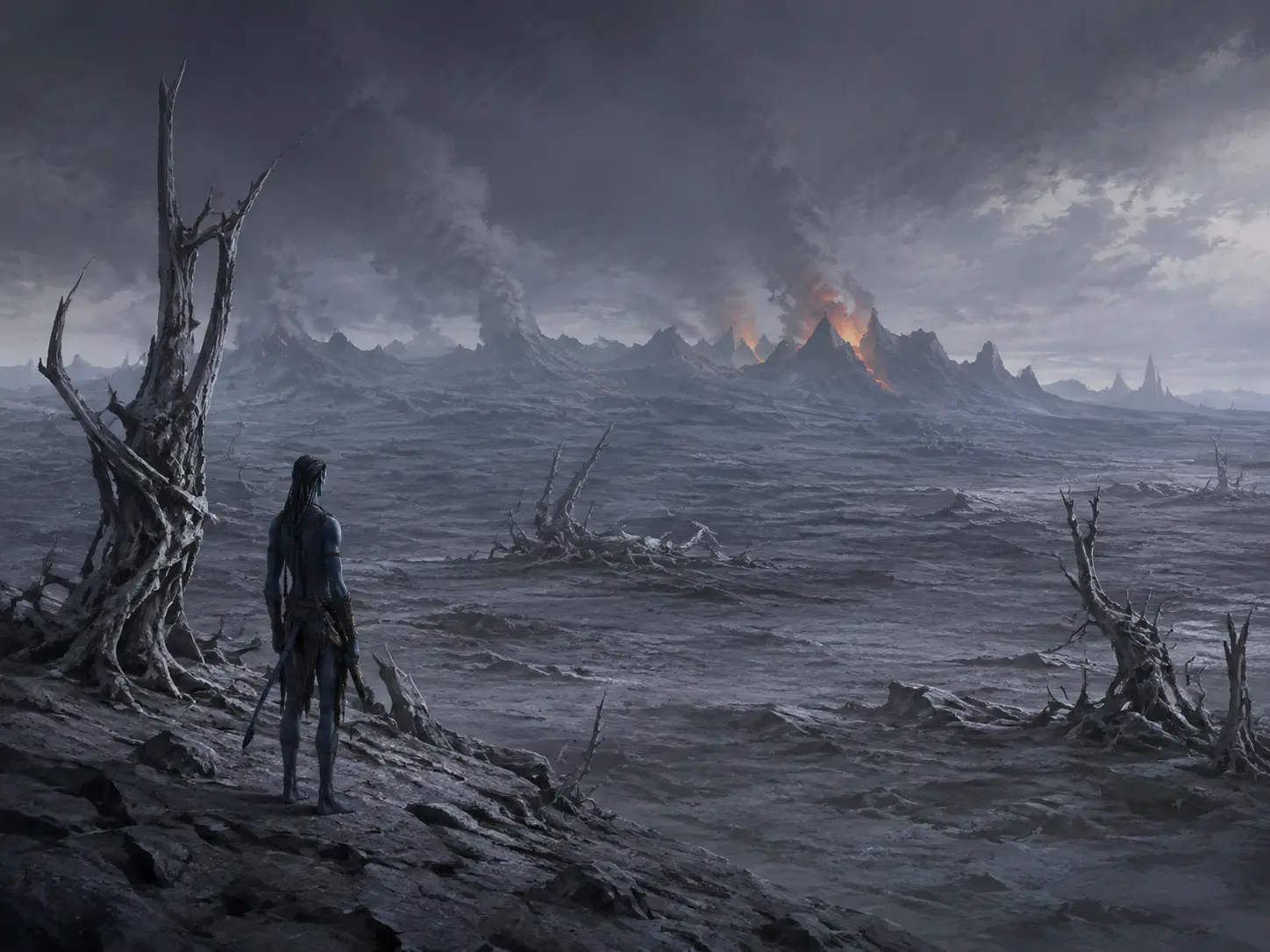
Kneel down at the edge of the Ashlands and pick up a handful of the ground.
It runs through your fingers like coarse grey flour, faintly warm where a fumarole breathes somewhere below. There is no give to it, no dark crumb of humus, no thread of root. A little farther out, the calcined skeleton of what was once a forest giant stands against the sky, its bark long gone, its wood turned to something between charcoal and stone. Steam leaks from a crack in the crust. Nothing green interrupts the grey in any direction you care to look.
A generation ago this was the home of the Mangkwan. Their Hometree stood here; their children were born under it. Then the mountain took it — buried the whole territory under pyroclastic flow and deep tephra in a single afternoon, and the survivors, the ones the films call the Ash People, stayed on the ruin rather than fleeing it. That much is canon. What canon does not explain, and what a careful eye cannot stop asking, is the thing in your hand right now.
It has been fifteen to twenty-five years. Why is this ground still dead?
We have an instinct that says it should not be. We have watched forests return after fire, watched a scar close over a wound, watched the RDA torch the Omatikaya's home and then, in the sequels, watched green climb back over the burn. Life comes back. That is the story the living world seems to tell everywhere.
The Ashlands are where that story breaks. And the reason they break it is not a Pandoran mystery at all. It is one of the most carefully documented lessons in Earth science — a lesson that arrived, for us, on the morning of 18 May 1980, on the flank of a mountain in the Pacific Northwest, and that took decades of patient fieldwork to learn properly. The short version is this: recovery is not a promise the living world makes. It is a bargain, and the terms are set by things you cannot see.
Two words for one ruin
Start with the instinct itself, because the instinct is half right.
When the RDA burned the Omatikaya's Hometree, they did something violent and — ecologically — survivable. Missiles and fire and felled trunks are a catastrophe at the surface. But underneath the char, the soil was still soil. The buried seed bank was intact. Root systems still ran through the ground, ready to send up new shoots. The fungal threads that lace a forest floor were singed at the top and alive below. Everything needed to rebuild was still present; the fire had removed the standing forest but not the capacity to grow one.
The mountain did something categorically different. A pyroclastic flow is not a fire passing over the ground — it is a burial. Hundreds of degrees of gas and rock settle over the land metres deep, and in the heat the soil itself is destroyed: the organic layer cooked away, the seed bank sterilised, the root networks turned to the charcoal we saw standing in the ash. Afterwards there is no soil to recover. There is raw mineral rock, and on top of it, the sky.
Ecologists give these two ruins two different names, and the whole chapter turns on the difference.
Secondary succession
Primary succession
The Omatikaya burn was secondary succession, and it is why the sequels can show green returning: the template held. The Ashlands are primary succession, and that single reclassification is most of the answer to the question you are holding in your hand. The eruption did not merely kill the forest. It deleted the ground the next forest would have needed, and reset the clock all the way to zero — to bare rock, the way the very first land on any world begins.
This is the first thing to carry out of the ash: how a place was destroyed matters more than how completely. A total burn and a modest burial can leave a landscape looking equally ruined on the day, and set it on recovery paths that differ by a factor of a hundred in time.
What survives decides everything
If primary succession is slow because there is nothing to build from, then the speed of any recovery is really a question about survivors. Not the ones who flee and come back — the ones who were already there and lived through the catastrophe underground.
Ecologists call them biological legacies, and learning how much they matter was the great surprise of the last half-century of disturbance research. The old textbook picture, inherited from the early twentieth century, imagined a devastated landscape as a uniform blank slate that recovered from its edges inward, colonists marching across the dead zone in an orderly wave from the living forest at the perimeter. It is a tidy image. It is also, mostly, wrong.
What actually happens is that recovery erupts from the inside, from thousands of scattered points where something lived through the blow. A seed cache sealed under enough soil to survive the heat. A root crown that resprouts. A fungal spore bank in a pocket of shielded ground. A burrowing animal that was underground when the sky fell and dug its way back up afterward. Each survivor becomes a tiny island of recovery — a focus that anchors the shifting substrate, shades a patch of ground, and begins seeding the sterile land around it. The landscape does not recover as an advancing front. It recovers as an archipelago.
Now the Ashlands' problem sharpens into something precise. The reason a volcanic burial is so much worse than a fire is not the heat as such — it is that deep burial and high temperature together destroy the legacies. No surviving root crowns, no viable seed bank, no shielded spores, because everything shallow enough to matter was cooked and everything else is under metres of sterile rock. Strip the legacies away and you have not just slowed recovery; you have changed its kind, from the fast rebuild-from-a-template of secondary succession to the glacial build-from-nothing of primary succession.
The Mangkwan, in other words, are not living on a forest that is taking its time to grow back. They are living on a surface that has to invent soil before a forest is even on the table.
The Same Blow, Three Futures
Recovery is set by what survived, not how hard the land was hit
Move between the three disturbances in the figure. The same violence, delivered three ways, produces three completely different futures — and the thing that separates them is never how hard the land was hit. It is what was left underneath.
The mountain that rewrote the textbook
Everything I have just claimed about legacies and archipelagos and the slowness of building from nothing — we did not know most of it with any confidence until one mountain taught us, and it taught us by contradicting what the experts confidently expected.
When Mount St. Helens erupted in 1980, it did not deliver one uniform disaster. It delivered several at once, laid across the landscape in zones. Closest to the crater, a pyroclastic flow buried fifteen square kilometres of ground under pumice up to forty metres deep — the Pumice Plain, as sterile a surface as the eruption produced, with essentially zero survivors. Farther out, a lateral blast flattened three hundred and seventy square kilometres of mature forest, snapping century-old conifers like matchsticks. Farther still, ash simply fell from the sky onto living ground. One eruption, and a gradient of ruin running from total sterilisation to a survivable dusting.
The ecologists who arrived expected the tidy old model: recolonisation creeping in from the green edges. What they found over the following decades was stranger and more instructive, and it overturned the model outright.
Consider the single most famous survivor. On the sterile Pumice Plain, where the textbook predicted nothing for years, primary succession was kick-started in 1982 by one plant: the prairie lupine, Lupinus lepidus. A lupine can grow where almost nothing else will because of what it carries in its roots — a partnership with bacteria that pull nitrogen straight out of the air and fix it into a form life can use. That trick matters enormously here, because the one thing fresh volcanic rock most conspicuously lacks is exactly nitrogen. The lupine did not wait for fertile ground. It made ground fertile.
As lupines lived, spread, and died, each patch became a small deposit of nitrogen-rich organic matter and trapped windblown grit — an island of soil where the next colonists, grasses and other plants that could never have started on bare pumice, could take hold. This is pioneering in its purest form, and it illustrates the classic pattern ecologists call facilitation: the early arrival changes the site in ways that make it habitable for those who come after.
But — and this is where the mountain refused to be tidy — the lupine was not only a benefactor. Dense living lupine mats also crowded out conifer seedlings, competing for the scarce surface moisture and physically blocking seeds from the mineral soil. The same plant that built the ground also, while alive, held back the forest. Only once a lupine colony aged and died did its accumulated legacy of soil truly open the door for what followed.
That double role — pioneer as both host and obstacle — is why the mid-century picture of succession as an orderly, cooperative march toward a fixed and predictable endpoint quietly collapsed. Frederic Clements had imagined plant communities as something like a superorganism climbing a staircase of stages toward one climatically determined climax, each stage dutifully preparing the way for the next. The reality on the mountain was messier and more interesting: a stochastic, path-dependent scramble in which the order of arrival matters, early winners can block later ones as easily as help them, and there is no single guaranteed destination. Recovery is contingent. It could go several ways, and which way depends on accidents of timing.
The blast zone taught the complementary half of the lesson. There, under the flattened forest, the ground had not been sterilised — and it turned out to be full of survivors. Among the most consequential were pocket gophers, small burrowing rodents that had been safe underground when the blast passed overhead. When they resumed digging, they punched through the sterile ash cap and hauled buried, living soil up to the surface, mixing the dead grey layer with the fertile dark one beneath and carrying up with it the fungal spores that most plants need to draw nutrients from poor ground. A rodent became one of the most effective agents of recovery on the mountain — not by growing anything, but by moving the legacy back into reach.
Put the two zones side by side and the shape of the whole lesson appears. The Pumice Plain had no legacies and recovered at the crawl of true primary succession, waiting on a lone nitrogen-fixer. The blast zone had abundant legacies and recovered far faster, because the template was there all along, just buried. Same mountain, same morning, futures a century apart — decided entirely by what lived through the blow.
How Long Is 'Recovered'?
Five real volcanic recoveries on one logarithmic clock
Why the ground says no
There is still something the survivor story does not quite explain. Grant that the Ashlands lost their legacies and must build soil from scratch. Fine — but soil does eventually form, pioneers do eventually arrive, and a generation is not nothing. Why is there not even a little green out here, a scattering of hardy first colonists gaining a foothold the way the lupine did?
Because a barren volcanic surface is not one obstacle. It is a stack of them, and each one alone is enough to kill a seedling.
Start with nitrogen. Fresh tephra can be surprisingly rich in mineral nutrients — phosphorus, potassium, calcium are all there — but it carries almost no biologically available nitrogen, because the heat of the eruption drove it off. And nitrogen is the element life needs in bulk and cannot easily improvise. Without a nitrogen-fixer to prime the pump, most plants simply starve on rock that looks, chemically, half-fertile. This is the bottleneck the lupine happened to solve, and it is the first gate every germinant must pass.
Then toxicity. As a volcanic plume condenses, acids coat the ash — sulfuric, hydrochloric, hydrofluoric. The first rains leach them, and the runoff can drop the water in the pores below pH 4, acidic enough to dissolve aluminium and manganese out of the minerals into forms that poison root tips and stop them dividing. The ground is not merely poor; in places it is actively hostile to the very organ a seedling leads with.
Then the physical surface. Fine ash, hit by raindrops and dried, packs into a hard crust that an emerging root cannot pierce and that sheds water rather than absorbing it — sometimes literally hydrophobic, so rain beads and runs off a surface that desperately needs it. Then the microclimate: bare grey ash under open sky swings tens of degrees between noon and night, and an unshaded seedling can be thermally girdled at the soil line, cooked through at the one spot where stem meets ground. And then, over all of it, erosion — rills, gullies, mudflows that strip away any nascent crust of life or bury it under fresh sediment, resetting the clock again and again.
Why the Ground Says No
A seedling must clear every gate at once — relieving one barely helps
Play with the figure, because it makes the crucial point better than a sentence can. These filters act in series, and survival is their product. Relieve any single one — imagine the ground suddenly rich in nitrogen — and a germinant still has to clear all the others, so the odds barely move. A seedling has to win every gate at once. That is why a barren zone can stay barren for decades even where one obstacle has plainly eased: the compound probability of clearing the whole gauntlet stays vanishingly small until many gates open together, which usually happens only in rare sheltered microsites — the lee of a boulder, a crack that traps grit and moisture and shade.
The severed super-legacy
Everything so far is Earth science laid over a Pandoran scene, and it holds without any special pleading. But Pandora adds one twist that Earth cannot, and it is worth stating carefully because it is inference, not canon — a reasonable extension of what the films establish, not something they show.
On Earth, one of the most important legacies is invisible: the mycorrhizal network, the mesh of fungal threads through the soil that most plants tap to draw nutrients from poor ground. It survives many disturbances underground and helps stitch a community back together — which is exactly why the gophers' spreading of fungal spores mattered so much. On Pandora, that underground network is not merely a nutrient utility. It is, by every indication the films give, the living substrate of Eywa herself — the root-and-filament fabric through which the planetary network signals and remembers.
Which means the volcanic burial did something to the Ashlands with no clean Earth analogue. In sterilising the ground it did not just destroy the soil and its ordinary legacies; it severed the local reach of the planetary network itself. The one legacy that most accelerates recovery elsewhere — the connective tissue that would carry resources and signals in from the living forest beyond — is precisely the thing the heat cut. The dead zone is dead, on this reading, partly because its network was killed, and a network cannot be reseeded from a buried survivor the way a plant can. It has to regrow inward from the intact edge, slowly, filament by filament, held back at the boundary by the same stack of filters that stops every other colonist.
If that is right, it reframes a moment the films treat as spiritual. When the Mangkwan reached for Eywa during their catastrophe and felt no answer, the theological reading is abandonment. The ecological reading is quieter and, in its way, sadder: there was no functioning network left in the ground to carry the call. Not a god who turned away — a severed line.
Living in the bottleneck
Which brings us, finally, back to the people standing on this ground, and lets us read their whole culture as something other than villainy.
A clan cannot eat a rate of succession. Whatever the ecology, the Mangkwan still have to find calories every day on a landscape whose primary productivity is close to zero — no forest to forage, no fertile ground to plant, a fauna thinned to whatever can cross or scavenge a dead zone. Canon tells us how they answer that: they shelter in the hollow roots of the collapsed Hometree, they lean on the few heat-tolerant megafauna the region still supports, they scavenge RDA metal against every older Na'vi taboo, and they raid their neighbours for the food and seed their own land will not give. They turned away from Eywa and toward fire and force.
Read against the ecology, none of that is a moral defect waiting for a hero to correct. It is what a society looks like when it is trapped inside the slow middle of primary succession — extracting from outside because inside produces nothing, hardening because the land gives no softness. The Ashlands did not just kill a forest and a Hometree. They imposed a mode of life, and the fierceness the films give the Mangkwan is, at least in part, the fierceness the ground demanded.
The far future
There is one more turn, and it is the strangest kindness in the whole story.
The very rock that is starving the Ashlands is, on a long enough clock, the seed of extraordinary fertility. Weathered over centuries in a wet climate, volcanic tephra transforms into Andisols — among the most productive soils that exist, prized on Earth for exactly the mineral wealth that fresh tephra locks away. The nutrients the eruption scattered are not gone; they are held in glassy grains that slow weathering will eventually unlock, decade by decade, into ground that could carry a forest richer than the one that burned.
The problem is purely one of tempo. The destruction took an afternoon. The fertility takes centuries to millennia. A human — or a Na'vi — lifetime falls entirely inside the gap between them, which is why the Ashlands can be simultaneously a wasteland to the people living on them now and a future paradise to no one alive to see it. The mountain did not only take. It also made a deposit, in an account that pays out on a geological schedule.
Honest edges
The solid ground here is Earth science, and it is genuinely solid: primary versus secondary succession, biological legacies, the Mount St. Helens field record, the facilitation-and-inhibition dynamics of the pioneer lupine, the nitrogen bottleneck and the full stack of geochemical and physical inhibitors, the long conversion of tephra to Andisols. These claims rest on decades of published fieldwork.
The canon is the founding catastrophe, the Ashlands as a persistent wasteland, the Mangkwan's survival strategies, and their turn from Eywa — all established by the films and official material. The inference is the bridge: that the eruption reset the region to primary succession, that lost legacies explain the arrest, and — the largest single inference — that severing Eywa's root network is itself the loss of a super-legacy. The speculation is fenced tightly around the specific biology of Ashlands organisms, which canon barely describes.
Auditing the claim
Three claims, three very different burdens of proof
- What the evidence shows
- Canon shows deep pyroclastic burial and a persistent wasteland; Earth's volcanic sites show exactly this arrest where legacies are destroyed.
- The honest caveat
- Canon does not directly confirm the soil is sterile rather than merely ash-smothered; the reset is inferred from the depicted burial and the decades-long barrenness.
What the Ashlands have not told us
Canon never says. The difference matters: acid-and-metal toxicity is a far harder gate than mere nutrient poverty, and it would push the recovery clock from centuries toward millennia. Earth volcanic soils span both cases.
Raiding and megafauna hunting are shown, but the caloric arithmetic is unstated. A stationary population extracting from a dead zone and its neighbours indefinitely, without collapsing local fauna, is a real ecological puzzle canon leaves open.
Unstated. Whether living root-and-fungal filaments from the intact forest are advancing inward across the ecotone — or whether ash temperature and toxicity form an impermeable barrier — would decide whether the Ashlands recover in centuries or effectively never, on human timescales.
Earth had its lupine. Canon gives the Ashlands hardy lithophytes and lichen-like forms in passing but no confirmed nitrogen-fixing pioneer. The identity of Pandora's first colonist — and whether it fixes nitrogen — is the single most important missing fact.
The handful returns
Open your hand and let the grey ground fall back where you found it.
It is not, you understand now, the aftermath of a death so much as the first page of an extremely slow beginning. Somewhere under it, or just past the edge of it, the terms of the bargain are being negotiated: whether a nitrogen-fixer arrives, whether the crust cracks in a sheltered spot, whether a filament of the living network reaches back across the boundary before the next rains strip the surface again. Each is a gate. The land greens only when enough of them open at once, and on this ground that may take longer than the Mangkwan clan itself will last.
That is the hard truth the Ashlands hold, and it is a truth about Earth as much as Pandora. We tell ourselves the living world is resilient, that it bounces back, that life finds a way. It often does — where the soil survives, where the legacies hold, where the template was only hidden and not destroyed. But strip those away and resilience is revealed for what it always was: not a guarantee written into the world, but a rate, fighting a stack of filters, on a clock indifferent to anyone waiting.
The forest does not owe the ash a return. It only, sometimes, given centuries and a first lucky pioneer, chooses to make one.
Read next
What Keeps Pandora Volcanically Alive?
A generation ago the Mangkwan homeland was old-growth forest. Then a volcano swallowed it, and now they stand on a plain of black lava where a Hometree once rose. The whole of this chapter is a question a physicist would ask of that fire: a moon this small, this old, should have gone cold and dead long ago - so what is still boiling its insides?
20 min read
Why Burning Eywa Doesn’t Kill It
Burn a hole in a forest and you have killed a great many trees. Whether you have damaged the network they belong to is a completely different question — and the answer is almost always no. The RDA learns it the hard way: you can fell the largest tree on the moon and the planetary mind does not so much as flicker. The reason lives in percolation theory and network resilience — one of the most useful things mathematics has ever proven about connected things, and the precise map of the four ways it would, finally, fail.
31 min read
The Wood-Wide Web Revisited
On Pandora the roots are said to connect everything — an electrochemical network strung across a whole moon. But real roots barely reach past their own canopy, so a world-spanning web cannot be root touching root. There has to be a third party threading between them. On Earth that third party is fungi — and the story of how it links trees, of what it provably does and what is only a beautiful tale that outran the evidence, is one of the most honest lessons forest science has to teach.
32 min read
Hometree as Keystone, Foundation and Cultural Keystone
Everyone calls Hometree a keystone, and everyone is wrong in a useful way. Robert Paine's keystone was rare and worked by eating; Hometree is most of the biomass around it and works merely by standing there. Those are different mechanisms, and telling them apart is what explains how felling Hometree can leave a planetary network untroubled and still be a loss nothing can repay. The idea to carry away: biomass grows back in decades, structure takes centuries — some things only time can build.
38 min read