

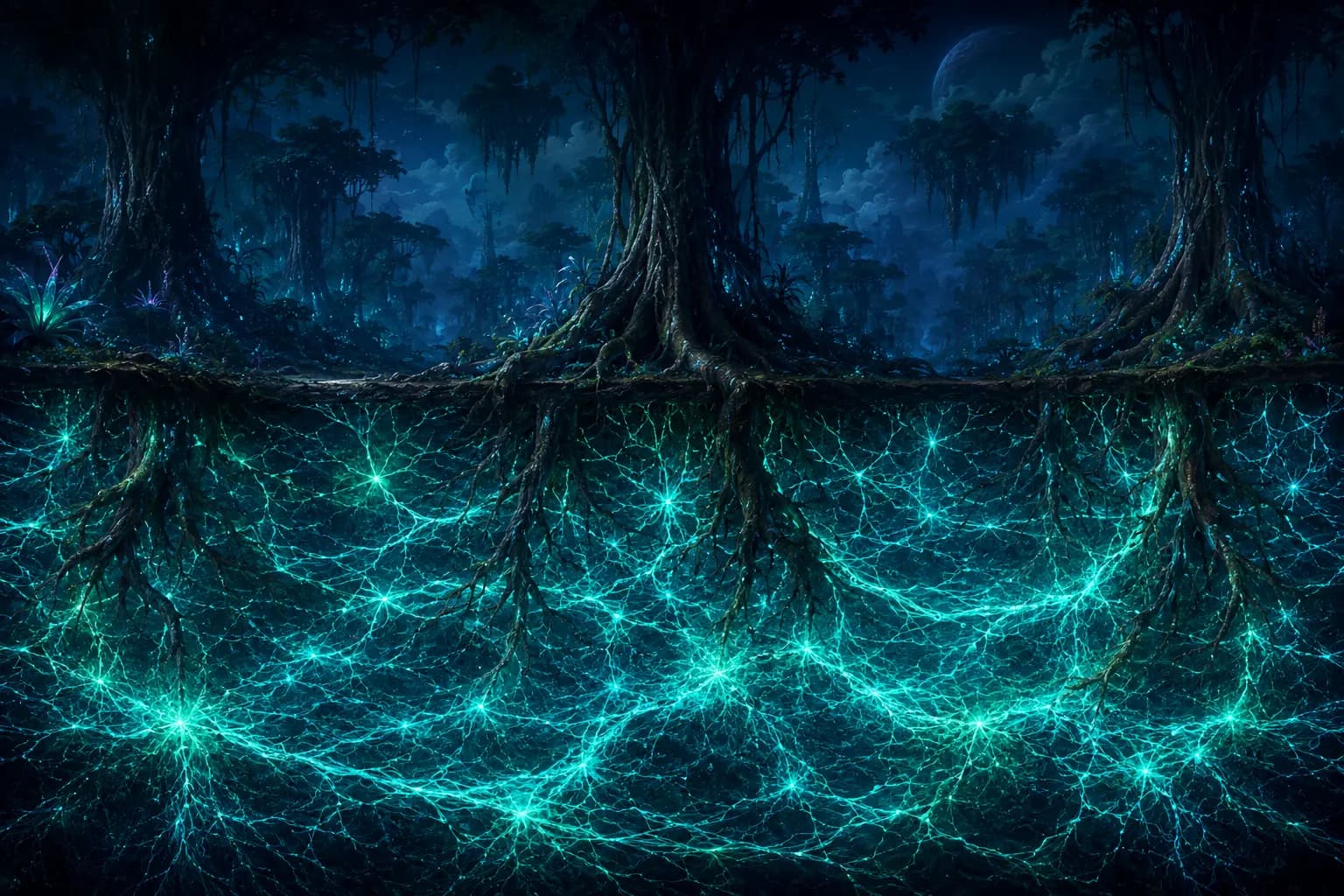
There is a scene, early in any honest reckoning with Pandora, where the mysticism has to be set aside and the soil has to be taken seriously. A xenobotanist named Grace Augustine — abrasive, chain-smoking, more at home with a root sample than with people — is trying to explain to a roomful of corporate and military skeptics why the forest they are about to bulldoze is not just standing in the way of a mine. She is not appealing to spirits. She is holding up data. "What we think we know," she says, "is that there's some kind of electrochemical communication between the roots of the trees. Like the synapses between neurons. Each tree has ten to the fourth connections to the trees around it, and there are ten to the twelfth trees on Pandora. That's more connections than the human brain. You get it? It's a network — a global network."
It is worth pausing on how much that single speech is doing, because the whole chapter lives inside it. Grace is making three concrete, almost stubbornly physical claims. First, the trees are connected — not metaphorically, not spiritually, but by literal tissue running through the ground. Second, the signal that travels along those connections is electrochemical — the same currency, broadly, that a nervous system runs on. And third, the scale is enormous and specific: ten thousand links per tree, a trillion trees, ten to the sixteenth connections in total, which she points out — correctly — is roughly a hundred times the connection count of a human brain. She is not asking the room to believe in a goddess. She is asking them to respect a circuit.
There's some kind of electrochemical communication between the roots of the trees. Like the synapses between neurons. Each tree has ten to the fourth connections to the trees around it, and there are ten to the twelfth trees on Pandora. That's more connections than the human brain. It's a network — a global network.
And here is the thing that makes Pandora such a good teacher: that claim is not as alien as it sounds. A planet whose forests are wired together underground into a single vast network, trading signals through their roots, is not a flight of pure fantasy bolted onto an alien moon. It is a slightly amplified, slightly mythologized version of something that is genuinely, verifiably true of the ground beneath your own feet — true of almost every forest, grassland, and garden on Earth. The wiring is real. The trade is real. The network is real. What Pandora does is take that real thing, turn the volume up, and dare you to say where the science ends and the story begins. Drawing that line — carefully, honestly, without either sneering at the fiction or swallowing it whole — is the entire work of this chapter.
So let us take Grace at her word and treat the underground of Pandora as an engineering problem. If the forest is a network, it must have a topology: nodes, hubs, and the cabling that runs between them. Canon is generous about the nodes and the hubs. The trillion ordinary trees are the distributed nodes, each one a small relay. And scattered through the forest are structures that are plainly something more — the network's data centers and access ports.
The architecture of the Oma
Recent Avatar lore gives the planetary network a name — the Oma — and a rough floor plan. The most famous structure is the Tree of Souls, the Na'vi's holiest site, a great weeping, willow-like tree whose canopy hangs down in a curtain of fine, unshielded, fiber-optic-looking tendrils. The Na'vi connect to it directly through tsaheylu, the neural bond made through their queue, and through it they can do something they can do nowhere else: not merely listen to the network but write to it at the highest level, even routing the permanent transfer of a consciousness from one body to another. In network terms the Tree of Souls is not just another tree. It is a primary hub — a massive input-output station carrying bandwidth the ordinary forest cannot.
Near it, and easy to confuse with it, is the Tree of Voices, where the Na'vi hear their ancestors. If the Tree of Souls is a live processing hub, the Tree of Voices behaves more like a server bank: a place where stored memories — recorded voices — can be read back. The distinction matters, because it tells us the network is not a uniform mat of identical roots. It has specialized organs: some for live, high-bandwidth transfer, some for archival storage. And in The Way of Water a comparable architecture turns up underwater, in the Spirit Tree of the reef-dwelling Metkayina, anchored to the seabed and serving the ocean in a role parallel to the Tree of Souls in the forest. That single fact reshapes the picture: the network is not just a terrestrial phenomenon that stops at the shoreline. The Spirit Tree shows a parallel marine route, but canon never maps a physical join between the two.
Then there is Hometree, Kelutral, the vast tree the Omaticaya live inside, supported by a buttressed, mangrove-like root system fused into the forest around it. When the mining company fells it — a deliberate, brutal piece of the story — the local devastation is total. And yet canon is quietly emphatic on a crucial point: the planetary network survives. The felling of one of the largest nodes on the moon does not so much as dim the Oma. That single detail is doing enormous structural work, and it is one we will return to: a network that can lose one of its biggest hubs without collapsing is, by definition, a decentralized, redundant one. There is no central server in the basement whose destruction takes the whole system down. (Exactly why that redundancy is so robust is the subject of a later chapter, V.4 — Why Burning Eywa Doesn’t Kill It, on the network's resilience; here it is enough to notice that the architecture has it.)
So the floor plan is clear enough. What is conspicuously missing from it is the cabling.
The substrate paradox
Here is the problem Grace's speech walks straight into and never resolves, and it is the hinge of the entire chapter. She keeps saying roots. The connections are "between the roots of the trees." But roots have a hard physical limit. A tree's roots, on Earth or anywhere else governed by the same physics, rarely reach much past the spread of its own canopy. They are expensive to grow and maintain, and there is no advantage to a tree in sending a root on a kilometre-long journey to touch a stranger. If Pandora's planetary network were genuinely built from roots touching roots, it would not be a global network at all. It would be a patchwork of tiny, isolated local huddles — clumps of trees close enough to interlace, separated by every river, ridge, and clearing on the moon. The first stream would cut the cable.
So either the planetary network is a canonical impossibility — a nice line of dialogue that doesn't survive contact with physics — or the word "roots" is standing in for something it shouldn't. And it is precisely here, in the gap canon leaves open, that the supplementary lore quietly drops in the missing piece. In the Lightstorm-sanctioned game Avatar: Frontiers of Pandora, the Western Frontier is threaded with what the game explicitly calls Mycelium Networks, and one clan, the Kame'tire, connects to the Oma not through a tree at all but through the Whispering Greatcap — a massive, bioluminescent polypore mushroom whose gills carry the same neural-connecting tendrils as the sacred trees. It is the first fungus canon identifies the Na'vi using to reach Eywa.
That is the whole game changer in one image. A fungus, doing the job of a sacred tree. Because the moment you allow a fungal layer into the picture, the substrate paradox dissolves. The trees do not have to reach each other. They only have to reach the fungus — and the fungus, threading microscopically and ubiquitously through every cubic centimetre of soil, reaches everything. The roots are just the terminals. The real cabling is the mycelium. And with that, Pandora's underground stops being an alien invention and becomes a recognizable, if exaggerated, portrait of something Earth has been running for four hundred million years.
The four-hundred-million-year handshake
Pick up a handful of soil from almost any forest on Earth and you are holding one of the oldest business partnerships on the planet. The word for it is mycorrhiza — literally "fungus-root," from the Greek — and it names the intimate symbiosis between plant roots and soil fungi. It is not a fringe arrangement. Somewhere between eighty and ninety percent of all land plant species form it. It is closer to the rule of terrestrial life than the exception, and it is very nearly as old as terrestrial life itself.
Rewind to the Devonian, roughly four hundred million years ago, when the first plants were hauling themselves out of the water onto a raw, mineral, hostile land surface. They had a problem. They could photosynthesize — they could turn sunlight and air into sugar — but they had no real roots, and the barren ground locked its phosphorus and nitrogen away in forms they could not reach. Fungi had the opposite problem and the opposite gift. They could not photosynthesize; they had no way to make their own food. But they were superb miners, threading filaments through the smallest pores of rock and soil and chemically prising loose exactly the minerals the plants could not get. The two struck a deal. The plant would pay in sugar — in carbon, fixed from the air by photosynthesis. The fungus would pay in phosphorus, nitrogen, and water, hauled in from a volume of soil no root could ever explore. Neither could thrive on land without the other. The greening of the continents may quite literally have been a joint venture, and the partnership has never been dissolved since.
Mutualism of this depth comes in two main architectures, and the difference matters for the Pandora story. The older and far more common type is the arbuscular mycorrhiza, formed by an ancient fungal lineage with about eighty percent of all plant species. Here the fungus is startlingly intimate: its threads push right through the cell walls of the root and balloon out inside the plant's own cells into microscopic, densely branched, tree-shaped structures called arbuscules. The arbuscule is the actual trading desk — a vast folded surface, fungus on one side and plant on the other, across which carbon flows out and phosphorus flows in. The fungus is, in a real sense, living inside the plant.
The second architecture, the ectomycorrhiza, is the one most associated with the great forests of the temperate and boreal world — the pines, oaks, firs, and birches — and it is the type that matters most for the "wood-wide web" stories. Here the fungus is more discreet. It does not pierce the root cells. Instead it wraps each root tip in a dense sheath, a mantle, and weaves a fine net of threads between the outer cells without entering them. The trade happens across that net. It is a slightly more arm's-length relationship than the arbuscular kind, but it builds the same thing: a living interface where sugar and minerals change hands.
The body of the fungus that does the reaching is the mycelium — a fan of countless microscopic filaments called hyphae, each only a few thousandths of a millimetre across. And the scale of it is genuinely hard to hold in the mind. A single gram of healthy forest soil — about a fifth of a teaspoon — can hold up to ninety metres of fungal hyphae. A cubic inch of rich undisturbed soil can contain something like eight miles of thread. Because the filaments are so fine, the mycelium folds an enormous surface area into a tiny volume, multiplying a tree's effective nutrient-gathering reach by a factor of several hundred. This is the part that is not contested, not romanticized, not a beautiful overreach. It is settled, measured, four-hundred-million-year-old science. The ground is threaded with living cable. The only question — and it is the question that has torn the field apart — is how much that cable actually carries between one tree and the next.
From "fungus-root" to "wood-wide web"
The leap is seductive and it is easy to see why it caught fire. If a single fungal individual can colonize the roots of one tree, there is no reason it should stop at one. A mycelium can spread through the soil and tap into the roots of two trees, or ten, or a whole stand — stitching them into what ecologists call a common mycorrhizal network, or CMN. And once two trees are plugged into the same fungal body, a tantalizing possibility opens up: maybe things can move between them. Not just between tree and fungus, but from tree to tree, through the fungal bridge. Maybe the forest is not a crowd of individuals competing for light but a connected, communicating, resource-sharing collective. Maybe the trees are talking.
That idea got its irresistible name in 1997, when the journal Nature put a study by the Canadian forest ecologist Suzanne Simard and colleagues on its cover, and a headline writer coined the phrase "the wood-wide web." It has been impossible to dislodge ever since. But the phrase smuggles in a great deal, and to read Pandora honestly we have to do what the popular accounts often don't: take the single idea of a "connected forest" apart into a ladder of separate claims, each of which earns its own, very different, level of confidence.
The interactive ladder below is the honest spine of this chapter. Climb it rung by rung and watch the evidence thin out beneath you — solid footing at the bottom, open air near the top.
Auditing the claim
Three claims, three very different burdens of proof
- What the evidence shows
- Shown in the lab and seen in the field; a single mycelium colonising several trees is not in doubt.
- The honest caveat
- Mapping continuous networks across wild forest is rare, and the links break and regrow constantly.
What Simard actually measured
Strip away the cover line and the legend, and Simard's original experiment is a small, elegant, real piece of science worth understanding on its own terms. She grew seedlings of two species — Douglas-fir and paper birch — close enough to share fungal partners, and then fed each species a different radioactive flavour of carbon dioxide. One got carbon-14, the other carbon-13. Because the two isotopes are distinguishable, any carbon that started in the birch and ended up in the fir, or the reverse, could be traced and weighed. Carbon was the dye, and the soil was the maze.
The result was real and it was striking: carbon moved, in both directions, between the two species, through the shared ectomycorrhizal fungi. And — the detail that launched a thousand metaphors — the net flow followed need. When the young firs were shaded and struggling to photosynthesize, more carbon flowed to them from the sunlit birch than the other way. The struggling tree, in that season, was a net receiver. To a careful reader this is rung two of the ladder, beautifully demonstrated: under some conditions, material moves through fungal links along a source–sink gradient, from where carbon is abundant toward where it is scarce. That is genuinely remarkable and it is genuinely established.
What came next was the leap. Over the following years the finding grew into the mother tree hypothesis: the idea that the largest, oldest trees in a forest act as central hubs, the most richly connected nodes in the network, and that they deliberately channel surplus carbon through the fungal web to nourish understorey seedlings — preferentially their own kin — subsidising the next generation, even passing on their resources as they die. It is a beautiful, almost maternal picture of the forest, and it is the single closest real-world analogue to Pandora's Tree of Souls: a giant, centralised, life-giving hub at the heart of a connected wood.
It is also exactly where the science gets thin, and we will come back to it with the seriousness it deserves. Hold the mother tree in mind as a hypothesis — a powerful, popular, and so far under-proven one — rather than a fact. The gap between "carbon can move between trees" and "old trees intentionally feed their children" is enormous, and most of the trouble in this field lives in that gap.
The cleanest way to feel where that gap comes from is to build the experiment yourself. Every claim on the ladder is bought by a specific control in the design, and skipping one does not weaken the conclusion slightly — it removes that conclusion from what you are entitled to say at all.
Build the experiment, earn the claim
Switch each control on and see which sentence the design lets you write.
Not a commune — a market
Before we reach the reckoning, there is a different, sharper lens on the network that does far more justice to the evidence than the cosy "trees helping trees" picture — and it comes from the work of the evolutionary biologist Toby Kiers and her colleagues. Their reframe is bracing: the underground network is not a charity. It is a marketplace.
Kiers studied the arbuscular symbiosis with clever split-root experiments, tracking carbon and phosphorus isotopes as they moved between plant and fungus. What she found was not altruism but trade, governed by something very like price. Plants can detect which fungal threads are delivering the most phosphorus, and they preferentially route more carbon — more sugar, the fungal currency — to those generous partners. They starve the stingy ones. And the fungi do exactly the same in reverse: they detect which plant roots are paying the best carbon, and they divert their phosphorus toward the better customers, withholding it from the cheapskates. Both sides reward cooperation and sanction cheating. Both sides can, in effect, punish a bad partner by cutting off the goods.
That market framing is the perfect tool to bring back to Pandora, because it lets us admire the network without sentimentalising it. The Na'vi speak of Eywa as a mother. The biology, here and there, speaks of trade. Both can be true at once, and holding the two together is exactly the kind of double vision this book is for. The interactive below lets you run the market yourself — feed carbon to a generous fungal partner and watch the phosphorus flow back, or try to cheat and watch the network route around you.
The underground market
You are the plant. Pay carbon, see what phosphorus comes back.
—
Can a forest send a warning?
Pandora's network does more than move resources; canon has it carrying threat — the forest sensing danger and the danger propagating. So the natural next question on Earth is whether real mycorrhizal networks carry information, not just carbon. The most cited evidence comes from a 2013 experiment by Zdenka Babikova and colleagues, and it is worth telling carefully, because it is both genuinely interesting and easy to over-read.
They grew broad bean plants linked by a shared fungal network, then let aphids attack one plant while sealing its neighbours from any airborne or above-ground contact — the only path left open between attacked and unattacked plants was the underground fungus. When the aphids struck, the attacked plant mounted its defence: it began producing volatile compounds that repel aphids and, cleverly, attract the parasitic wasps that hunt them. And then the connected, unattacked neighbour began producing those same defensive volatiles too — but only the neighbours joined to the attacked plant by an intact fungal link. Cut the fungus, and the warning did not arrive. Something had travelled through the network and primed a naive plant to defend itself before any aphid reached it.
That is a real signalling pathway, demonstrated under controlled conditions, and it is the closest Earth comes to canon's "the forest warns itself." But honesty requires the next sentence: this is one experiment and a handful of follow-ups, not a settled pillar; the sample sizes are small; and crucially, fungal signalling is only one of several ways plants warn each other. The best-established channel is not underground at all — it is airborne. Plants routinely release volatile chemicals into the air that neighbours detect and respond to, and that channel is far better proven than the fungal one. So the fungal early-warning system is a real and tantalising result, but it is a contested, minor channel beside the open-air one, not the forest's main telephone line.
There is a harder constraint on it than the evidence, though, and it is one the experiment quietly built in: the plants were pots apart. A warning is only a warning if it arrives before the thing it warns about, and the alarm's speed is set by the physics of a fungal tube. Set the two plants a real forest distance apart and run the race yourself.
Does the warning arrive first?
An alarm is only an alarm if it beats the herbivore to the neighbour.
The speed problem
Here is where the most beloved line in all of Pandora's biology runs head-first into physics. Grace compares the root signals to "the synapses between neurons" — and synapses are fast, firing in thousandths of a second, which is what lets a brain think in real time. If Pandora's network is a brain-like thing, the implication is brain-like speed. So how fast does a signal actually move through a real fungal network? The answer is the quiet demolition of the whole "planetary brain" romance.
There are two ways a signal could travel, and both are slow. The first is to physically carry it — to move molecules through the hyphal tubes. Fungal threads are not empty pipes; they are pressurised cylinders, and their contents flow by cytoplasmic streaming, pushed along by differences in internal pressure from a source toward a sink. It works, but it crawls: streaming moves at roughly five to forty micrometres per second. To cross a single metre of forest floor that way takes the better part of a day. This is the engine that moves Simard's carbon, and it explains why such transfers play out over a growing season, not an afternoon.
The second way is electrical, and this is the one that sounds most like canon's "electrochemical." Remarkably, fungi do generate electrical activity. The computer scientist Andrew Adamatzky pushed fine electrodes into fungal colonies and recorded trains of electrical spikes travelling through the mycelium — spikes that cluster into patterns complex enough that he, only half-jokingly, mapped them to a "vocabulary" of up to fifty distinct word-like elements. It is a real and genuinely strange finding: the wiring does carry electrical signals. But the speed is the reality check. Those spikes propagate at something like seven millimetres per minute — orders of magnitude slower than the millisecond crackle of a neuron.
This is the single most important correction the science hands back to canon, and it is a subtle one. Grace was right that the network could have more connections than a human brain — the arithmetic of ten thousand links across a trillion trees is sound, and connection count alone is no obstacle. But a brain is not fast because it has many connections; it is fast because signals cross those connections in milliseconds. A planet-spanning network built on fungal physics could be vast beyond imagining in its wiring and still be incapable of a single quick thought, because a message takes hours or days to cross it. The honest verdict is precise and a little haunting: the magic of Pandora is not that the trees are connected. It is that, somehow, the signal travels fast enough for the planet to think at all.
Synapse
~1 ms
A neuron fires in thousandths of a second
Fungal electrical spike
~0.7 cm/min
Orders of magnitude slower than a neuron
Cytoplasmic streaming
5-40 um/s
Carbon takes most of a day to cross one metre
Connections, Pandora
10^16
Grace's count — more than a human brain
The year the story broke
For twenty-five years the wood-wide web grew in the telling. Each retelling rounded the corners a little smoother: can became does, demonstrated under some conditions became the forest shares, and the mother tree went from a useful metaphor to a wise old being nursing her young. The story was beautiful, and it was everywhere — in bestsellers, in documentaries, in the felt sense that a forest is one cooperating organism. It is, not coincidentally, almost exactly the story Avatar tells. And in 2023 three ecologists decided to check whether the evidence had kept pace with the story.
Justine Karst, Melanie Jones, and Jason Hoeksema went back through the entire body of literature on common mycorrhizal networks in forests, and what they found was a quiet scandal of citation. Over the preceding quarter-century, the frequency of confident, unsupported claims about these networks had doubled in the peer-reviewed literature — not because new evidence had arrived, but because of positive citation bias. When an early paper cautiously showed that a network could form, later papers cited it as proof that networks do span forests and do coordinate them. Each citation dropped the original authors' careful hedges. The caveats evaporated; the claims hardened. Scientists themselves had become the vectors carrying the overreach.
Their specific findings were sobering. The actual physical structure of these networks in wild forests is far less mapped than the popular story implies — across the whole world, only a couple of studies have ever traced real fungal individuals across continuous ground to real tree roots, and fungal threads are constantly broken and regrown, so the "continuous web" is often a patchwork of transient links. The claimed benefits to seedlings turned out inconsistent across field studies, and where they appeared they could usually be explained more simply — a seedling drawing nutrients from its own fungi, not a gift routed from a mother tree. And on the single most evocative claim of all — that mature trees deliberately funnel resources and warnings to their own offspring through the network — they found zero supporting field evidence. None.
Auditing the claim
Three claims, three very different burdens of proof
- What the evidence shows
- Demonstrated in the lab and seen in the field; the basic biology of a shared mycelium is not in doubt.
- The honest caveat
- But mapping continuous networks across wild forest is rare — only a handful of studies worldwide — and the links break and regrow constantly.
It is important to be clear about what this correction does and does not say. It does not say mycorrhizal networks are fake, or that Simard's careful experiments were wrong, or that carbon never moves between trees. The bottom rungs of the ladder are solid. What it says is that the top rung — the forest as a single coordinating, nurturing intelligence — was never earned by the evidence, and that we collectively talked ourselves into it because the story was lovely and we forgot to keep checking. The network is real. The mind reading itself onto the network was ours.
Back to the forest floor
So now we can climb back up out of the soil and look at Pandora again with clear eyes, and the strange thing is that knowing all this makes the fiction better, not worse. Grace's speech survives the encounter with science remarkably well — provided we make one substitution she never quite made herself. Where she said "roots," we say "roots and the fungal web they plug into," and the whole impossible architecture suddenly stands up. The trees do not need to reach each other across rivers and ridges. They need only reach the mycelium, and the mycelium reaches everything. The Whispering Greatcap was the tell all along: a fungus doing a sacred tree's job, dropped into the lore as if to whisper that the real cabling of Pandora extends beyond roots alone.
Read the rest of the architecture through Earth's lens and it keeps paying off. The Tree of Souls is a mother tree with the volume turned all the way up — a giant, central, richly connected hub, exactly the structure the popular wood-wide web imagined, except that on Pandora the hub demonstrably does what Earth's mother trees only allegedly do. The Spirit Tree shows a comparable architecture beneath the sea, the way a single fungal genus can underlie a whole stand. Canon never maps a physical join between that marine system and the forest network. And Hometree's fall, leaving the planetary network intact, is the signature of precisely the kind of decentralized, redundant web that real mycelium builds — no central server, no single point of failure, just countless transient links rerouting around the wound.
But the deepest gift Pandora gives a careful reader is not the part where the fiction comes true. It is the part where the science refuses to let it. Earth's forests taught us, the hard way and only recently, that a network being real is a completely different claim from a network being a mind — that "connected" and "coordinated" and "conscious" are three separate rungs, and that the climb between them is steep and mostly unproven. Pandora is the thought experiment that asks: what would it take to actually finish that climb? What would have to be true for "the roots are all connected" to become "the planet is awake"? And the answer the physics keeps handing back is speed. The connections are the easy part; Earth has more fungal cable underfoot than we can map. The hard part — the genuinely alien part, the part that is still fiction — is a signal that crosses the web fast enough to think.
Honest edges
It is worth drawing the line cleanly, because that line is the whole discipline. What is settled Earth science here is a great deal: that mycorrhizal symbiosis is real, ancient, and nearly universal; that fungi link multiple trees into shared networks; that material can move between trees through those links under some conditions; that the underground behaves like a market of reward and sanction; that fungal transport and signalling are real but glacially slow. None of that is in doubt, and all of it makes Pandora's underground far less fanciful than it first sounds.
What is contested — and we have flagged it every time — is the top of the ladder: that forests purposefully share, that mother trees nurture their kin, that the network is a coordinating intelligence. The 2023 review did not disprove these so much as show they were never proven, and that we mistook a beautiful story for a finding. The honest stance is not to sneer at the wood-wide web but to hold it at exactly the confidence its evidence has earned — generous at the bottom of the ladder, sceptical at the top.
And what is canon sits in its own column: the Oma, the sacred-tree hubs, the surviving network, the fungal access point. Between the firm science and the firm canon runs a bridge of inference — reading "roots" as mycelium, reading the Tree of Souls as a mother-tree hub, reading the Whispering Greatcap as canon's own admission that fungi were always the cabling. That bridge is sound, but it is reasoning, and we have marked it as reasoning. A few things canon simply never says — what the fungal partner actually is, how an electrochemical root signal could ever carry something as structured as a memory, whether the forest and ocean networks are truly one system — and those we have left open rather than invent.
The roots, it turns out, really are all connected — on Pandora and under your own feet, by a fungal web older than the forests it built. That much is true, and it is wonder enough. What is not yet true, on either world, is the next sentence everyone wants to add: that the connection adds up to a mind. Earth has not earned that sentence. Pandora simply imagines a world where it was earned — and then, if you read it honestly, hands you the exact tools to tell the difference.
What stays open
Supplementary canon confirms fungi do the network's long-distance cabling — the Whispering Greatcap, the Mycelium Networks of the Western Frontier — but never describes the organism: its biology, its relationship to the trees, whether it is one planet-spanning individual or countless local ones. Earth's mycorrhizae are the model, not a documented fact about Pandora. The substrate that makes the whole network possible is named and then left blank.
Canon has the Na'vi upload and download memories — even whole consciousnesses — through the Tree of Souls. But real electrochemical signalling in roots and fungi is slow and low-bandwidth, nothing remotely like the structured, high-density information a memory would require. How the network encodes, stores, and replays something as rich as an ancestral voice is never explained. This is the chapter's hardest unclosed gap, and the next chapter on the network's bandwidth takes direct aim at it.
The Spirit Tree of the Metkayina carries the same architecture beneath the sea that the Tree of Souls carries on land, which implies one continuous planet-spanning Oma crossing the seabed. But canon never shows the two physically joined, and a marine network could just as easily be a separate system running the same design. Whether Pandora has one global mind or several regional ones is left genuinely, tantalisingly open.