

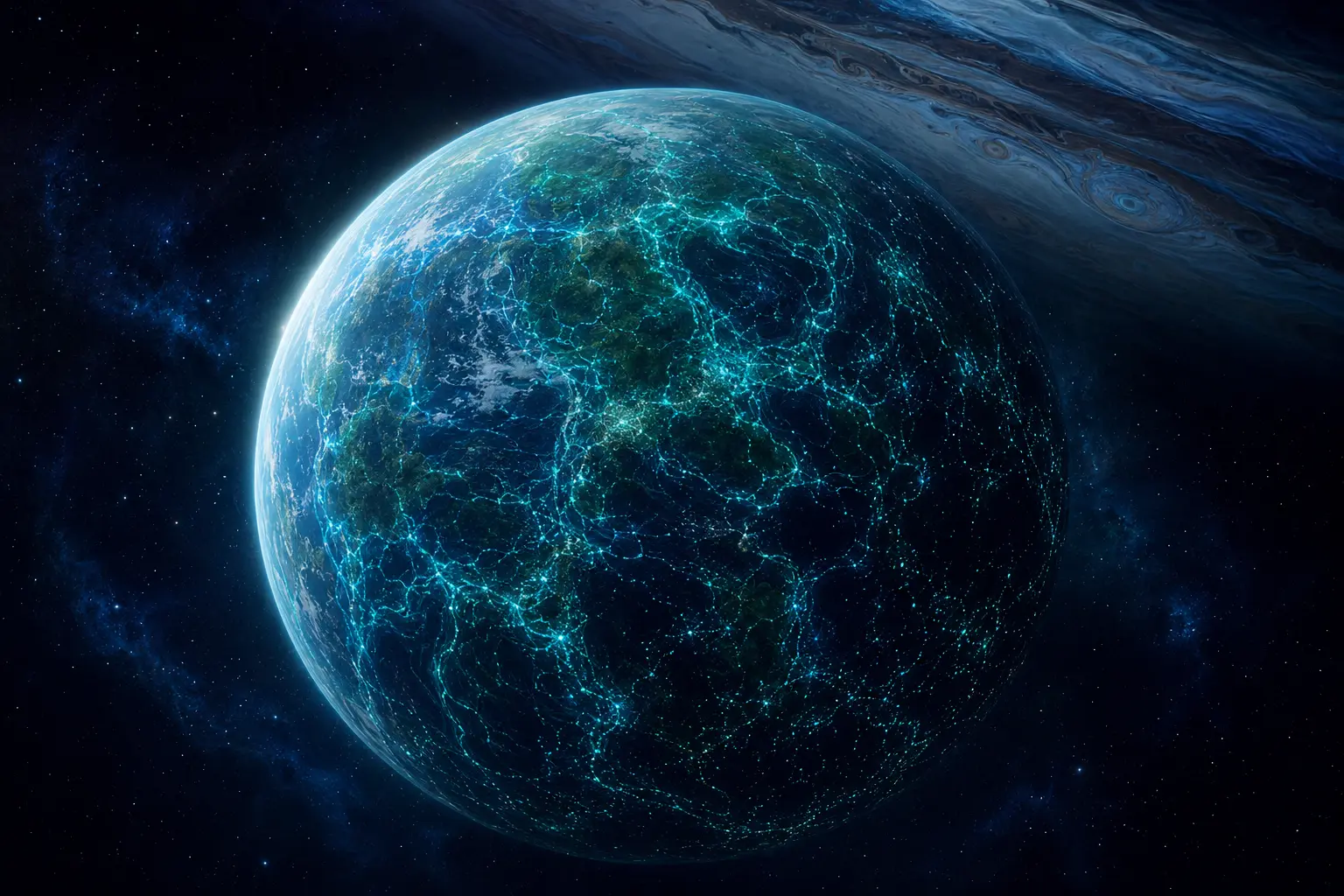
There is a sentence the Na'vi say to each other that sounds, at first, like a prayer, and turns out on inspection to be a law of physics. All energy is only borrowed, they say, and one day you have to give it back. It is the kind of line that is easy to file under reverence and move past — a poetic way of saying be grateful, take only what you need. But read it the way you would read any claim about how a world works, and it stops being soft. It is a closed-loop statement about thermodynamics. Nothing on Pandora is owned outright; everything is on loan from a larger account, and the account is balanced. Matter and energy flow through every living thing and return, on death, to the whole that issued them. The Na'vi are not describing a virtue. They are describing a system — one that recycles, regulates, and keeps its own books.
We have already taken that system apart, mechanism by mechanism. We found the wiring first (V.2 — The Wood-Wide Web Revisited) — that the forest is laced together not by root touching root but by an ancient fungal web threading between them, a real architecture with a real Earth analogue. We asked whether all that connection adds up to a mind (V.1 — What Eywa Is), and found distributed cognition: intelligence with no central self, competence with nobody home. We measured what such a network could actually carry (V.3 — The Bandwidth of a Planet), and ran the bandwidth against the hard limits that govern any channel. And we asked why burning a piece of it never seems to kill it (V.4 — Why Burning Eywa Doesn’t Kill It), and found the cold mathematics of redundancy and percolation — why a richly cross-linked network shrugs off damage that would sever a tidy one.
Four mechanisms, four chapters, each one a piece of Eywa held up to the light on its own. This chapter does the opposite. It steps back far enough to see all of them at once, because the question that has been waiting at the end of Part V is not about any single mechanism. It is about the whole. When you assemble the wiring and the cognition and the bandwidth and the resilience into one planet-spanning system that recycles its own matter, defends its own balance, and stores its own dead — what kind of object have you got? A planet that merely has life on it, the way Earth has life smeared across its surface? Or a planet that, in some defensible and not merely poetic sense, is a single living thing?
That question is not science fiction. It is one of the most consequential and most misunderstood ideas Earth science produced in the twentieth century, and Pandora turns out to be the cleanest possible thought experiment for thinking about it clearly.
The book that balances
Start with what the canon actually claims, because it is more specific than the reverence around it suggests. The Na'vi do not merely feel connected to their world; they describe a mechanism. Eywa, in their understanding, keeps the balance of life — not a vague harmony but an active equilibrium, a state held steady against disturbance. When Grace Augustine's team mapped the root network, they were measuring the physical substrate of exactly that: an electrochemical web running tree to tree across the whole moon, the same web the previous four chapters have been anatomising. The theology and the science are pointing at one object from two directions. The Na'vi call its bookkeeping the balance of life. A systems scientist would call it homeostasis — the maintenance of a stable internal state in the face of a changing outside.
And crucially, the canon presents the system as unified, not as a patchwork of unrelated regional stories. The land network of the forest clans and the marine network of the reef clans use the same kind of memory-bearing interfaces: the Metkayina commune with their ancestors through an underwater Spirit Tree anchored to the seabed, and the tulkun carry memory across open water through their own bodies. Newborn whale calves and Na'vi infants are linked to the same shared memory in the same rite. The story presents forest and sea as parts of one network, but it never maps the physical connection between them.
So the canon hands us a planet that recycles all its matter through a single balanced loop, holds a steady equilibrium, and presents land and sea as parts of one connected system. Hold that picture. It is going to turn out to be the literal, physical version of an idea that Earth scientists could only ever argue about in the abstract.
All energy is only borrowed, and one day you have to give it back.
A planet that defends itself
The most dramatic thing Eywa does — the thing that turns a quiet equilibrium into something that looks unmistakably alive — is defend itself. When the RDA's machines tore into the forest and burned through the biomass, the response was not local and it was not slow. At the climax of the war, the moon's wildlife converged on the human line from every direction at once: a continent-scale mobilisation of animals that had no business cooperating, all turning on the same target in the same moment. The Na'vi read it as Eywa answering a prayer. Read mechanically — and the previous chapters earned us the right to read it mechanically — it looks like something with a precise Earthly name: an immune response.
Think about what your own body does when a thorn breaks the skin. There is no committee, no central decision to care about the wound. A local disturbance crosses a threshold, chemical alarm signals propagate, and defenders flood the site — not because a self weighed the situation and chose to act, but because the system is built to detect a deviation from balance and move, reflexively, to restore it. An immune system does not take sides. It has no sides. It registers not-self, damage, deviation, and responds. Scale that up to a planet wired into a single network, and the wildlife surge stops being a miracle and becomes a fever: the biosphere detecting a wound and mounting a coordinated defence, the RDA cast — accurately, from the system's point of view — as a pathogen.
This is where the canon's own language turns out to be sharper than its mystics realised. Eywa does not take sides; she protects the balance of life. That is not a hedge. It is very nearly a textbook description of homeostatic regulation. The system is not rooting for the Na'vi. It is correcting a perturbation, and the Na'vi happen to be on the side of the correction. Even the Na'vi themselves fit the pattern: by refusing to expand, to farm intensively, to permanently reshape their habitat, they hold their own populations inside the carrying capacity of the world — behaving, in effect, as one more regulatory organ keeping the balance rather than breaking it. A planet that registers damage and mobilises against it, with no central self choosing to do so, is doing precisely what a living body does. The question is whether that makes it a living thing — and to answer that honestly, we have to leave Pandora and go to the one planet where we can actually check.
Earth got there first
In the mid-1960s, a British chemist named James Lovelock was working for NASA on a deceptively simple problem: how would you tell, from a great distance, whether a planet was alive? The Viking landers were still years from Mars, and the assumption around him was that you would have to go and look — scoop the soil, culture it, hunt for microbes. Lovelock thought there was a faster way, and it came from chemistry rather than biology. You wouldn't need to land at all. You could read the answer off the atmosphere.
His reasoning was elegant. A dead planet, he argued, settles into chemical equilibrium. Its atmosphere is whatever the rocks and the sunlight and the slow grind of geology leave behind, all the reactive species long since burned out, the gases sitting in stable, boring coexistence. Look at Mars or Venus and that is exactly what you find: atmospheres that are more than ninety-five percent carbon dioxide, inert, chemically finished. Nothing is fighting the equilibrium because nothing is left to fight it.
Now look at Earth. Earth's atmosphere is, by the same chemical standard, impossible. It holds twenty-one percent oxygen — a furiously reactive gas — sitting alongside methane, which oxygen should destroy almost instantly. The two react readily; left to chemistry alone, the methane would vanish and the oxygen would slowly bind to rocks until the air went as quiet as Mars. Yet both persist, year after year, at stable concentrations. The only way to hold a reactive mixture that far from where chemistry wants it is to pump it there continuously — a vast, ceaseless flux of gases produced by something. That something is life. Earth's atmosphere is not a passive envelope; it is a chemical signature being actively maintained, billions of tonnes of disequilibrium held open by the metabolism of the whole biosphere.
Atmospheric disequilibrium is, to this day, considered one of the most robust biosignatures we have — a key thing the next generation of telescopes will hunt for in the air of distant exoplanets. And it was the seed of a far larger idea. If life was holding the atmosphere away from equilibrium, Lovelock reasoned, then life and the planet's physical environment were not two separate things — a stage and its actors — but a single coupled system, each shaping the other. Working with the microbiologist Lynn Margulis, he gave the idea a name borrowed from the Greek personification of the Earth: the Gaia hypothesis.
But naming it was the easy part. The hypothesis came in two strengths, and the difference between them is the whole intellectual drama of this chapter — and the exact axis along which Pandora and Earth turn out to differ.
Reading life off the air
A dead world settles; a living world is held impossible
Two strengths of one idea
The weak version of Gaia is almost uncontroversial today, so much so that it has been renamed and absorbed into mainstream science. It says only this: life and its physical environment have co-evolved as a tightly coupled system, and biological feedbacks genuinely influence the planet's chemistry and climate. Plankton affect cloud cover; forests affect rainfall; microbes built the oxygen atmosphere we breathe. Life is not a passenger on a geological stage — it is a force shaping the stage itself. This is now uncontentious, and we will come back to its grown-up form.
The strong version is where the fight is. It claims that the Earth does not merely influence its environment but actively regulates it — that the biosphere optimises planetary conditions to keep them suitable for life, the way your body holds its temperature at 37 degrees. At its most extreme, strong Gaia drifts toward saying the planet is a single living organism with something like a purpose: a self that keeps itself alive.
And that is precisely where most scientists got off the bus, for one devastating reason. A claim that a system acts in order to keep itself alive is a claim about teleology — about purpose, about foresight. And purpose in nature is supposed to have exactly one source: natural selection, grinding over generations of competing, reproducing individuals. A planet does not reproduce. There is no population of competing Earths, no planetary deaths and births for selection to act on. So how could Earth ever have evolved a will to regulate itself? Strong Gaia seemed to smuggle in goal-directed design with no mechanism to produce it — the cardinal sin in post-Darwin biology. It sounded, to its critics, like mysticism wearing a lab coat.
Lovelock knew this was the fatal objection. And his answer to it is one of the most quietly brilliant moves in the history of the idea — a toy planet, built entirely out of daisies, that regulates its own temperature with no purpose, no foresight, and no mind at all.
A planet made of daisies
In 1983, Lovelock and the climate scientist Andrew Watson published a model so simple it can be explained in a paragraph, and so pointed that it ended a decade of argument. They called it Daisyworld.
Picture a featureless planet orbiting a sun that, like every real star, slowly brightens over its lifetime. The planet grows only two things: black daisies and white daisies. The two are identical in every way but colour, and colour is the whole trick. Black daisies are dark — they absorb sunlight and warm the ground around them. White daisies are pale — they reflect sunlight and cool the ground around them. Both kinds grow best at the same comfortable temperature and refuse to grow when it gets too cold or too hot. That is the entire model. No daisy knows anything. No daisy is trying to do anything except grow where it personally finds the temperature pleasant.
Now turn up the sun, slowly, and watch what happens. Early on, when the star is faint and the planet is cold, the only daisies that can get a foothold are the black ones — they warm their own patch of ground enough to grow, while white daisies just make their cold worse. As black daisies spread, they darken the whole planet, drop its albedo, and pull in more heat. The planet warms — far faster than the slowly brightening sun alone would warm it — until it reaches the temperature daisies like. Now the star keeps brightening. The planet starts to overheat. But a hot planet is exactly where white daisies thrive: they reflect light, cool their own patches, and as they spread they brighten the whole world, raise its albedo, and throw heat back into space. The planet cools itself against the rising sun.
The result is the thing that should not be possible. Across an enormous range of solar brightness — a range over which a lifeless rock would scorch from frozen to molten — Daisyworld holds its surface temperature nearly flat, parked right where life prefers it. The planet regulates its own climate. It exhibits homeostasis, the same self-stabilising behaviour as a body holding its temperature.
And here is the point that detonated the teleology objection: nothing in Daisyworld is trying to regulate anything. There is no planetary thermostat, no controller, no goal encoded anywhere. Each daisy is a selfish little organism growing where it finds the local temperature nice. The global regulation is a side effect — an emergent property of millions of selfish growth decisions coupled to the physics of albedo. Purpose was never needed. The regulation falls out of competition and feedback for free.
Daisyworld
A planet that regulates its own temperature with no controller and no foresight
This is the rigorous core of what survives from Gaia, and it is worth holding onto as the cleanest idea in the chapter: a planet can robustly regulate its own conditions through nothing but local feedbacks, with no central control and no foresight whatsoever. Daisyworld is to planetary self-regulation what the slime mould was to cognition — proof that the global competence is real and that no mind is required to produce it.
But Daisyworld is a toy. It silenced the teleology objection in principle, but a real planet is not two kinds of flower on a featureless ball, and the critics had a second objection waiting that no toy could answer.
The cheater in the meadow
The deepest critique of Gaia came from evolutionary biologists, and it is worth taking seriously because it is correct — it just doesn't prove what its authors thought it proved. Richard Dawkins and, later and more carefully, the molecular biologist W. Ford Doolittle pressed two points that between them seemed to bury strong Gaia for good.
The first is the population of one problem. Adaptations — the eye, the wing, the clotting cascade — are built by natural selection winnowing a population of competing, reproducing individuals across deep time. Planetary self-regulation, if it were a genuine adaptation, would need the same machinery: a population of planets, varying, reproducing, the well-regulated ones leaving more offspring than the badly regulated ones. But there is one Earth. It has no parents and no offspring and no competitors. Whatever Earth's regulation is, it cannot be an adaptation in the Darwinian sense, because the process that builds adaptations never ran on planets.
The second is sharper, and it is the one that really bites: the cheater problem. Suppose, for the sake of argument, that a planet's organisms did somehow cooperate to regulate the global climate — each species paying some metabolic cost to, say, produce a cooling gas. Global regulation is a public good, shared by all. And public goods are notoriously vulnerable to freeloaders. Imagine a mutant that stops paying the cost — stops making the costly gas — but still enjoys the stable climate everyone else is maintaining. That cheater saves energy, outbreeds its dutiful neighbours, and spreads. Selfishness is always locally cheaper than cooperation, so natural selection, which only ever sees the local advantage, should grind any planet-wide altruism into dust long before it could stabilise anything. Cooperation at the scale of a whole biosphere should be evolutionarily impossible.
These objections are real, and for a couple of decades they were treated as fatal. But notice what they actually refute. They refute the idea that planetary regulation is a cooperative adaptation — a thing evolved on purpose, for the good of the whole, by selection between planets. They say nothing whatever against the Daisyworld mechanism, where regulation is not an adaptation at all but an unintended byproduct of ordinary selfish competition. The daisies are not cooperating. There is no public good and no cost to cheat on — a black daisy warms the planet purely as a side effect of doing the selfish thing, growing where it is warm enough. The cheater objection assumes regulation requires altruism. Daisyworld's whole point is that it doesn't.
Why strong Gaia fails
Why self-regulation survives
In recent years Doolittle himself has gone further, sketching how a kind of selection could act on a lone planet after all — not selection for reproduction but for persistence. Systems that happen to stumble into stabilising feedback loops last longer; systems that don't collapse fast. Over geological time the surviving planets are, trivially, the ones whose feedbacks held — a "selection by survival alone" that needs no offspring. He pairs it with a slogan, it's the song, not the singer: the individual species cycling through the biosphere are transient singers, but the biogeochemical cycles they perform — the carbon cycle, the nitrogen cycle — are the persistent song, carried on by whatever organisms are recruited to sing it next. It is a real loosening of the Darwinian frame, and it remains contested. But we do not need it for what comes next, because the mainstream science quietly took Gaia's defensible core and built something solid on it.
Gaia, grown up
The respectable descendant of the Gaia hypothesis has a duller name and a far stronger claim on the truth. It is called Earth-system science, and it treats the planet exactly as Lovelock urged — as one coupled system of rock, water, air, and life — but drops the loaded talk of a single living organism and replaces it with something checkable: specific feedback loops, each one a piece of chemistry or physics you can measure, that together hold the planet's climate within habitable bounds over staggering spans of time. No mysticism. No purpose. Just negative feedbacks — loops where a change triggers its own correction — found, named, and quantified.
The crown jewel is a loop that has kept Earth habitable for nearly four billion years, and it solves a paradox that ought to keep you up at night. The sun, early in its life, was about thirty percent dimmer than it is today. With that feeble a sun, the young Earth should have been frozen solid, an ice ball, from its surface to its core — and yet the geological record is unambiguous that there was liquid water, and life, almost as far back as the rocks go. A weaker sun, and no ice. This is the faint young sun paradox, and its resolution is the planet's deep thermostat: the carbonate–silicate cycle.
It works like this. Carbon dioxide is a greenhouse gas; the more of it in the air, the warmer the planet. Atmospheric CO₂ dissolves into rain to make a weak acid, and that acid slowly eats away at the silicate rock of the continents — chemical weathering. The dissolved products wash to the sea, where marine life locks them into shells of calcium carbonate, which sink and become seafloor rock, dragging that carbon out of the air and down into the Earth. Tectonics eventually subducts the rock, cooks it, and volcanoes breathe the CO₂ back out. A planetary loop, turning over every few hundred thousand years. And here is the thermostat hidden inside it: the rate at which acid eats rock depends on temperature. When the planet warms, weathering speeds up, devouring CO₂ faster, thinning the greenhouse, and cooling the planet back down. When the planet cools, weathering stalls, volcanic CO₂ piles up unconsumed, the greenhouse thickens, and the planet warms back up. A rise in temperature triggers its own reversal. The early Earth stayed liquid under a dim sun because a cold planet accumulates CO₂ until the greenhouse compensates — the thermostat simply ran hot to cover the faint sun, and has been turning itself down ever since as the sun has brightened.
The thermostat with no thermostat
How Earth stayed liquid under a sun 30% fainter
It is not the only such loop. Over the oceans there is a faster one, proposed by Lovelock and colleagues and known by its authors' initials as the CLAW hypothesis. Microscopic marine plankton, under heat and light stress, release a sulphur compound that escapes to the air and seeds cloud droplets. More plankton, more cloud-seeds, more cloud — and clouds are bright, reflecting sunlight back to space and cooling the ocean surface. Warm the sea and the plankton bloom and brew more cooling cloud; cool it and they retreat and let more sun through. Another negative feedback, life reaching up to adjust the planet's albedo, exactly as the white daisies did — except these are real organisms in the real ocean, and the loop is observed, debated, and refined rather than imagined. (Lovelock, characteristically, later worried about its dark twin: warm the ocean too far and the plankton don't bloom but collapse, the cooling clouds fail, and the feedback flips from stabilising to runaway. A reminder that not every loop is a friendly one.)
This is what Gaia became when it grew up and submitted to measurement: not a goddess and not an organism, but a planet laced with feedback loops, some fast and some achingly slow, that have kept the surface within the narrow band life can tolerate — not because anything is steering, but because planets whose feedbacks happened to stabilise are the ones still carrying life to talk about it.
The dial has edges
There is a sting in the tail of this story, and it is the part that turns an abstract debate about planetary self-regulation into the most urgent science of our own century. A thermostat is reassuring right up until you discover its limits — and every one of these stabilising loops has limits.
The carbonate–silicate thermostat is real, but it is slow, correcting over hundreds of thousands of years. It is no help at all against a sudden insult — say, a species digging up half a geological epoch's worth of buried carbon and burning it back into the air over two centuries. On that timescale the thermostat hasn't even noticed. And negative feedbacks, the stabilising kind, are not the only kind a planet has. There are positive feedbacks too — loops where a change amplifies itself — and they sit quiet until a threshold is crossed, then take over. Melt enough bright polar ice and you expose dark ocean that absorbs more heat and melts more ice. Thaw enough permafrost and you release greenhouse gases that thaw more permafrost. Cross the line and the system stops correcting itself and starts running away, flipping to a new state it will then defend just as stubbornly as the old one.
This is the framework of planetary boundaries and tipping points — the recognition that Earth's habitable equilibrium is not guaranteed but bounded, a safe operating space with walls, and that the same coupled system which has held steady for millions of years can be shoved across a threshold into a different, less hospitable steady state that holds just as hard. Earth System Science maps where those walls are. The verdict is sobering: we have already pushed several of them — the carbon in the air, the rate of extinctions, the flood of fixed nitrogen — past the edge of the range that defined the stable Holocene, the twelve-thousand-year calm in which all of human civilisation was built.
Which is the moment to walk back into the burning forest on Pandora, because we have now assembled everything we need to read it correctly.
Eywa as the dream made literal
Here is the whole of Part V brought to a point. Earth is a planet that life has transformed into a self-regulating system — but the regulating is done blindly, by chemistry and competition, with nothing steering and no one home. The carbonate–silicate thermostat does not know it is a thermostat. The plankton do not know they brew clouds. The daisies do not know they hold a climate. Earth's homeostasis is real and it is profound, and it is also, every step of the way, the kind of mindless emergent regulation that Daisyworld proved you can get for free. Earth keeps itself habitable the way a river keeps to its bed — not by intending to, but because the alternative configurations didn't last.
Pandora is what you get when you take that same planetary self-regulation and run a nervous system through it.
Everything Earth does slowly, blindly, and locally, Pandora does fast, and through a literal network. Earth's thermostat corrects over hundreds of thousands of years; Eywa, wired into a planet-spanning neural mesh, can register a wound and mobilise a continent's wildlife against it within an afternoon. Earth's feedbacks are scattered across unrelated chemistry — weathering here, cloud-seeding there, no two loops aware of each other. Pandora's feedbacks run through a single integrated system that stores its own history and recalls it on demand. Earth's regulation is the song with no singer — cycles persisting while the organisms cycle through. Pandora's regulation has, in some sense the films leave tantalisingly open, a singer: a unified network that the Na'vi commune with as though it were one vast, slow, listening mind.
This is the precise sense in which Pandora is the dream made literal. The strong Gaia hypothesis — the version Earth science had to reject, the planet as a single living organism that regulates itself on purpose — is false for Earth. There is no population of Earths, no selection for planetary will, no mechanism to build a global purpose, and the homeostasis we do have needs none of that to exist. But strong Gaia is not incoherent. It is just not how Earth happened to be built. Pandora is the existence proof that it could be built: a world where the planetary regulation really is integrated, really is fast, really does run through something network-shaped enough that calling it a single living system stops being a metaphor and starts being a description. Lovelock's rejected idea is not nonsense. It is simply science fiction — and Avatar is the fiction it belongs to.
Honest edges
This chapter rests on three different kinds of ground, and the honest move is to mark exactly which is which. The Earth science is the bedrock: the atmospheric-disequilibrium biosignature, the Daisyworld model and what it does and does not prove, the population-of-one and cheater objections to strong Gaia, the carbonate–silicate thermostat and its resolution of the faint-young-sun paradox, the CLAW feedback, and the planetary-boundaries framework — all of these are real, cited, and as settled as this fast-moving corner of Earth-system science gets, controversies flagged where they live.
The canon is firm on a smaller set of things, and the chapter leans only on those: that the Na'vi describe energy as borrowed and returned to the whole; that Eywa keeps a balance of life and does not take sides; that the story presents land and ocean as parts of one system, with Spirit Trees and tulkun linking their memories; and that the wildlife mounted a coordinated, planet-scale defence at the climax of the war. Those are on the screen.
Everything between — that Eywa is best read as a planetary immune system, that the wildlife surge is a homeostatic reflex rather than a decision, that Pandora is the literal embodiment of strong Gaia where Earth is only the weak version — is inference, reasoned from canon and physics, and I have tried to flag each crossing as I made it. And a few things sit in genuine speculation, marked as such: whether the planet's regulation is in any sense experienced by a unified self, or merely executed; and whether the deep mechanism that lets a slow biological network regulate a whole world in real time could work as the films imply, or is simply asserted by the story. The film never shows the machinery. We are reading the specimen, not dissecting a manual.
A real living planet
So: is Pandora a planet with life on it, or a planet that is alive? After four chapters taking the network apart and one putting it back together, the honest answer is that the question was always slightly wrong — because Earth, it turns out, already blurs the line. Earth is not merely a rock with life clinging to its surface. Earth is a system that life has reached into and rebuilt: an atmosphere held chemically impossible, a climate steadied by loops that run partly through living things, a planet kept habitable across four billion years and a thirty-percent brightening of its sun by feedbacks that life is woven into. By any fair reading, Earth is already a kind of living planet — just one whose life regulates it without ever meaning to, without a centre, without anyone home to know.
What Pandora adds is the wiring. It takes the diffuse, blind, emergent self-regulation that is real on Earth and threads it through a single integrated network — gives the watershed a nervous system, gives the song a singer, collapses the hundred-thousand-year thermostat into an afternoon's reflex. It is the same phenomenon, planetary homeostasis, carried to the one configuration Earth never took. And that is why Pandora is worth reading this closely: not because it is real, but because it is the cleanest mirror we have for seeing what Earth actually is. Hold the two worlds up side by side and the mirror shows you the thing that was always hardest to see from inside it — that you are standing on a living planet right now, one that has kept itself breathable and temperate and balanced for longer than there have been eyes to notice, and that it has done all of it, every bit, without taking sides and without anyone choosing to. All energy is only borrowed. The Na'vi were not being poetic. They were describing the planet under your feet.
What stays open
The whole chapter argues that planetary self-regulation needs no mind — Daisyworld and the carbonate–silicate thermostat prove it runs on blind feedback. But Pandora's regulation runs through a network the Na'vi commune with as though it listens, and the films leave it deliberately unclear whether that integrated system merely processes the planet's balance or in some sense feels it. This is the same hard problem we hit with Eywa's cognition, now raised to planetary scale: we can describe everything Pandora does and still not know whether there is anyone home to do it.
Earth's feedbacks are slow precisely because they ride on geology and ocean chemistry. Pandora's premise is that a living network can do the same job fast — sensing a continental wound and responding within hours. Canon asserts the capability but never shows the mechanism: how signal, energy, and coordination could move fast enough, across a whole moon, to steer climate and mobilise wildlife as one. It may be the boldest unexamined claim in the entire mythology.
The chapter's tidy split — Earth regulates blindly, Pandora regulates through a network — is cleaner in prose than it may be in reality. Earth's biosphere is itself a vast network of signalling, symbiosis, and exchange, and the boundary between 'emergent feedback' and 'integrated system' is not as sharp as a two-column comparison suggests. How much integration does a planet's life need before 'a planet with life' tips into 'a living planet'? Pandora sits comfortably past the line and Earth sits before it, but no one can yet say precisely where the line is drawn.