

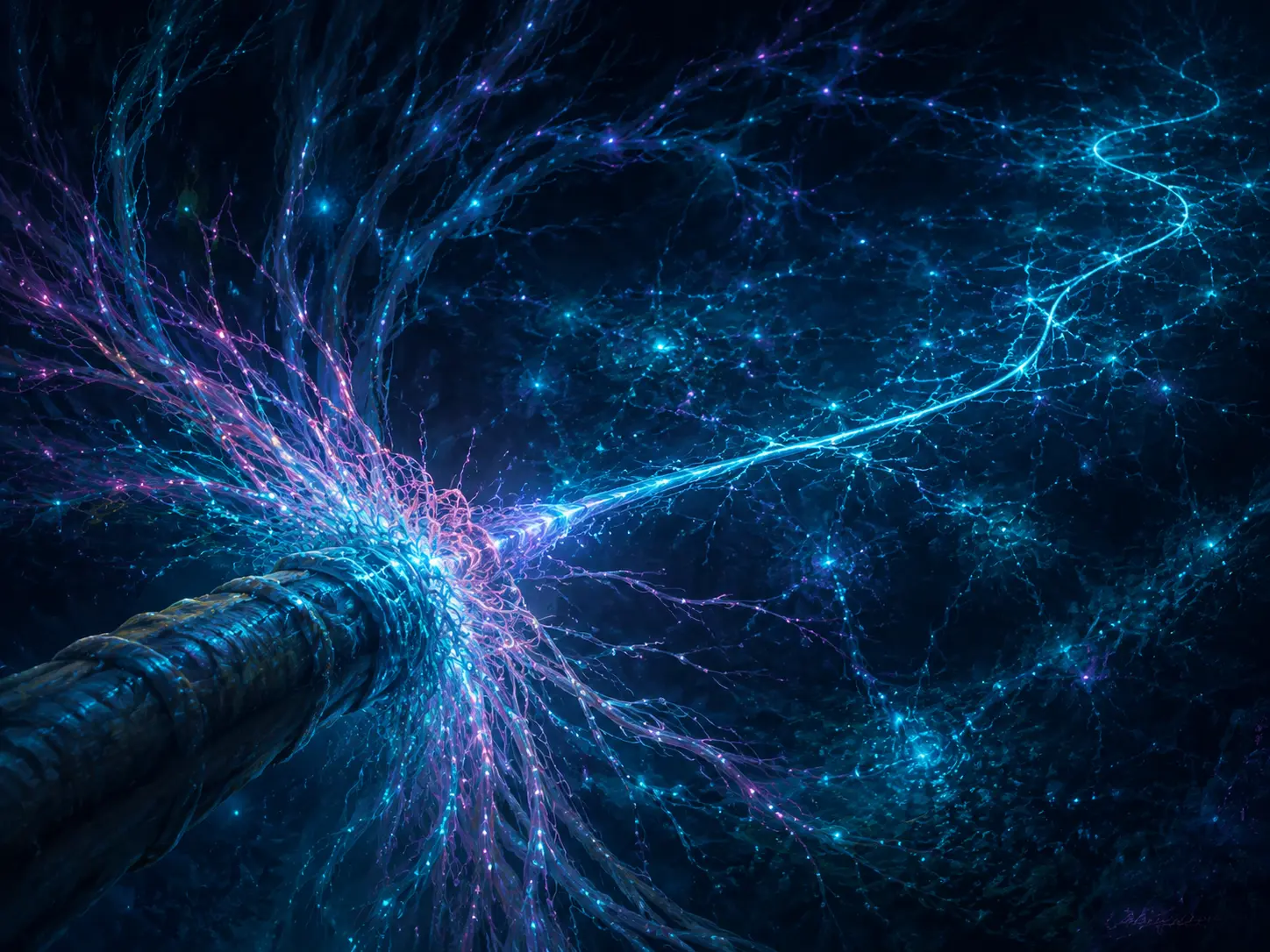
There is a gesture that happens over and over in the Avatar films, so gracefully that it is easy to miss what an extraordinary claim it is making. A Na'vi reaches up, takes the end of their queue — the long braided appendage trailing from the back of the skull — and brings it to the matching antenna of a six-legged horse, or a great flying predator, or the glowing tendrils of a sacred tree. The pink filaments inside each tip stir, reach toward each other on their own, and interlace. And then two creatures are joined. The rider feels the animal's heartbeat as if it were their own; the animal feels the rider's intent and obeys it. The Na'vi call this tsaheylu — the bond. Canon, when it gets technical, calls it something less reverent: a neural connection, a living version of a cable plugged into a port.
That is the word that gives this chapter its hook. Cable. Because the instant you describe tsaheylu as a cable, you have smuggled in a whole science without meaning to. A cable is not a mystery. A cable is a channel, and channels obey laws — hard, quantitative, unforgiving laws worked out on Earth in the middle of the twentieth century by a quiet engineer named Claude Shannon. A channel can be measured. It has a capacity, a ceiling on how many bits per second it can carry, set by its bandwidth and its noise, and no amount of wishing moves that ceiling. So if Eywa's planetary web really is wired together by neural cables, then everything that crosses those cables — a command to a banshee, an ancestor's voice, and, at the absolute limit, a complete human soul — is information moving through a channel, and every bit of it is answerable to Shannon.
The previous two chapters circled the network from the outside. V.1 — What Eywa Is asked whether Eywa is a mind. V.2 — The Wood-Wide Web Revisited asked what the wiring is physically made of, and found the answer in fungus and root. This chapter asks the coldest question of the three, the engineer's question, the one that turns awe into arithmetic: how much information actually crosses the bond, and how fast can it cross? And it carries that question all the way to the most audacious thing the films ever show — the night the Na'vi try to move a dying woman's entire consciousness through a tree — and asks, with a straight face and a calculator, whether the numbers could possibly work.
What actually crosses the bond
Before we can weigh anything, we have to be precise about what canon claims is moving. Tsaheylu is not one feat repeated; it is a ladder of increasingly outrageous transfers, and the rungs are worth separating because they demand wildly different amounts of bandwidth.
The lowest rung is the everyday animal bond, and canon describes it in physical, almost clinical terms. The queue's braid is sheath for what the supplementary lore calls a "neural whip" — a mass of fine, writhing, intensely sensitive tendrils that are direct extensions of the creature's own nervous system. When two of them interlock, nerve meets nerve, and the channel that opens is explicitly two-way: command flows out, sensation flows back. Grace Augustine, the films' resident scientist, is blunt about the substrate of the whole network. There is, she says, "some kind of electrochemical communication" running through it — the same broad currency a brain runs on, ions and voltages, not magic.
The middle rung is stranger. When a Na'vi bonds not to an animal but to the Tree of Voices or the Tree of Souls, they do not steer anything. They listen. They hear the recorded voices of ancestors long dead; they retrieve memory that is not their own. Grace, again, reaches for the language of computing without apology: at these sites, she says, the Na'vi can "upload and download data — memories." The network is, in her framing, not just a telephone line but an archive — a planetary store of the recorded experience of everyone who ever lived and bonded with it.
What we think we know is that there's some kind of electrochemical communication between the roots of the trees... they can upload and download data — memories — at sites like the one you just destroyed.
And then there is the top rung, the one everything else in this chapter is really about. At the Tree of Souls, in the most sacred ceremony the Na'vi have, the network attempts something no telephone line and no archive should be able to do. It tries to move a self.
Riding as a data link
Start at the bottom of the ladder, because the bottom rung is where the science is kindest to the fiction. When Jake Sully first bonds with a direhorse, Neytiri does not hand him a manual of muscle commands. She tells him to feel: "Feel her heartbeat. Feel her breath. Feel her strong legs." And to command, she tells him to intend: he is to tell the animal what to do "inside," from the mind, without rein or word. Later, fighting to control a banshee in the air, the instruction is even simpler. Think "fly."
That single detail — think "fly" — is the most important piece of engineering in the whole animal bond, and it is easy to read right past it. Because notice what the rider is not doing. They are not transmitting the firing pattern for every muscle in a banshee's wing, beat by beat, microsecond by microsecond. That would be a torrential flood of data — millions of channels of motor telemetry, the kind of bandwidth no biological cable could dream of carrying in real time. Instead the rider sends a single high-level intention — fly, climb, turn — and the animal's own nervous system, its own lower brain and spinal cord, unpacks that compressed command into the thousand coordinated muscle movements that actually lift it into the air.
This matters enormously for our budget, because it means the animal bond is cheap. The outgoing command stream — abstract intent — is trivial, a handful of bits. The incoming sensory feed is richer; feeling an animal's body from the inside is real information, and we will see it still fits comfortably inside what a single biological nerve can carry. The everyday miracle of riding a banshee, the thing that looks most like fantasy, turns out to be the rung most at peace with Earth's physics. It is the top of the ladder, the night at the Tree of Souls, that is going to make the numbers scream. To see why, we have to leave Pandora for a moment and meet the man who taught the world how to weigh a thought.
What a bit really is
In 1948, in a paper published in a telephone-company journal, Claude Shannon did something that sounds impossible until you see how he pulled it off: he found a way to measure information itself — to put a number on it, in a unit, the way we put a number on length or mass. Before Shannon, "information" was a vague, almost literary idea. After him, it was a physical quantity with an unbreakable accounting. His paper, "A Mathematical Theory of Communication," is one of those rare documents that founds an entire science in a single stroke, and very nearly everything in your digital life — every file, every stream, every bar of signal on a phone — runs on the machinery he built in it.
His first and deepest move was to throw away meaning. This feels like vandalism the first time you hear it. Surely the whole point of a message is what it means? But Shannon saw that meaning is the engineer's enemy, because it cannot be measured. So he redefined information as something colder and countable: information is the resolution of uncertainty. A message carries information precisely to the degree that it tells you something you could not have predicted. If I promise to send you a letter that will certainly say "yes," the letter, when it arrives, tells you nothing — you knew already. Information lives entirely in surprise.
From that single idea falls the unit that now rules the world: the bit. One bit is the amount of information needed to settle one perfectly balanced either/or — a single fair coin-flip, a clean yes-or-no. Two bits settle a choice among four equally likely things; ten bits, a choice among 1,024; and so on, each bit doubling the number of possibilities it can pin down. The amount of information in a source is, in Shannon's framework, the average number of these yes/no questions you would have to ask to nail down its message. He gave that average a name borrowed from physics — entropy — and a formula, but the formula matters less than the intuition behind it: a predictable source carries little information per symbol, an unpredictable one carries a lot. English text, for all its hundred-odd keyboard characters, is so riddled with redundancy and pattern that each letter carries only about one bit of genuine information. The rest is predictable filler — which, as we will see, is not waste at all, but the very thing that lets a message survive a noisy world.
Shannon then drew the picture every communications engineer now carries in their head. Any act of communication, he said, is the same five-part machine. An information source produces a message. A transmitter encodes it into a signal. The signal crosses a channel. A receiver decodes it back into a message. And it arrives at a destination. Lurking over the channel is the villain of the whole story — noise: the random corruption, the static, the thermal jitter that every real physical medium inflicts on every signal that crosses it. Map tsaheylu onto that machine and it fits with almost unsettling ease.
The mind of the rider is the information source. The machinery at the base of the queue, converting thought into electrochemical pulses, is the transmitter. The interlaced neural tendrils are the channel. The banshee's nervous system, or the root-system of the Tree of Souls, is the receiver. And noise is there too, inescapably — because a warm, wet, living biological cable is one of the noisiest channels imaginable, awash in thermal jitter and chemical cross-talk. That last fact is going to matter more than any other when we reach the soul.
The speed limit nobody can break
Shannon's masterpiece was not the bit. It was a theorem about the channel — a single equation that places an absolute, physical ceiling on how fast information can cross any medium, and proves that the ceiling cannot be beaten by any trick, any technology, any expenditure of effort. It is called the Shannon–Hartley theorem, and in a chapter full of awe it is the one piece of hard law worth stating exactly:
Two brutal lessons live inside that little equation, and both come back to bite Pandora. The first: capacity grows only with the logarithm of the signal-to-noise ratio. Logarithms are the mathematics of diminishing returns. To double your data rate by brute force — by shouting louder — you do not double your power; you must square the signal-to-noise ratio, pouring in exponentially more energy for each additional increment of speed. Raw power is an almost useless lever. The second lesson is the one that names this chapter: capacity grows linearly with bandwidth. Bandwidth is the precious resource, the true measure of a channel's worth. A copper phone line has a bandwidth of a few thousand hertz and can carry tens of kilobits a second. A fibre-optic strand has bandwidth in the terahertz and carries terabits. The difference between a trickle and a torrent is, almost entirely, bandwidth.
And Shannon proved one more thing, the cruelest and most beautiful result of all — the noisy-channel coding theorem. As long as you transmit below the channel's capacity, you can — with clever enough encoding — drive your error rate as close to zero as you like. Perfect, lossless communication over an imperfect, noisy channel is genuinely possible. But the instant you try to push faster than capacity, the guarantee shatters. Errors become not unlikely but mathematically certain. The data corrupts, and no amount of cleverness can save it. This is not an engineering inconvenience to be designed around. It is a law, as firm as the speed of light, and we are about to hold a dying woman's soul up against it.
The cost of a perfect copy
There is a quiet assumption buried in the Tree of Souls ceremony, and it is the assumption that breaks budgets. When the Na'vi move Grace's consciousness, or permanently transfer Jake's, the transfer must be perfect. A soul copied with errors is not a soul. Drop a few thousand bits and you have not slightly degraded the person — you may have erased a childhood, scrambled a personality, corrupted the very thing the ritual exists to save. The maximum-payload event on Pandora is also the one event that can tolerate zero loss. And it is being attempted across the noisiest kind of channel there is.
Shannon tells us exactly what perfection costs on a noisy line, and the answer is: redundancy. To beat noise, you cannot simply send the message; you must send extra, carefully structured bits alongside it — error-correcting codes — so that the receiver can detect corruption and mathematically reconstruct what was damaged. This is the same trick that lets a scratched disc still play, that lets a spacecraft billions of kilometres away send back a clean photograph through a sea of cosmic static. Real neural systems appear to do it too: there is active research suggesting the brain's own circuits use redundancy as a kind of biological error-correction, spending neurons to buy reliability against the constant noise of wet biology.
So the true cost of the consciousness transfer is not just the size of a mind. It is the size of a mind, plus the enormous overhead of guaranteeing that not one critical bit of it is lost in transit across the worst kind of cable for the job. We now have both halves of the engineer's question framed. We know the channel obeys C = B · log₂(1 + S/N), and that perfection on a noisy line is taxed heavily in redundancy. All that remains is the payload. How many bits, exactly, is a human being?
How many bits is a mind?
Here the inquiry splits in two, and the whole question of whether the Tree of Souls ceremony is impossible or merely extravagant turns on which fork you take. There are two utterly different ways to measure the size of a human mind, and they disagree by a factor of more than a million.
The first way is to count the hardware. A human brain holds something on the order of a hundred trillion synapses, each a connection whose strength is a piece of stored information. If a mind is the complete state of that wiring — every synapse, every weight, the full connectome — then copying it means copying all of it. The popular figure that floats around for this is about 2.5 petabytes: two and a half million gigabytes, the brain-as-hard-drive number. Treat it with suspicion — the brain does not store discrete files, and any "the mind is X bytes" claim papers over deep uncertainty about what is even being counted — but as an upper bound on the raw hardware state, the petabyte scale is the figure to beat.
The second way is to measure not the hardware but the experience — the actual rate at which conscious thought flows. And here the science delivers one of its great humbling surprises. Your senses pour something like eleven million bits per second into your nervous system; the eyes alone account for most of it. But the amount that reaches conscious awareness — the bandwidth of the self that thinks, decides, and remembers being you — has been estimated, by classic psychophysics, at a mere ten to fifty bits per second. Slower than a 1980s modem. The psychologist's name for the gap is the conscious bottleneck, and the philosopher Tor Nørretranders called the result "the user illusion": the brain ruthlessly compresses a firehose of raw sensation down to a thin, abstract trickle of meaning, throwing away all but the gist, and that trickle is what you experience as your mind.
The connectome reading
A mind is its hardware: every synapse, every weight, the full wiring diagram.
To copy it, you copy everything — on the order of 2.5 petabytes, the brain-as-hard-drive number.
This is the maximalist payload. It is the figure that makes the ceremony sound impossible.
The conscious-stream reading
A mind is the experience — the thin trickle of thought that reaches awareness.
That stream runs at just 10–50 bits per second: a lifetime of conscious selfhood is only tens of gigabits.
This is the minimalist payload. It is the figure that makes the ceremony almost reasonable.
The gap between these two readings is the gap between the impossible and the merely astonishing, and we are about to run both numbers against the cable.
The conscious bottleneck
Eleven million bits in; a few dozen bits of self out
Before we do, take the equation out for a drive yourself. The figure below is Shannon's channel-capacity law made playable: set the bandwidth of a channel and its signal-to-noise ratio, choose a payload — a spoken word, a photograph, a whole connectome — and watch how long the transfer takes. Push the sliders and feel the two lessons in your hands: how bandwidth moves the answer in great linear strides, and how raw signal power barely nudges it at all.
Shannon's channel, made playable
C = B · log₂(1 + S/N)
Payload to send
The real cable's specs
So what are the specs of the cable the Na'vi are actually using? Canon is unambiguous on the one point that matters most: the connection is electrochemical. Grace says so, and the queue's interlocking neural tendrils behave like nerve tissue. That single word is a hard constraint, because we know exactly how fast electrochemical signalling goes, and it is nothing like the speed of light down a wire.
A nerve impulse is not electricity flowing through copper at nearly three hundred thousand kilometres a second. It is a slow chemical cascade, ions pumping across a membrane, regenerating itself step by step along the axon. The fastest, fattest, most heavily insulated nerves in your body — the ones built for emergency reflexes — manage perhaps a hundred and twenty metres per second. The bare, slow ones crawl at one metre per second, walking pace. This is the conduction velocity ceiling, and it is set by chemistry, not engineering. No biological cable escapes it.
That ceiling has a consequence the capacity equation never mentions. Bandwidth decides how much crosses a link; conduction speed decides how much of the planet is even within reach of an answer. Pick a deadline — a reflex, a day, a season — and the moon divides into regions that can coordinate inside it and regions that cannot, and the second kind might as well be separate worlds.
How much of a moon can answer in time?
Capacity says how much crosses. Latency says how much of the planet is even in reach.
Electrochemical signalling spans about 1 m/s in bare fibres to 120 m/s in the fattest insulated ones. Nothing biological is known to go faster, so the whole slider is the real envelope.
But raw speed is latency, not bandwidth — and the more useful question is how many bits a biological cable can actually carry per second. For that we have a gorgeous real measurement. The human optic nerve — a million-odd fibres bundling the eye's output to the brain, one of the highest-bandwidth data links in all of biology — has been clocked at roughly ten million bits per second. The speed of an early home ethernet cable, running down the back of your eye. That is what a million parallel nerve fibres, honed by hundreds of millions of years of evolution for raw throughput, can do.
Optic nerve
~10 Mb/s
A million nerve fibres — biology's best data link
Nerve signal speed
~120 m/s
Top electrochemical speed; light is millions of times faster
Fibre-optic cable
terabits/s
The artificial channel, for scale
Conscious thought
10–50 b/s
The thin trickle that is your experienced self
The Na'vi queue is plainly a more serious piece of hardware than a single optic nerve — community references put its dense mass at tens of thousands of neural tendrils. Be generous, wildly generous. Suppose the kuru runs a hundred optic nerves in parallel, every one of them flawless. That puts the absolute ceiling of the tsaheylu channel at roughly one gigabit per second — a good home broadband connection. Hold that number; it is the cable we must push every payload through. And now we can finally do the arithmetic the whole chapter has been walking toward.
The transfer, recalculated
Take the connectome reading first — the maximalist one, the mind as 2.5 petabytes of synaptic hardware. Push 2.5 petabytes through a channel running at a generous gigabit per second and the transfer takes a little over two hundred days — and that is before you spend a single bit on the error-correction that a lossless soul-copy demands. Add the redundancy tax and you are looking at well over a year of continuous, flawless transmission to move one mind. The Tree of Souls ceremony lasts a single night. Under the connectome reading, the canon is not exaggerated; it is off by a factor of hundreds. It is, flatly, impossible.
But run the other number. If what crosses the bond is not the hardware but the conscious stream — the thin trickle that is the experienced self — the budget collapses by a factor of a million. A lifetime of conscious experience at fifty bits a second, lived across thirty or forty years, comes to something on the order of forty to fifty gigabits. Triple it for heavy error-correction, round up generously for everything the simple estimate misses, and call the whole soul a few hundred gigabits. Push that through the same gigabit-per-second cable and the transfer takes a few minutes to a few hours.
That is the quiet gift the engineer's calculus hands back to the storyteller. Read literally, as a download of every synapse, the consciousness transfer shatters against Shannon's wall. But read as the transfer of the narrow, compressed, high-meaning stream that the conscious self actually is — the gist, not the gigabytes — it fits, with room to spare, inside one night's bandwidth. And that is not a cheat. It is the same trick your own brain runs every waking second, throwing away the firehose and keeping the meaning. The Na'vi ceremony, read this way, is not moving a hard drive. It is moving the user illusion — and the user illusion was always small enough to send.
Which returns us, finally, to Grace's speech and the awe in it. V.2 — The Wood-Wide Web Revisited has already shown why the connection count she reached for is the wrong thing to be awed by — the wiring is glacial. This chapter adds the other half of the reckoning, and it is the more surprising half: even a slow cable can carry a self, because a self is a far smaller payload than it feels like from the inside. The real wonder of tsaheylu is not that it connects everything. It is that, across a warm and noisy biological cable, working strictly within laws that Claude Shannon wrote down on Earth in 1948, it manages to carry the one payload that matters — a self — small enough and clean enough to arrive whole.
The bond, it turns out, obeys the same law as a telephone line and a fibre-optic strand and the nerve behind your own eye: bits, bounded by bandwidth and noise. That much is true on Pandora and true under your own skull. What canon adds — a cable fast and clean enough to carry a soul across in a night — is the one sentence the physics cannot yet sign off on, unless the soul being carried is the small, compressed, experienced self rather than the vast machine that produces it. Read it that way, and the most mystical event in all of Pandora becomes a clean problem in information theory, with an answer that is almost — almost — reasonable.
What stays open
Information theory measures how many bits cross the channel, not whether the original survives. A lossless copy of a mind, by definition, leaves the original intact — yet canon has the source body die and a single self continue. Whether tsaheylu moves a consciousness or duplicates it is a question about identity, not bandwidth, and a later chapter on uploaded minds takes it up directly. The bits cross either way; what the bits *are* once they arrive is the deeper mystery.
Even granting the conscious-stream reading and a gigabit cable, no canon explains the codec — how a living pattern of neural activity is serialised into a signal, carried, and reconstructed in a new brain without the receiving substrate already having to be a near-copy of the sender. Earth has no such encoder for minds, not even in theory. The bandwidth math says the payload could fit; it says nothing about how you would ever format it.
Electrochemical signalling crawls, and a moon-spanning network would take days to pass a signal end to end. A self buffered inside Eywa between bodies might therefore think in geological slow-motion, or not continuously at all. Whether 'being with Eywa' is a lived, present experience or a frozen archive awaiting download is left entirely open — and the answer turns on latency, the one specification canon never gives.