

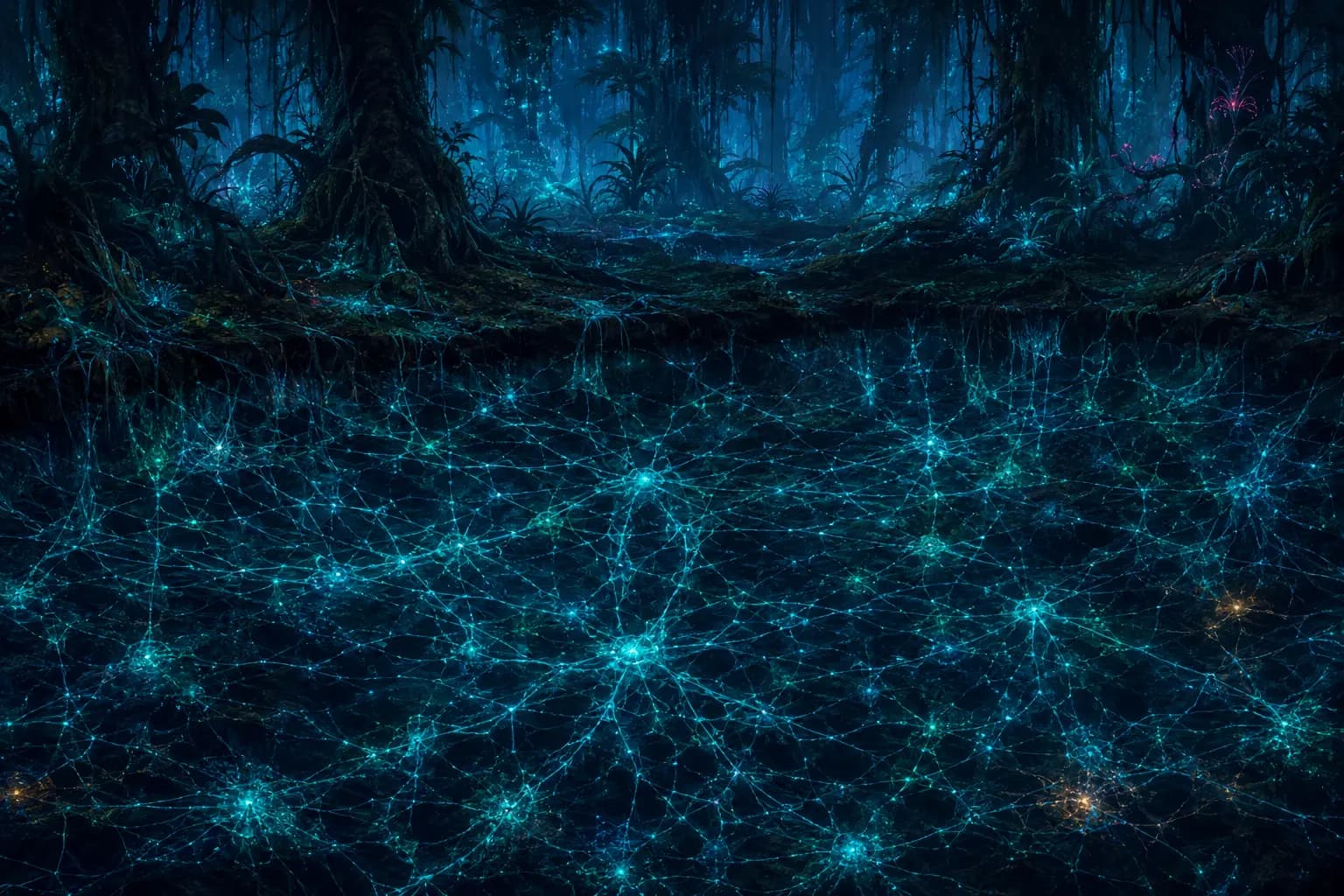
There is a moment near the end of the 2154 war for Pandora when the forest itself seems to take a side. The Na'vi are losing. Their charge has broken against the RDA's armour and air power, and the battle is all but decided — and then the wildlife arrives. Not a few startled animals fleeing the noise, but the whole biosphere turning at once: hammerhead titanotheres and thanators bursting from the treeline, viperwolves pouring through the smoke, banshees stooping in formation, every large animal on the plain abandoning its ordinary behaviour to fall on the human line together. Neytiri, who moments before had told Jake that Eywa does not take sides, she only protects the balance of life, watches the impossible coordination and changes her mind in four words: Eywa has heard you.
It is one of the most quietly staggering sequences in either film, and almost everyone reads it the same way: the planet's goddess, moved by Jake's plea, reached down and chose. That reading is satisfying and it may even be what the Na'vi believe. But it smuggles in an enormous assumption — that the coordination we just watched required a mind to produce it, a central self that weighed the situation and decided to act. And that assumption is exactly the thing worth interrogating, because it sits on top of one of the deepest unsettled questions in all of science. When a vast network of simple parts produces behaviour that looks intelligent, looks purposeful, looks chosen — has a mind appeared? Or is something else going on, something that can counterfeit choice so perfectly that the difference stops being visible from the outside?
This chapter is about Eywa, and the honest answer to what Eywa is turns out to be the most interesting science the moon has to offer. To get there we have to do something the Na'vi never would and the RDA never quite managed: set the theology aside, set the awe aside, and read Eywa the way you would read any unfamiliar system — as a specimen, asking not is it sacred? but what is it actually doing, and what would it take to do that?
Two readings of the same forest
Within the canon, Eywa comes to us already split in two, described in two incompatible vocabularies by two sets of people who never agree.
To the Na'vi, Eywa is the All-Mother — a guiding, globally present force that keeps the balance of life. She is not a tyrant-god who issues commands so much as a regulator who maintains an equilibrium, and the Na'vi's whole relationship to her is one of reverence and tending. Neytiri's line is the clearest canonical statement of the theological reading: Eywa does not take sides. She protects the balance, full stop, even when her own worshippers are the ones losing.
To Dr. Grace Augustine and her science team, that same Eywa is something else entirely: a planet-wide biological network. Grace is blunt about it. What the Na'vi worship, she argues, is a measurable physical infrastructure — an electrochemical communication running between the roots of the trees, like the synapses between neurons. And she puts numbers on it that have become the single most quoted fact about the whole system. Each tree, she says, has on the order of ten thousand connections to the trees around it; there are some ten-to-the-twelfth trees on Pandora; and the product — more than ten-to-the-sixteenth connections — is, in her words, more connections than the human brain.
The theological reading
The biological reading
Hold onto Grace's number, because the whole chapter turns on it. The instinct behind it is intuitive and almost universal: that many connections, surely, must add up to a mind. It is the same instinct that makes us uneasy about large language models, the same one that made people wonder whether the global internet might one day "wake up." More parts, more links, more complexity — at some point, the feeling goes, the lights must come on. Grace looks at a connection count that dwarfs the human brain's and concludes there must be a global mind on the other end of it.
The trouble is that this instinct, as comforting as it is, is one of the most reliable errors in the science of cognition. Raw connection count is almost the wrong thing to measure. And the gap between what Grace assumes and what the connections actually buy you is precisely where the real science of this chapter lives — the science of how networks of mindless parts can think, when "thinking" stops and something we'd call a mind begins, and why those two thresholds are nowhere near each other.
Intelligence without a brain
Start with the half of the question that is not mysterious at all, because Earth settles it decisively: a network of simple parts, with no brain and no central controller, can absolutely produce adaptive, problem-solving, goal-looking behaviour. This is not speculation or a fringe claim. It is one of the best-established results in biology, and once you have seen it a few times the wildlife stampede on Pandora stops looking like a miracle and starts looking like a category of thing we already understand.
Take a honeybee swarm choosing a new home. When a colony outgrows its hive, ten thousand bees cluster on a branch while a few hundred scouts fly out to hunt for cavities. Each scout that finds a candidate comes back and dances — a waggle dance that encodes the direction and distance of her find, and she dances longer and harder the better the site is. Other scouts read the dance, fly out to inspect, and if they agree, come back and dance for the same site. Here is the crucial part, the part Thomas Seeley spent decades pinning down: no bee compares all the options. No bee holds a map. The queen has nothing to do with it. Instead, scouts at each candidate site monitor how crowded it is getting with other scouts, and once the number at one site crosses a threshold — a quorum — those scouts switch from dancing to a piping signal that shuts the other dances down and triggers the whole swarm to launch. The colony reliably picks the best available cavity. It makes a genuinely good decision. And there is no decider anywhere in the system — only thousands of bees each following a few local rules about dancing, inspecting, and counting their neighbours.
Swarm intelligence is the name for this, and the bees are only the cleanest demonstration. The same principle — global competence assembled out of local rules — turns up wherever you look closely at a colony. Ants find the shortest path to food not because any ant knows the route but because pheromone trails on shorter paths get reinforced faster. Termites build cathedral mounds, metres tall, threaded with ventilation shafts that hold the colony's temperature steady, and they do it with no architect and no plan. Each worker just deposits a pellet of mud where the local chemical and physical cues tell it to, and the cues left by earlier pellets steer the later ones. The structure builds itself out of the builders' reactions to what previous builders left behind.
Stigmergy is the technical word for that last trick — coordination through traces left in the environment rather than direct communication — and it matters here because it shows how a system can pursue a long, complex, structured goal with no memory of the goal and no representation of it anywhere. The plan isn't in any termite's head. The plan isn't anywhere. It is smeared across the half-built mound itself, and the mound finishes itself by being what it is. Memory and computation get offloaded into the world.
The headline case, though — the one that should permanently dislodge any link between "brainless" and "stupid" — is a single-celled slime mould called Physarum polycephalum. It has no neurons. It has no brain. It is, structurally, one enormous cell with many nuclei, a sprawling yellow network that creeps over damp surfaces eating bacteria. And in a now-famous experiment, Japanese researchers laid out oat flakes on a wet plate in the exact geographic pattern of the cities around Tokyo, placed the slime mould on the spot marking Tokyo itself, and let it forage. Within a day the mould had spread to engulf every oat. Then, over the following days, it did something that looks impossible for a thing with no nervous system: it pruned. It withdrew from the redundant connections and reinforced the efficient ones, until the network of living tubes it left behind reproduced — in layout, in efficiency, in fault-tolerance — the Tokyo rail system that human engineers had spent decades optimising.
The slime mould "solved" a hard network-design problem using nothing but local feedback: tubes carrying more flow get thicker, tubes carrying less wither, and that one rule, applied everywhere at once, converges on a near-optimal map. No intent. No plan. No mind. Just physics and feedback grinding out an answer that looks for all the world like the product of careful thought.
More is different
There is a name for what is happening when bees and ants and slime moulds produce competence no single part possesses, and it is one of the most important ideas in all of complexity science. In 1972 the physicist Philip Anderson wrote a short, combative essay called More Is Different, arguing against the seductive assumption that once you understand the parts you understand the whole. You can know everything about a single water molecule, Anderson pointed out, and never predict the wetness of an ocean. You can know everything about one neuron and never predict a memory. At each jump in scale, genuinely new properties appear — properties that belong to the arrangement, not to the pieces. This is emergence, and it is the engine behind every "the whole is more than the sum of its parts" you have ever heard.
But emergence comes in two grades, and the difference between them is the hinge of this whole chapter. Philosophers separate weak emergence from strong emergence, and the line between them is exactly the line between a network that behaves like a mind and a network that is one.
Weak emergence is the ordinary, well-behaved kind. The macro-behaviour is surprising — you would never have guessed it from the parts — but it is fully derivable from the local rules if you bother to work them out or simulate them. The Tokyo-rail slime mould is weakly emergent: astonishing to watch, completely explained by "thick tubes where flow is high." A flock of starlings wheeling in the dusk is weakly emergent; so is a traffic jam, so is a snowflake, so is the bee swarm's good decision. Nothing in any of them violates or transcends the local rules. The wonder is real and the mechanism is mundane, and those two facts are perfectly compatible.
Strong emergence is the contested, philosophically explosive kind. It claims the whole acquires genuinely new causal powers that cannot be reduced to the parts — that the higher level reaches back down and pushes the lower level around in ways the lower-level rules alone could never produce. The standard candidate for strong emergence, and arguably the only serious one, is human subjective consciousness: the raw fact that there is something it is like to be you, an inner experience that many thinkers argue cannot be fully captured by any description of neurons firing. Whether strong emergence is even real is genuinely unsettled — plenty of serious scientists think the category is incoherent. But that is the point. Strong emergence is the steep wall, the thing we are not sure exists at all.
And here is why that distinction decides the Eywa question. To produce a coordinated continent-wide defensive response, a root network needs only weak emergence: local chemical and electrical rules, cascading, producing a global pattern that looks purposeful — exactly the slime mould, scaled up. To be a mind, to genuinely experience and choose, the network would need to clear the wall of strong emergence, to have an irreducible inner perspective that the firing of its parts cannot account for. Those are not two points on one scale. They are different kinds of thing, and a system can be drowning in the first while possessing none of the second. The wildlife stampede is firmly, unspectacularly weak emergence. Whether anything more is present is the question raw connection counts can never answer — which brings us back to Grace's number.
Bigger is not a mind
Grace Augustine looked at more connections than a human brain and inferred a global mind. This is the most natural mistake in the world, and connectomics — the science of mapping the complete wiring diagrams of nervous systems — has a clean, almost cruel way of showing why it is a mistake. The rebuttal lives inside your own skull.
Your brain has about 86 billion neurons. They are not distributed the way you would guess. The structure you think with — the cerebral cortex, the wrinkled outer sheet responsible for perception, thought, language, the felt texture of being you — holds only about 16 billion of them. The lion's share, roughly 69 billion neurons, nearly 80 percent of every neuron you own, is packed into the cerebellum, the dense little structure tucked under the back of the brain that coordinates movement and balance.
Now the punchline. People who lose their cerebellum — to stroke, to disease, occasionally to being born without one — are not rendered unconscious. They are not diminished as selves. They suffer real motor problems: clumsy gait, slurred speech, trouble with fine coordination. But their awareness, their personality, their inner life, their consciousness — all intact. Eighty percent of the brain's neurons can be absent and the lights stay on. Whatever consciousness is, the structure holding the overwhelming majority of the brain's "connections" barely contributes to it.
Why? Architecture, not headcount. The cerebellum is wired almost entirely feed-forward: signals pour through it in one direction, get processed, and exit, with very little looping back. It is a magnificent, massive, one-way pipeline. The cortex is the opposite — saturated with recurrent connections, loops that fold back on themselves, regions in constant conversation with each other and with the thalamus, information reverberating and re-entering and binding together. The cerebellum has far more parts; the cortex has far more integration. And it is the integration, the recurrent feedback, that tracks consciousness — not the raw count.
Bigger is not a mind
Raw connection count does not make consciousness — architecture does
This is the direct answer to Grace. Her ten-to-the-sixteenth connections are real, and they are beside the point, because a network of that size built as a diffuse, slow, mostly feed-forward mesh — which is exactly what root-to-root chemical and electrical signalling through soil and mycelia would be — could have a connection count that dwarfs any brain and still integrate information no better than a sprawling pipeline. The internet has more transistors than your brain has synapses and nobody worries it is brooding. A bigger network is not automatically a smarter one, and it is nowhere near automatically a conscious one. The number that awed Grace is the wrong number to be awed by.
Where the line actually sits
If connection count is the wrong measure, what is the right one? This is where the science gets genuinely hard, because measuring consciousness from the outside is one of the open frontiers of neuroscience, and there is no settled answer. But there are two serious frameworks, and both of them, applied to Eywa, point the same way.
The first is Integrated Information Theory, or IIT, developed by the neuroscientist Giulio Tononi. Its central claim is radical: consciousness just is integrated information, a quantity the theory labels Φ (phi). A system has high Φ when it is both richly differentiated — able to be in a great many distinct states — and richly integrated, meaning the information it holds genuinely belongs to the whole and cannot be cleanly carved into independent parts. Crucially, IIT says a purely feed-forward network has a Φ of zero, no matter how large or behaviourally clever, because feed-forward systems can always be unfolded into independent chains. Only recurrent, irreducible, looping causal structure generates Φ. By IIT's lights, the cerebellum's near-irrelevance to consciousness is not a puzzle but a prediction.
I should be honest that IIT is fiercely contested — in 2023 a large group of researchers publicly branded it unfalsifiable, even "pseudoscience," and the calculation of Φ for any real system is so intractable it can rarely be done at all. But its core intuition, the one that survives the controversy, is exactly the lesson of the cerebellum: integration, not size, and recurrence, not raw connectivity. On that measure a slow, diffuse, planet-spanning root mesh — whatever its connection count — is a poor candidate for high Φ. It might harbour pockets of dense local integration, the way the Tree of Souls seems to be a hub. But a single, unified, planet-wide subjective Φ, welded together across continents of sluggish chemical signalling? The architecture argues against it.
The second framework is Global Workspace Theory, or GWT, associated with Bernard Baars and Stanislas Dehaene, and it sidesteps the maths entirely by asking about architecture. In GWT the brain is a crowd of specialised, unconscious local processors — vision, memory, motion, all churning away in parallel and in the dark. A contents becomes conscious at the moment it is selected and broadcast across a shared "global workspace," made available to every processor at once. Dehaene calls the neural signature of this broadcast "ignition": a sudden, system-wide flare of synchronised activity that lights up distant regions together. No global workspace, no ignition, no unified conscious moment — just a heap of isolated routines doing their jobs.
Ask whether Eywa has a global workspace and the canon is quietly damning. There is no sign of a dedicated, high-speed, planet-spanning broadcast channel that flares the whole network into a single shared state. What we see instead is local access: to reach a memory, a Na'vi physically plugs into a specific tree at a specific place. The information is there, stored with astonishing fidelity — but it is retrieved point-to-point, like reading a file off a drive, not broadcast in a planet-wide moment of ignition. By GWT's criterion, too, Eywa looks less like one waking mind and more like an immense archive that parts of the network can query.
Put the two frameworks together and you have something better than an opinion about Eywa: you have an instrument. Four checks in series — does the system solve problems nobody told it about, does it loop back on itself irreducibly, does it broadcast one content to the whole of itself, and is there anything it is like to be it — and a signal that travels only as far as the first check the system fails. Before trusting what such a bench says about a planet, calibrate it on cases whose answers we already know. Run the slime mould and the bee swarm through it; they should pass the first check and stall soon after. Run the cerebellum through it: if a test cannot fail the structure holding four-fifths of your neurons, it is counting parts rather than measuring minds. Run the cortex through it, the one specimen that has to clear everything. Only then is it worth asking what the bench reads for Eywa.
Network or mind?
Four checks in series, and five specimens to run through them — including two whose answers we already know
Observed behaviour
Coordinates a continent-wide defence, holds a biosphere's balance for millennia, and stores whole personalities with enough fidelity to replay them. Competence is not in question anywhere in this chapter.
Integrated Information Theory
Grace's connection count is real and beside the point. Root-to-root chemical and bioelectric signalling is slow and diffuse — dense local integration at hubs like the Tree of Souls, no evidence of one fast, irreducible, planet-spanning whole.
Global Workspace Theory
Canon shows point-to-point access: a body plugs into one specific tree to reach one specific memory. That is a query answered off a drive, not a planet flaring into a single shared moment.
The hard problem
Unanswerable, and saying so is the honest result rather than a hedge. Subjective experience cannot be read off behaviour from outside — not for Eywa, and not for anyone else either.
And yet Eywa demonstrably does one thing that looks deeply mind-like: it stores and replays the memories of the dead. Grace's own consciousness is uploaded into the network through the Tree of Souls; in The Way of Water, Kiri communes with the neural echo of her mother, and Jake and Neytiri reach their lost son through the Spirit Tree. The network encodes and returns entire personalities with their memories intact. This is real, and it is the strongest evidence for the "mind" reading — but notice precisely what it proves. It proves Eywa is a superb substrate: a biological server of staggering capacity, able to record and replay the full data of a self. Functionalism — the view that a mind just is what a system does, regardless of what it is made of — would say that a network storing and processing selves this well is doing the work of a mind. But storing a self is not the same as being one. A library holds a thousand voices and hears none of them. The question of whether those stored echoes are experiencing souls or exquisitely detailed recordings is one the films never answer — and one of the genuinely open problems we will come back to.
Reading the climax again
Now go back to the battle, because we can finally read it with the right tools in hand. Jake, desperate, had plugged into the Tree of Souls — the network's densest, most connected hub, its richest single node — and poured in a plea backed by the memories he carried of a dying Earth, a whole biosphere stripped and killed. Then the wildlife turned, and the Na'vi called it Eywa choosing a side at last.
But look at the shape of what happened. A massive, anomalous signal — distress, threat, the chemical and electrical signature of catastrophe — was injected at the most connected point in a planet-spanning network. From there it propagated outward through the root-and-mycelial mesh, raising the alarm in everything it reached. Local populations of animals, wired into the same network, received the rising signal. And once enough of them, in enough places, crossed their own thresholds, the response ignited and swept the whole region — every large animal abandoning its ordinary behaviour to converge on the source of the threat.
That is not a goddess weighing a moral case and deciding to intervene. That is quorum sensing and a stigmergic cascade, scaled to a continent. It is the bee swarm's threshold dynamics and the slime mould's spreading feedback, running on a planetary network instead of a branch or a petri dish. Jake didn't persuade a mind; he tripped an alarm. The biosphere mounted an immune response, the way your body floods a wound with defenders — not because some central self in you decided to care about the cut, but because the local signals crossed the thresholds that release the cascade. An immune system does not "take sides" against a pathogen. It restores equilibrium by reflex. And that, read mechanistically, is exactly what Eywa did.
A network that decides with no decider
Inject a distress signal at the most connected node and watch local thresholds do all the work
Two roused neighbours flip a quiet agent
Here is the part that should give a careful reader pause, though: this mechanistic reading does not demote Eywa. It does the opposite. Read as an immune cascade, Neytiri's theology turns out to be literally correct — Eywa really does not take sides, because an immune system has no sides to take. It does not weigh worshippers against invaders. It detects a disturbance to the balance and moves, reflexively, to neutralise it. The Na'vi happened to be on the same side as the biosphere's homeostasis in that moment; the RDA was the pathogen. "Eywa does not take sides, she only protects the balance of life" is not a pious evasion. It is, more or less, an accurate functional description of a planetary immune response — arrived at by a people who never needed the mechanism to trust the behaviour.
Honest edges
This is a chapter built more on reasoning than on canon, and the discipline of reading Pandora honestly means marking exactly where each claim stands. The Earth science is the firm ground: swarm intelligence and quorum sensing, stigmergy, weak versus strong emergence, the cerebellum's near-irrelevance to consciousness, the architecture-over-size lesson of connectomics, and the two leading frameworks for drawing the line — these are real, cited, and as solid as this difficult corner of science gets, controversies and all.
The canon is firm on a different, smaller set of things: that the Na'vi read Eywa as a balance-keeping All-Mother who does not take sides; that Grace describes a root network with more connections than a human brain; that the network stores and replays the memories of the dead through specific trees; and that the wildlife mounted a coordinated defence at the climax. Those are the load-bearing facts, and the chapter leans only on them.
Everything between the firm science and the firm canon is inference — and it is the bulk of what makes this chapter a reading rather than a recap. That Eywa is best understood as distributed cognition rather than a unified mind; that the wildlife surge is a quorum-driven immune cascade; that the network is a high-capacity substrate with low global integration — these are conclusions reasoned out from canon and physics, and I have tried to flag each one as reasoning when I crossed it. They are sound, but they are arguments, not facts on the screen.
And a few things the canon simply refuses to settle, which we leave open rather than paper over: whether the stored dead are experiencing souls or perfect recordings; whether slow chemical signalling could ever integrate fast enough for any genuine planet-wide unity; and the deepest one, unanswerable from the outside for Eywa exactly as it is for the person sitting next to you — whether, behind all that competence, there is anything it is like to be Eywa at all.
What Eywa is
So: what is Eywa? Strip away the theology and the awe, read the specimen on its own terms, and what stands revealed is not smaller than the goddess of the Na'vi but stranger and, in its way, more profound. Eywa is the most complete realisation imaginable of distributed cognition — a planet running the same tricks as the bee swarm and the slime mould and the termite mound, scaled until they span a world. It stores selves with the fidelity of an archive. It defends itself with the reflexive ferocity of an immune system. It keeps the balance of an entire biosphere through feedback loops too vast and too slow to feel from inside any one of its parts. By every measure we have — integration, recurrence, the global broadcast that lights up a single conscious moment — it shows the signature of overwhelming intelligence and little sign of unified sentience. Eywa, most likely, does not think. Eywa computes.
And that should not disappoint anyone, because it is the better story. A goddess who chooses is a familiar thing; we have been telling that story for as long as we have had gods. A brainless, mindless, planet-wide network that stores the dead, balances a biosphere, and mounts a coordinated defence of itself — all without anyone home to intend any of it — is a genuinely new thing, and a far more vertiginous one. It says that intelligence, memory, and staggering ecological power do not require a mind to wield them; that the appearance of purpose can be manufactured, flawlessly and at planetary scale, by nothing more than a billion simple parts each following its own local rules in the dark.
Neytiri was right, and more right than she knew. Eywa does not take sides. She only protects the balance of life. It turns out that is not a smaller claim than the one the RDA's instruments were reaching for. It is the same claim, read correctly — and the reading is the whole gift Pandora hands a careful observer: that the line between a network and a mind is real, that it is not where our instincts place it, and that you can be standing in front of the most magnificent intelligence in the known universe and still have to ask, honestly, whether anyone is there to know it.
What stays open
Canon is firm that Eywa records and replays whole personalities — Grace's uploaded consciousness, the neural echoes Kiri and Jake commune with. What it never settles is the subjective status of those stored selves: whether they go on experiencing, continuously and self-aware, inside the network, or whether they are exquisitely detailed interactive recordings that respond without anyone being home to feel the responding. The difference is the whole difference between a mind and a library, and the films leave it deliberately unspoken.
Grace's connection count is canon; the timing is not. Root-to-root chemical and bioelectric signalling is inherently slow and diffuse, and the leading frameworks for consciousness demand fast, recurrent, irreducible integration. Whether any architecture of sluggish planet-spanning links could weld itself into one unified subjective moment — rather than a sea of locally integrated pockets — is left entirely open. The honest reading is dense local cognition, not a global self; but the mechanism is never shown.
This is the hard problem, and it is exactly as unanswerable for Eywa as for the person beside you — only louder, because the stakes are a planet. Every external measure we have points to intelligence without unified sentience: high competence, low global integration, no sign of a broadcast workspace. But subjective experience cannot be read off behaviour from the outside, even in principle. We can say with confidence what Eywa *does*. Whether it experiences any of it, we cannot.