
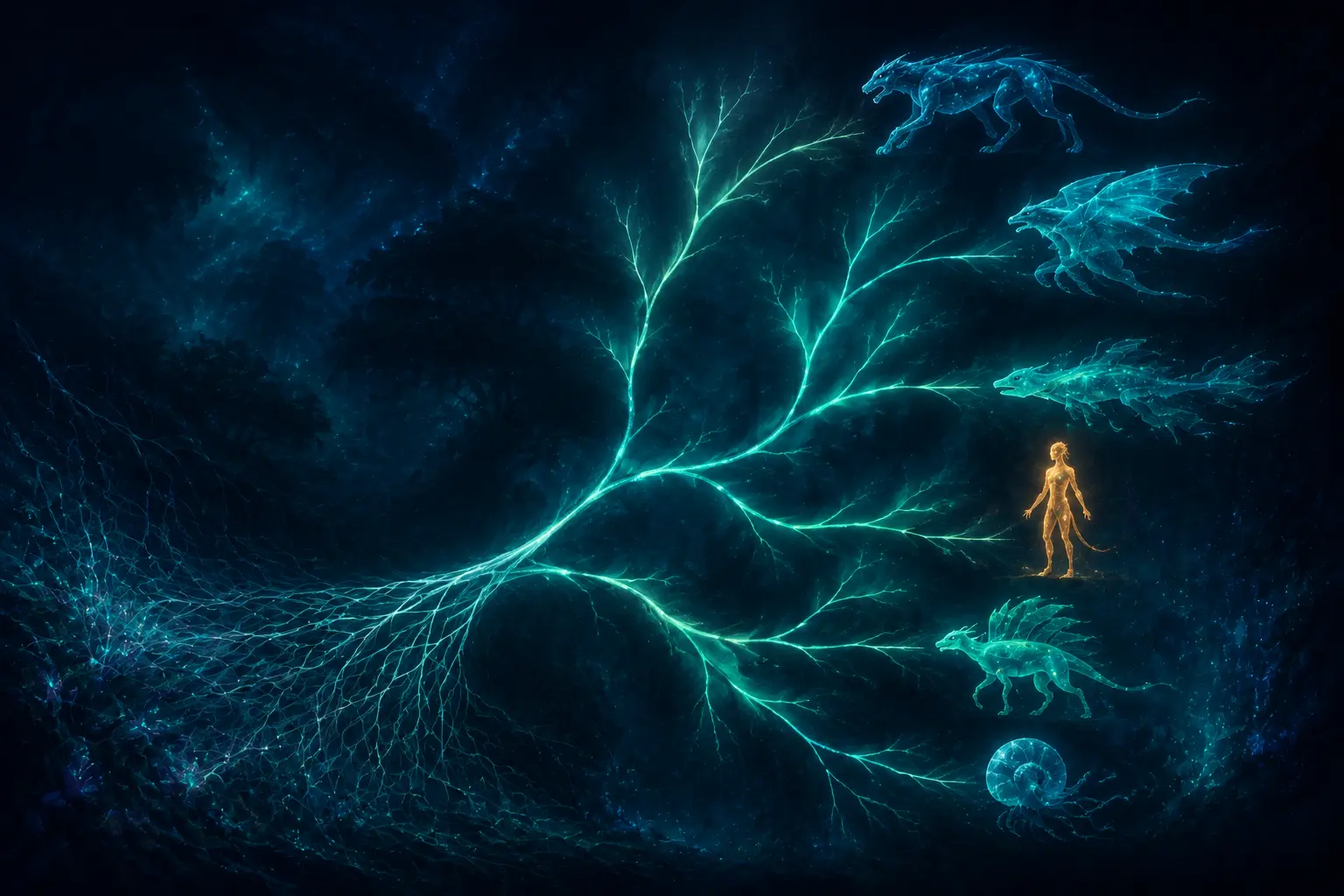
Imagine the bench. A xenobiologist has been handed the better part of a moon's animal kingdom, reduced to its hard parts and laid out under cold light: the great hooked skull of a thanator, a single paddle-flipper from an ilu, a curved slab of tulkun vertebra heavy as a door, and — standing oddly upright among the beasts — the slender, almost human skeleton of a Na'vi. Crates of it. Bone enough to keep a comparative anatomist happy for a decade. And on the corner of the bench, tipped on its side and conspicuously empty, a glass vial of the kind that should hold the one thing she would normally reach for before anything else.
Because on Earth, by now, this is a solved problem. Hand a modern biologist a heap of unknown creatures and her first move is not to measure the bones. It is to sequence them — to read the long chemical text inside their cells, line it up letter against letter, and let the family tree fall out of the differences. DNA is the master document; the bodies are just its handwriting. Take the molecules and the rest is arithmetic.
But Pandora does not file its records in DNA. Canon is blunt and unhelpful on exactly this point: Pandoran life does not use the nucleic acids we know how to read, and not one genome of one Pandoran creature has ever been published. The chemical text is either written in an alphabet we cannot yet sound out, or it is not a text at all. Whatever the truth, the vial stays empty. The biologist at the bench has the entire bestiary and none of its source code.
So here is the question this chapter is built on, and it is a real one, not a contrivance: can she still reconstruct the tree? With no molecules — no sequences, no genomes, no clean letter-by-letter arithmetic — is the family history of Pandoran life simply unknowable, locked away in chemistry we can't open? Or is there another way to read kinship, one that works on bone alone?
The century before sequencing
The reassuring answer is that Earth did exactly this for a hundred years, and did it well. The molecular shortcut is recent — barely older than the people reading this. For the whole long stretch of biology before it, the tree of life was built the hard way, from bodies: from bones and teeth and the branching of blood vessels, from how a jaw hinged and how many holes pierced a skull. Darwin had no sequences. Neither did anyone who classified a living thing before the 1980s. They had specimens on benches, and they got most of it right.
The trick they worked out is the one our xenobiologist needs, and it is deeper than the molecular shortcut that later joined it. It comes down to a single hard-won insight: not all similarity means the same thing. Two creatures can look alike for reasons that have nothing to do with family, and two relatives can look wildly unalike. If you simply sort animals by overall resemblance — putting the things that look similar in one pile — you will get a tidy arrangement that is, as often as not, evolutionary nonsense. The eye has to be taught what kind of similarity is a clue to ancestry and what kind is a trap.
So the question sharpens. It is not really "can we build the tree without DNA." It is: which of the resemblances on this bench tell us who is related to whom — and which are lying to us? Answer that, and the bones will give up the tree. Get it wrong, and the bones will hand you a confident, beautiful, completely false history.
Three kinds of likeness
Lay two creatures side by side and note something they share — six limbs, say, or a streamlined shape, or a forward-facing pair of eyes. That shared feature is evidence of something. The whole art is working out of what.
The first possibility is the one we want: they share the feature because they both inherited it from a common ancestor who had it. This is homology — sameness by descent. The single-boned upper arm you share with a bat and a whale is homologous; all three of you got it from the same long-dead ancestor, and the shared bone is a true thread of kinship you can follow back.
The second possibility is the trap. Two creatures can arrive at the same feature independently, with no shared ancestor handing it down, because the same problem pushed them toward the same answer. This is homoplasy, and its most famous engine is convergent evolution: a dolphin and a shark both arrive at a torpedo body not because they are close kin — they could hardly be further apart — but because fast swimming in water dictates that shape to anything that attempts it. The resemblance is real. As a clue to ancestry, it is poison. Read it as homology and you will file a fish beside a mammal.
This is why "looks similar" is such treacherous ground. Homology and homoplasy produce the same visible sameness; you cannot tell them apart just by looking harder. You need a rule for which similarities to trust.
The rule came from a quiet German entomologist named Willi Hennig, and it reorganised all of biology around a single distinction that sounds like hair-splitting and is in fact the hinge everything turns on. Hennig said: even among the true, inherited, homologous traits, only some are useful for grouping. The others — just as real, just as inherited — actively mislead you. To read a tree you have to sort the inherited traits into the ones that group and the ones that don't.
Hennig's hinge: shared, and newly so
Here is the distinction, in plain terms. Every trait an animal has is, at the moment you look at it, either old or new relative to the group you're studying. An old trait — one inherited from so far back that everyone in the room already has it — Hennig called a plesiomorphy, an ancestral state. A new trait — a change that arose more recently, a departure from the ancestral condition — he called a apomorphy, a derived state.
Now the payoff. A shared ancestral trait — a symplesiomorphy — tells you nothing about who is closely related to whom, because everyone has it. That you and a lizard and a trout all have a backbone does not pick out you and the lizard as special kin; the trout has it too, and so did the common ancestor of all three. Grouping by an ancient shared trait just lumps together everyone who hasn't lost it, which is not a family — it's a leftover.
But a shared derived trait — a synapomorphy, a new feature that arose in one ancestor and was passed only to its descendants — is gold. It is a signature. If two creatures share a derived feature that the rest of the world lacks, the most economical explanation is that they both got it from the one ancestor in whom it first appeared — which makes them kin, to the exclusion of everyone who doesn't carry the mark. Feathers are the textbook case: birds and certain dinosaurs share them, the rest of life does not, and that shared novelty binds birds and theropods into one branch. Find a synapomorphy and you have found a clade.
And there is a third category, the loner. A derived trait unique to a single creature — an autapomorphy — is no help for grouping either, simply because it is shared with no one. The leonopteryx's particular crest tells you that animal is distinctive; it cannot tell you which other animal is its cousin, because no other animal has it. Remember this one. It will reach up and bite us later.
One more tool finishes the kit. To use this rule you must know which state of a trait is old and which is new — and you can't tell just by staring. The fix is the outgroup: pick a creature you already know branched off before the group you're studying, and look at what it has. Whatever the outgroup shows is, by definition, the ancestral condition for your group — the baseline. Anything your creatures have that the outgroup lacks is the novelty, the derived state, the thing worth grouping by. The outgroup is the fixed point that tells you which way is "new."
Which makes the choice of that fixed point the most consequential decision on the bench, and the easiest to make carelessly. Nominate the wrong creature and nothing in the specimens complains; the scores stay exactly as they were, and the method keeps working with perfect confidence in the wrong direction. Try it below — swap the baseline and watch the same unchanged bench hand you a different answer.
The baseline decides which traits are new
Nominate a starting point and re-read the same scores against it
The bench, scored
| Specimen | Limbs | Eyes | Breathing | Queue | Bone |
|---|---|---|---|---|---|
| ▸ Early marine form | Six limbs | Two eyes | Head airway | No queue | Plain mineral |
| Ilu | Six limbs | Four eyes | Head airway | Neural queue | Carbon-threaded |
| Direhorse | Six limbs | Four eyes | Flank intakes | Neural queue | Carbon-threaded |
| Hexapede | Six limbs | Four eyes | Flank intakes | Neural queue | Carbon-threaded |
| Prolemuris | Split forelimbs | Two eyes | Flank intakes | Neural queue | Carbon-threaded |
| Na'vi | Four limbs | Two eyes | Head airway | Neural queue | Carbon-threaded |
Reading the bench
Now the bones can talk. Our xenobiologist does what Hennig taught: she ignores how the creatures feel — how thanator-like or how Na'vi-like — and hunts only for shared novelties. She picks an outgroup, some simple marine creature that branched off near the root of Pandoran life, with unreinforced bone, plain eyes, no neural cabling. That sets her baseline. Then she scores the bestiary for derived traits the outgroup lacks.
Two features leap out, and they are spectacular synapomorphies. The first is the bone itself: nearly every large Pandoran animal has a skeleton shot through with a lattice of natural carbon fibre — light, holey, absurdly strong, and utterly unlike the plain mineral bone of the outgroup. The second is the queue: the bundle of living neural filaments, sheathed in muscle, that lets these animals plug directly into one another and into the moon's network. Neither trait is the kind of thing that gets invented twice by accident. Carbon-threaded bone and a working brain-to-brain cable are far too intricate, too specific, too arbitrary to be convergence. They are signatures — and they are stamped on the thanator and the ilu and the tulkun and the Na'vi alike.
That settles the biggest question on the bench in a single stroke. Every creature carrying those two shared novelties belongs to one branch — one clade, a single ancestor and all its descendants. The whole sprawling bestiary, air and land and sea, is one family. The carbon bone and the queue are the family crest, and almost everything on Pandora wears it.
But which creatures sit where inside that family? This is where the second half of Hennig's method does its work, and where the bench rewards patience. The deeper you look, the more nested the novelties become. The carbon bone and the queue unite everyone. But within that great family, smaller groups share their own extra novelties — and one cluster of those smaller novelties is about to make the most human-looking creature on the bench say something startling about where it belongs.
The most parsimonious story
To choose between competing family trees, the biologist needs a tie-breaker, and it is the same one science uses everywhere: when several explanations fit the facts, prefer the one that asks you to believe the least. Applied to trees, this is the principle of maximum parsimony — a direct descendant of Occam's razor. Of all the possible trees you could draw connecting these creatures, prefer the one that requires the fewest independent evolutionary changes to explain what you see. Every time a tree forces the same feature to evolve twice, or to appear and then vanish, that's an extra cost — an extra coincidence you're asking the world to have paid for. The cheapest tree, the one with the fewest such coincidences, is the best hypothesis.
It works because homoplasy — convergence, reversal, all the misleading sameness — is expensive to a tree. If you draw the family wrongly, you force features to evolve over and over independently to patch up the story, and the bill climbs. Draw it rightly, with each novelty arising just once in the ancestor that first had it, and the bill is small. Parsimony simply reads the bill. The tree that makes the carbon bone and the queue evolve once each, in one shared ancestor, costs almost nothing. Any tree that scatters those traits around, making them spring up independently in lineage after lineage, costs a fortune. So parsimony picks the first, and the whole bestiary collapses into one tidy, low-cost family.
The same logic places the Na'vi — and this is where the bench turns surprising. Take a small, sharp set of traits and lay the Na'vi against their candidate relatives. The Na'vi have the carbon bone and the queue (so: inside the family, no question). They also share a specific bundle of reductions — two eyes instead of the ancestral four, a single queue instead of paired ones, four limbs instead of six — with one particular creature on the bench: the prolemuris, that strange canopy-dweller with the split forearms. Those reductions are derived novelties, and they are shared. By Hennig's rule, that is a synapomorphy binding Na'vi and prolemuris together as close kin, deep inside the Pandoran family, far from anything that looks remotely humanlike.
The interactive below lets you feel parsimony actually choosing. Move the Na'vi to where they look like they belong — out near a human, by overall resemblance — and watch the cost of the tree climb as features are forced to evolve twice. Move them back beside the prolemuris, where their shared novelties point, and the cost drops to its minimum. You are watching the method pick the family.
Character matrix → the most parsimonious tree
Characters × taxa
| Limbs | Eyes | Resp. | Queue | Bone | |
|---|---|---|---|---|---|
| Outgroup | 0 | 1 | 1 | 0 | 0 |
| Ilu | 0 | 0 | 1 | 1 | 1 |
| Direhorse | 0 | 0 | 0 | 1 | 1 |
| Prolemuris | 1 | 1 | 0 | 1 | 1 |
| Na'vi | 2 | 1 | 1 | 1 | 1 |
Evolutionary steps
Fewest steps — carbon-fibre bone and the queue evolve just once
The matrix, scored honestly, comes out strikingly clean — the shared novelties line up with almost no conflict, which is parsimony's way of saying the signal here is strong and the homoplasy low. The biologist doesn't need a number to feel it. The tree practically falls out of the bench: one family, united by carbon bone and queue, with the Na'vi nested deep inside it as the aberrant, much-reduced cousins of an arboreal animal that looks nothing like them. No DNA required. Only the discipline to group by the right kind of likeness.
Earth did this to itself
If this feels like a conjuring trick — a whole history pulled from dry bone — it is worth knowing that Earth science performed the same trick on its own tree of life, repeatedly, and was repeatedly stunned by the result. The method our xenobiologist is using is not a Pandoran improvisation. It is exactly how we rewrote our own family album, and the rewrites were not small.
Start with the birds. For most of the twentieth century "reptiles" were one thing and "birds" were another — feathers and warm blood and flight on one side, scales and cold blood on the other. Then the shared novelties were taken seriously. Birds and a particular group of dinosaurs, the theropods, share a long list of derived features — wishbones, hollow bones, three-fingered hands, and, as the fossils piled up, feathers themselves. By Hennig's rule those shared novelties are synapomorphies, and they say something that sounded absurd when first proposed and is now simply textbook: birds are dinosaurs. Not descended-from, not similar-to. The sparrow at your window is a living theropod, nested inside the dinosaur family as snugly as the Na'vi nest inside Pandora's.
Then the whales — and this one rhymes with our bench almost exactly. By overall look, a whale is a fish-shaped thing that belongs out in the open ocean with the other big swimmers. By shared novelties, it is nothing of the sort. Whales turned out to be nested deep inside the even-toed hoofed mammals — the artiodactyls, the group that holds cows and pigs and, as the closest living cousin of all, the hippopotamus. The clinching synapomorphy was a peculiar double-pulley shape of one ankle bone, the astragalus, that artiodactyls share and almost nothing else does — and there it was, in early fossil whales with legs. A creature that looks built for the deep sea is in fact a modified hoofed mammal that walked back into the water. Swap "ankle bone" for "carbon-threaded bone" and "hippo" for "prolemuris," and that is the Na'vi story told in Earth's own words.
And deepest of all, the rewrite of the whole base of the tree. When Carl Woese stopped sorting microbes by how they looked under a glass and started reading a shared molecule across all of them, an entire third great branch of life — the archaea — fell out, hiding in plain sight among things everyone had filed as ordinary bacteria. They look like bacteria. By the traits that actually track ancestry, they are closer kin to us than to the bacteria they resemble. Same lesson, one more time: overall resemblance is the liar, shared novelty is the witness.
Where the method bends
A good tool earns trust by knowing its own failure modes, and this is where the honest part of the chapter begins. Our xenobiologist has a powerful method and a clean result — but a careful scientist does not stop at the answer she likes. She asks where her method could be fooling her. On Pandora there are three such places, and naming them is not a retreat from the tree. It is the tree's maturity.
The first is the trap we have circled all chapter: the lure of overall resemblance, what biologists call phenetics — sorting by similarity rather than by shared novelty. On the bench it has a single seductive object: the Na'vi skeleton, standing upright, two-eyed, long-limbed, eerily like the human one a few crates over. Every instinct says put those two together. They are both tall, bipedal, big-brained, two-eyed, four-limbed. Group by the look and the Na'vi land beside Homo sapiens as our cosmic cousins.
It is a disaster, and parsimony detonates it instantly. To make Na'vi and humans close kin you must explain away the carbon-threaded bone and the neural queue — features the Na'vi share with every Pandoran beast and which no human has — as either independently invented on two worlds or wholly discarded. Either way you are buying expensive coincidences by the cartload, and the cost of the tree explodes. Worse, the resulting group — humans-plus-Na'vi-but-not-the-prolemuris — isn't even a real branch. It is a polyphyletic grab-bag, two unrelated twigs from two different trees tied together because they happen to rhyme. (The old companion-guide habit of filing the Na'vi under the genus Homo is exactly this error, embalmed in a Latin name.) The bipedal, two-eyed Na'vi body is not inherited from a humanlike ancestor. It is convergence — Pandora arriving independently at a tall upright biped, the same way the ocean keeps arriving independently at a torpedo. The resemblance is real and it is meaningless, and only Hennig's discipline keeps the biologist from filing the most important creature on the bench in the wrong kingdom.
By resemblance (wrong)
Group the Na'vi with humans: both tall, upright, two-eyed, four-limbed, big-brained. Tidy — and false. It forces the carbon bone and neural queue to be invented twice or thrown away, and ties together two twigs from two different trees. A polyphyletic grab-bag built on a look-alike.
By shared novelty (right)
Group the Na'vi by the derived traits they actually share — carbon bone and queue with the whole bestiary, plus reduced eyes, limbs, and queue with the prolemuris. The Na'vi fall deep inside Pandora's family. The human resemblance is convergence — real, and irrelevant to ancestry.
When fast lineages lie
The second failure mode is subtler, and it is the one that should most worry a biologist working from bones with no molecules to check her. It is called long-branch attraction, and it is parsimony's own shadow.
Here is the problem. Parsimony counts shared derived traits and groups the creatures that have the most in common. Usually that works. But consider two lineages that have each been evolving fast and for a long time — racking up change after change, far out on their own long branches. Each accumulates a huge pile of novelties. And because there are only so many ways to build a body, some of those novelties will, by sheer chance, happen to match between the two fast lineages — not because they share a recent ancestor, but because both have changed so much that they've stumbled onto some of the same answers independently. They are autapomorphies — remember the loner traits? — masquerading as shared synapomorphies. Parsimony, counting matches, sees the pile of coincidental agreements, mistakes it for deep kinship, and yanks the two long branches together near the base of the tree. The method doesn't just fail; it fails confidently, producing a clean, wrong answer.
On Pandora there are two obvious long branches: the flyers. The mountain banshee and the great leonopteryx have each been under the brutal, specific pressures of flight for a very long time — hollowed bones, reshaped limbs, slashed weight, a hundred derived skeletal tricks that flight demands. Both are far out on long, fast branches. And many of their flight novelties look alike, because flight in Pandora's thick air imposes similar solutions. A parsimony program handed only their bones is at real risk of seeing all those matching flight-traits and concluding the two flyers are each other's closest kin — bundling them into a tidy "flying clade" near the root — when in truth each may be a flying offshoot of a different ground-dwelling line, their resemblance just the convergent stamp of the air.
The demonstration below shows the error happening. On Earth, this is precisely where molecules ride to the rescue: a gene sequence can distinguish "changed a lot in the same direction" from "actually related," because it carries far more independent signal than a skeleton does. But our biologist has no molecules. She has bone, and bone is exactly what long-branch attraction preys on. This is not a flaw she can fix from the bench. It is a limit she must mark on the map and respect.
Long-branch attraction
True tree
Parsimony infers
Ikran and toruk sit on two separate lineages. Long branch = fast evolution, heaping up independent flight traits.
The tree that is also a web
The third failure mode is the deepest, because it questions not whether the biologist has drawn the tree correctly, but whether a tree is even the right shape for the story.
Everything so far has assumed the classic picture: lineages split and never rejoin, ancestry flows strictly downward, and the history of life is therefore a branching tree — twigs diverging from limbs, limbs from the trunk, never growing back together. That assumption is what lets a cladogram be a tree at all. And on Pandora there is a reason to doubt it, woven through every creature on the bench: the queue, and the planet-spanning network it plugs into.
That network does something no Earth ecosystem does. Through the queue, creatures across the entire bestiary — and the flora, and the fungal mat under everything — are wired into a living information web through which signals, memories, and possibly more pass horizontally, between organisms that are not parent and child, across lineages that branched apart eons ago. On Earth we have a muted version of this: genes do sometimes jump sideways between distant microbes, and when they do, the base of our own tree blurs into a tangled web rather than a clean fork. The phenomenon has a name — reticulate evolution, from the Latin for "net" — and where it operates, the tidy branching diagram is a simplification of something genuinely web-shaped.
Pandora may run this in a permanent, high-bandwidth, whole-biosphere key. If the queue can carry not just nerve signals but heritable information across the network — and canon is silent on exactly how far it goes — then Pandoran life is not purely a tree at all. It is a tree whose branches are stitched together by a billion horizontal threads, a phylogeny and a network at once. The biologist's cladogram would not be wrong, exactly. It would be the skeleton of something that also has a circulatory system the diagram cannot show.
What the bench can and cannot say
Step back from the three failure modes and the honest shape of the result comes clear. The biologist can reconstruct the tree, and most of it is solid. The hard, canonical facts are the anatomy: the carbon-threaded bone and the queue on nearly every creature, the four-eyed six-limbed lattice of the bestiary, the reduced two-eyed four-limbed Na'vi with the prolemuris sitting in between. Those are given. The method she uses to turn that anatomy into a family — Hennig's sorting of shared novelties, parsimony as tie-breaker, the outgroup as compass — is real Earth science, as well-founded as biology gets, and it is the very method that rebuilt our own tree.
What is inferred is the bridge: that Pandoran kinship can be read by these rules at all, and that the cleanest tree — one family, Na'vi nested deep beside the prolemuris — is the true one. That inference is strong; the alternative, the human-Na'vi grouping, fails so badly under parsimony that it can be set aside with real confidence. But it is an inference from bone, not a reading from molecules.
And then there is what stays frankly uncertain, and we have tried to flag it as we went: whether long-branch attraction has quietly mis-seated the flyers, where exactly the reductions of eyes and limbs and queue fall relative to one another, and how far the reticulate web bends the whole tree out of true. Above all there is the empty vial — the total absence of the molecular data that on Earth turns a good morphological hypothesis into a settled fact. The biologist has built the best tree bone can build. She has also, like any honest scientist, drawn the borders of where bone runs out.
The hypothesis written in bone
Come back to the bench, and to the empty vial that started everything. It is still empty. No genome arrived to rescue the biologist; none was ever going to. And yet the family tree of an entire moon now lies sketched across the specimens — one great clade crowned by carbon bone and the queue, its branches radiating into runners and flyers and swimmers, and tucked deep among them, beside an arboreal animal with split arms, the upright and much-reduced lineage that ends in the Na'vi. She read all of it from bodies, by refusing to trust the one thing the eye most wants to trust: overall resemblance.
The point that survives the bench is larger than Pandora. A family history is not something you see; it is something you reason to, by sorting likeness into the kind that descends and the kind that merely repeats. The genome is a magnificent confirming witness, but it was never the thing that did the work — the work is the logic, and the logic runs on bone just as well as on letters. Birds became dinosaurs, whales became hoofed mammals, archaea became their own domain, and the Na'vi became Pandora's own children, all by the same discipline applied to whatever evidence was on the bench.
And knowing where that discipline bends — the phenetic mirror that ties the Na'vi to us, the long fast branches of the flyers, the web of queues that turns a tree into something also net-shaped — is not the method failing. It is the method grown up enough to mark its own edges. On Pandora the tree of life is a hypothesis written in bone, strong where the novelties are clean and frank about where they are not. And at its root, where the queues thread every branch into every other, it is also, quietly and astonishingly, a web.
What stays open
By bone, the placement is strong: the Na'vi share the carbon skeleton and queue with the whole bestiary, and a specific bundle of reductions — two eyes, one queue, four limbs — with the prolemuris in particular. Those shared novelties point hard into Pandora's family and away from any human link, and the human grouping fails badly under parsimony. But with no Pandoran genome ever published, this remains the best tree bone can build, not a molecularly confirmed fact.
Quite possibly. The banshee and the leonopteryx are both far out on long, fast branches shaped by flight, and flight imposes similar skeletal solutions — exactly the recipe for long-branch attraction, where chance matches between fast lineages get mistaken for kinship. On Earth, gene sequences break this illusion; here there are none. A morphology-only tree cannot rule out that the two flyers have been wrongly snapped together near the root.
Both, and that is the honest answer. Ordinary descent — the branching tree — clearly happened: the carbon bone and queue arose once and were inherited downward. But the queue network may carry heritable information horizontally across lineages, which would stitch the branches into a reticulate web alongside the tree. Canon doesn't say how far that horizontal transfer goes, so the degree to which the tree is also a net stays unresolved.
Read next
Six Limbs and the Bilateral Lattice
Lay the skeletons of a thanator, a banshee, and a tulkun side by side and you see one blueprint repeating - six limbs, four eyes, a pair of queues sprouting at the temples. Then comes the ten-foot Na'vi, and the blueprint shatters - four limbs, two eyes, a single queue. The whole of this chapter is the question of why a planet would cast nearly all its life from one mould, and why its cleverest species is the lone exception - a mystery that Earth's own evolutionary biology, it turns out, already knows how to solve.
26 min read
Convergent, but Not Quite
The first human to walk Pandora's forest kept naming things - that is a panther, that is a wolf-pack, that is an eagle - and was almost always right about the job, never about the build. A moon with its own separate origin of life, built on a six-limbed body plan, keeps stubbornly reinventing Earth's cast of characters. The answer is not that Pandora copied us. It is a law that forces life anywhere to converge on the same short list of good answers - and the deeper truth in why it never converges all the way.
30 min read
What Eywa Is
Eywa is worshipped as a goddess and decoded as a biological supercomputer in the same breath. Strip the theology away and lay it on the table and you meet a question that sits on the sharpest edge of Earth's cognitive science: at what threshold does a network of simple parts become an intelligence — and when, if ever, does an intelligence cross over into a mind?
27 min read