
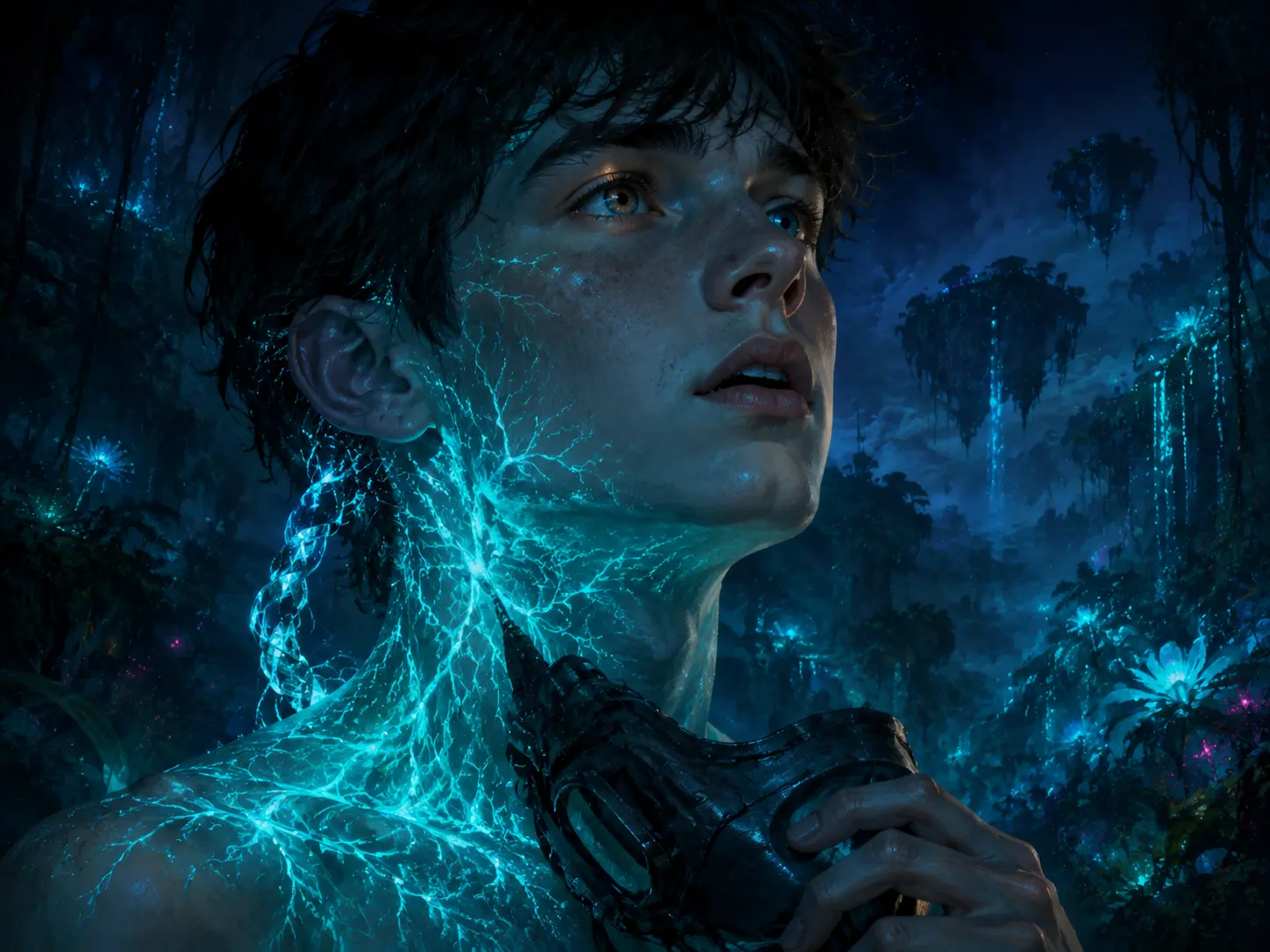
There is a moment in Spider Socorro's story that ought to be impossible, and it is worth pausing on before we explain it away. A human boy, born on Pandora but built like any of us, pulls the breathing mask off his own face in the open air — and does not die. He should. The air around him is a slow poison to a human: heavy with carbon dioxide, laced with hydrogen sulfide, the kind of atmosphere that drops an unmasked person inside a couple of minutes and does not give them back. Every other human on the moon lives inside a bubble of filtered air, tethered to a mask, because the alternative is suffocation. And here is this one boy, breathing.
The easy thing is to file it under Pandoran wonder and move on. But that is exactly the move this book refuses. Something physical has happened to Spider's body — the diagnosis in the story is blunt about it — and that something is not magic and not a screenwriter's shortcut. It is the oldest, deepest, most thoroughly proven trick in the history of life on Earth, run at a speed that has never been seen. To understand the boy who breathes Pandora, we have to understand how one living thing moves inside another and rewrites it from within. And the first thing to say is that this is not exotic at all. It is the reason you are alive to read this.
The oldest trick
Look closely enough at any cell in your body and you will find something that does not quite belong. Tucked inside it, by the hundreds, are small bean-shaped bodies called mitochondria — the parts that take in oxygen and burn your food to power everything you do. They have their own loop of DNA, separate from the DNA in the cell's nucleus. They divide on their own schedule. They are wrapped in a double membrane, the outer one yours and the inner one unmistakably not. They look, on close inspection, exactly like what they are: the descendants of a free-living bacterium that, something like two billion years ago, moved inside another cell and never left.
That is not a metaphor. It is the settled account of where complex life came from, and it has a name: serial endosymbiotic theory, argued into the mainstream by Lynn Margulis in the late 1960s against considerable resistance and now among the best-supported ideas in biology. An ancient host cell and an ancient bacterium stopped being two organisms and started being one. The bacterium gave up its independence and became a power plant; the host gave up burning its own fuel and became something that could grow large and intricate in a way no bare cell ever had. Every plant, animal, and fungus is the living result. The technical word for one organism living inside the cells or body of another is endosymbiosis — a special, intimate case of symbiosis — and it is not a rare curiosity of the deep past. It is the event that made us.
Hold that beside Spider and the shape of his transformation stops looking supernatural and starts looking familiar. What canon shows is a mycelial organism — a strand of Pandora's fungal network — taking up residence in his body and granting him a capability he did not have before: the ability to breathe. That is the mitochondrial bargain exactly. A guest moves in; the host gains a power it could never have evolved on its own. The only thing that has changed is the clock. The merger that made us took evolutionary ages to settle; Spider's, the story says, takes days.
And that compression is the whole problem. Endosymbiosis is real, proven, and foundational — but everything we know about it says it is slow, negotiated across millions of years of mutual adjustment. To do it to a fully grown human in a matter of days, a symbiont would have to clear, in a rush, four specific biological hurdles that evolution normally has aeons to work through. The rest of this chapter is those four hurdles, in order of how hard they are — because it turns out Earth has already solved some of them, and the one it has not solved is precisely the one that should give us pause.
A world of lodgers
Before the hurdles, it helps to see how varied and how common these live-in arrangements actually are, because Spider is not as much of an outlier as he first appears — except in one revealing way. Earth is full of organisms that carry other organisms inside them, and the ways they take up residence sort along two simple questions. First: did the host inherit the symbiont from its parent, or acquire it fresh from the environment? Second: how deeply integrated is the guest — a removable tenant, or a permanent part of the body plan?
Consider the aphid, a small sap-drinking insect with a problem: its diet is nearly pure sugar, missing amino acids it cannot live without. Inside special cells called bacteriocytes, it houses a bacterium, Buchnera, that manufactures exactly those missing nutrients. The partnership is so old and so total — over a hundred million years — that Buchnera has shed most of its genome and cannot live anywhere but inside an aphid, and an aphid cannot live without it. The aphid inherits its bacteria from its mother; the arrangement is sealed, obligate, and passed down the generations.
Now consider the Hawaiian bobtail squid, which does something quite different. It hatches with no symbiont at all, and within hours it must harvest a specific glowing bacterium, Vibrio fischeri, from the open seawater around it — filtering it out of a crowd of other microbes, admitting only the right one, and building a light organ around the colonists it lets in. Every squid acquires its partner anew, from scratch, from the environment. This is horizontal transmission, and it is the model that matters most for Spider, because Spider, too, was not born with his symbiont. He acquired it — under duress, all at once — from the living world around him.
There is the coral, which takes microscopic algae into its own tissues and lives largely on the sugar they photosynthesize — feeding on sunlight at one remove, until a heatwave makes the partners turn on each other and the coral bleaches white. There is a single-celled amoeba, Paulinella, caught in the act of turning a swallowed cyanobacterium into a permanent organelle, tens of millions of years into a merger that echoes the one that gave plants their chloroplasts. There is even a salamander whose eggs are invaded by green algae that end up inside the embryo's cells — the clearest case we have of a photosynthetic guest living within the cells of a vertebrate, which is not supposed to happen and does anyway.
Lay them out together and Spider takes his place among them — with one difference that is the crux of everything. He is like the squid: he acquired his symbiont horizontally, from the environment, not from a parent. But he is unlike every organism on that plate in the depth and speed of the integration. The squid grows its light organ over days, yes — but it is running a developmental program its species has honed for millions of years, primed and waiting for the bacterium. Spider's body had no such program. It was a standard human, and it was rewritten from a standing start. That is the leap. To see how large it is, we take the four hurdles one at a time.
Where Spider fits among Earth's lodgers
Every endosymbiosis answers two questions: inherited or acquired, tenant or permanent part.
A mycelial symbiont acquired all at once, under duress, from Pandora's living network — then integrated deeply and permanently enough to rewrite an adult human's breathing and body, at a speed nothing on Earth approaches.
The Pandoran outlier
Hurdle one: not being killed by your own body
The first problem a live-in symbiont faces is the most immediate: the host's immune system is built, from the ground up, to find and destroy exactly this kind of thing. A large foreign organism setting up inside your tissues is, to your immune system, indistinguishable from a catastrophic infection. Your body carries dedicated machinery — receptors that recognize the molecular signatures of fungal cell walls, alarm cascades that summon inflammation, cells that exist only to kill and digest intruders. Drop a proliferating fungal mass into an ordinary human and the expected outcome is not symbiosis. It is a fever, a raging immune assault, and very possibly death from the response itself.
So any real endosymbiont has to solve a delicate problem: it must switch off, or slip past, the host's alarm — without leaving the host defenceless against everything else. This is immune tolerance, and the reason we can be confident it is possible is that Earth's symbionts do it routinely, by several different routes. The bobtail squid's light organ initially floods itself with a hostile chemical, nitric oxide, to repel the wrong microbes — and the correct partner, once it colonizes, actively switches that defence down, converting a killing zone into a welcome. In the salamander-algae partnership, the host cells harbouring algae quiet the very signalling pathways that would normally raise the alarm. And your own body already runs the most impressive version of all: a pregnant mammal tolerates a fetus that is genetically half-foreign, suppressing the immune attack precisely and locally, for months, without becoming vulnerable elsewhere.
Read against this, Spider's tolerance of his fungal lodger is the least troubling part of his transformation. It asks nothing biology has not already demonstrated many times over. A symbiont that secretes the right molecular signals, engaging the host's own "stand down" switches at the site of colonization while leaving the rest of the immune system armed, is squarely within what we know living things can do. Of the four hurdles, this is the one Earth science clears with room to spare. Call it established.
Hurdle two: breathing a different sky
The second hurdle is the one that matters most to the story, because it is the visible miracle: Spider breathes air that should kill him. To see what his symbiont must accomplish, you have to know why the air is lethal in the first place, and it is not the reason most people assume. Pandora's atmosphere is not poor in oxygen. The trouble is what else is in it.
I.4 — What’s Really in the Air? works the lethality out in full, and the short version is a double bind. The air is roughly a fifth carbon dioxide, enough to reverse the gradient a lung depends on: instead of flowing out of the blood, CO₂ floods in, and the blood turns acid within minutes. Meanwhile hydrogen sulfide jams the very enzyme mitochondria use to burn oxygen. The atmosphere suffocates you not by withholding oxygen but by poisoning the machinery and drowning you in your own waste gas — which means Spider's symbiont has two separate problems to solve, not one, and it must solve both in a body that has already finished growing.
Breathing a poison sky
Why Pandora's air kills — and how a symbiont could make it breathable.
No adult human can grow a new breathing organ overnight, so a symbiont cannot solve this by rebuilding the lungs from scratch. What it can do — and here Earth offers a startling proof of concept — is line the existing airway and act as a living chemical filter. Consider the giant tubeworms that live around deep-sea hydrothermal vents, in water saturated with the same hydrogen sulfide that poisons us. The tubeworm has no mouth and no gut. Instead it carries, in a special organ, billions of bacteria that take the toxic sulfide and the abundant CO₂ and turn them into food, by a process called chemosynthesis — building life from chemical energy where there is no light. The worm's blood is even specially built to carry sulfide safely, bound at one site while oxygen rides another, ferrying the poison to the bacteria that eat it. An animal has been remade, in evolutionary time, around a symbiont that turns a toxic gas into a resource.
That is the template for Spider's second biology. A mycelial film lining his airways, expressing enzymes that convert incoming CO₂ before it can acidify the blood and neutralize sulfide before it can reach the mitochondria, would let ordinary human lungs draw usable breath from a poisonous sky — not by out-engineering the atmosphere, but by installing a chemistry that eats the parts that would kill him. We have no example of a symbiont retrofitting a mammal's respiration this way, and the surface area and speed such a filter would need are daunting. But the principle — a symbiont rebuilding a host around a hostile gas — is written into the rock of every vent on Earth. Call this one plausible: not demonstrated in a vertebrate, but not forbidden by anything we know.
Hurdle three: growing an organ that was never there
Here is where the honest reckoning gets uncomfortable, because the third thing that happens to Spider is the one Earth has not learned to do. He does not merely tolerate a symbiont and breathe strange air. He grows a wholly new organ — the neural queue, the living braid that lets a Na'vi bond, through Tsaheylu, to the creatures and the network of Pandora. A structure his body had no blueprint for, grown from the base of his skull, in an already-grown human. That is a different order of problem from the first two, and it is worth being precise about why.
An animal's body is built once, early, by a breathtakingly precise program. During development, chemical gradients tell each cell where it is and what to become; genes switch on and off in strict sequence; and once the plan is executed, it locks. Biologists call this canalization — the way development settles into fixed channels that are then extraordinarily hard to reopen. There is a good reason for the lock: a grown body that could still be told to sprout new structures is a body one signal away from a tumour. In fact, when adult tissue does switch its old growth programs back on without the exquisite spatial control of an embryo, that is very often exactly what it produces — not an organ, but a cancer.
Growing an organ that was never there
Adult tissue keeps its build program sealed — for good reason.
The window between 'nothing' and 'cancer' is narrow
So the queue is not just "a new body part." It is a demand to reopen a developmental program that adult biology keeps sealed precisely because reopening it is so dangerous — and to have the result come out as an organized, functional organ rather than a disorganized growth. How close is Earth to that? Closer than you might think in some respects, and still hopelessly far in others. A salamander can regrow a whole amputated limb, rebuilding bone, muscle, nerve, and skin in the right order, by forming a blastema — a bud of reset cells that re-runs the developmental program on demand. A deer regrows its antlers every single year: a large, blood-fed, nerve-threaded appendage, grown at astonishing speed, in a mammal. So the genome plainly can retain the instructions for rapid, organized, large-scale growth, and can switch them back on in an adult without producing chaos.
But notice the catch in every one of those examples: the animal is regrowing something its species already builds. The salamander's body knows what a salamander limb is; the deer's body knows antlers. Neither is growing an organ that never existed in its lineage. That is the line Spider's queue crosses and Earth's biology does not. There is a tantalizing frontier here — the work of researchers like Michael Levin, who have shown that the faint electrical voltages across cells, the tissue's bioelectricity, act like a blueprint that can be rewritten, coaxing flatworms and frogs to build eyes and extra limbs in the wrong places by changing the electrical pattern rather than the genes. It is the most suggestive hint we have that a symbiont might impose a new "grow here, like this" pattern on adult tissue. But inducing a known organ in the wrong place is still a universe away from growing a novel sensory organ, correctly wired, on a human. Of the four hurdles, this is the one that is frankly speculative — the place where Spider's biology outruns anything Earth can yet do.
Hurdle four: learning to feel through a new limb
Suppose the queue grows anyway. A fourth problem waits, quieter than the others but just as real: a new organ is useless until the nervous system learns to use it. The queue is not decorative; it carries signals both ways, letting Spider feel and be felt by whatever he bonds with. That means its thousands of nerve fibres have to find their way to the spinal cord and brain and wire in — and then the brain has to learn to read an input it was never built to receive.
The first half of that is something the body already does. Peripheral nerves — the ones outside the brain and cord — can regrow after injury, growth cones creeping along chemical trails and physical scaffolds toward their targets. The developing embryo routes new nerves to new structures constantly, guided by a migratory population called the neural crest that gives rise to much of the peripheral nervous system. A symbiont that laid down the right chemical trail could, in principle, guide the queue's fibres inward along the mycelial scaffold itself. The wiring is a hard problem, but a recognizably solvable one.
The second half is subtler and, remarkably, is the part we have the most direct human evidence for. The adult brain is far more plastic than we used to think: it remaps itself around new inputs and outputs all the time. People who learn to read the world through a camera wired to their tongue, patients who learn to control robotic limbs, even volunteers fitted with a working extra thumb — all show the same thing, the brain's map quietly reallocating territory to a channel it never expected. This is neuroplasticity, and it means the final step — Spider's brain actually learning to feel the world through the queue — is the one hurdle we can watch humans clear, in a lab, today. Not with a living braid grown by a fungus, but the principle that a human brain can annex a strange new sense is not in doubt.
What this means
Honest edges
Sorting Spider's transformation by how much real biology stands behind each piece gives a clean ladder, and it is worth climbing deliberately, because the tiers are genuinely different kinds of claim.
Spider's four hurdles, by how much Earth backs them
Run each step of the transformation against the biology we actually have. They do not sit at the same level of credibility — and being honest about which is which is the whole point.
- Earth analog
- Squid–Vibrio light organ; salamander–algae; mammalian pregnancy
Immune tolerance of a foreign organism is demonstrated repeatedly, by several independent routes. A symbiont engaging the host's own 'stand down' switches at the colonization site asks nothing biology hasn't already shown. This hurdle is the easy one.
The line worth drawing cleanly is the one between the principle and the performance. The principle underneath all four hurdles — that one organism can move inside another, be tolerated, hand over a new metabolic power, and become a permanent part of it — is not speculation at all. It is endosymbiosis, the settled science that produced the mitochondria in your cells, the chloroplasts in every leaf, and a whole gallery of living partnerships from aphids to coral. A body that is really a coalition of once-separate organisms even has a name — a holobiont — and by that measure you are one already. What is canon is narrow and specific: that a mycelial symbiont colonizes Spider, that he breathes unaided, that he grows a working queue, and that the RDA covets the mechanism. Everything between the firm science and the firm canon — reading the transformation as horizontal acquisition, the airway as a chemosynthetic filter, the queue as induced organogenesis — is inference, and it is marked as inference. And the growth of a brand-new organ on an adult is further out still, honest speculation about a step Earth has not taken.
So the boy pulls off his mask and breathes, and it is not a miracle and not a cheat. It is the oldest bargain in biology — a guest moving in, a host made new — offered at a speed evolution never runs it. Three of the four things that bargain demands of Spider's body, Earth has already shown are possible: the truce with the immune system, the chemistry that eats a poison sky, the brain that learns a new sense. Only one, the growing of an organ that never was, still lies beyond us, and it is worth sitting with the fact that it is the growing — not the breathing, not the bonding — that is the hard part. Spider breathes Pandora for the same reason you breathe Earth: something else moved into his cells and gave him the power. The difference is only that yours arrived two billion years early, and has been so quiet for so long that you had forgotten it was ever a guest at all.
What stays open
Canon ties Spider's transformation to Pandora's fungal network and to Kiri's intervention, but never says whether the organism inside him is the ordinary mycorrhizal network of the forest floor or a distinct, specialized symbiont. It matters enormously: an off-the-shelf network fungus doing this implies the capability is latent everywhere on Pandora, while a special organism implies a rare, perhaps deliberate, event. The story leaves it genuinely unspecified.
The transformation could work at two very different depths. It might be purely somatic — the symbiont remodelling his existing tissues and adding its own, leaving his human DNA untouched — or it might reach into and edit the genome itself. Canon's framing (a diagnosis of colonization, not mutation) leans toward the first, and that is what the RDA's 'reverse-engineer it' dream would need. But whether anything heritable has changed, and so whether the trait could ever be passed on, is never addressed.
This is the strategic question the film raises and does not answer. Spider is one integrated organism in which symbiont and host divide in step, immunity is managed, and growth is guided — the very coordination that lab synthetic biology cannot yet achieve. Whether that integration is a portable *mechanism* that could be extracted and deployed across ordinary humans, or an irreducible one-off that only happened because a planet-scale network did it deliberately to one boy, is exactly the line between a real bioweapon and a story. Canon keeps it open on purpose.