

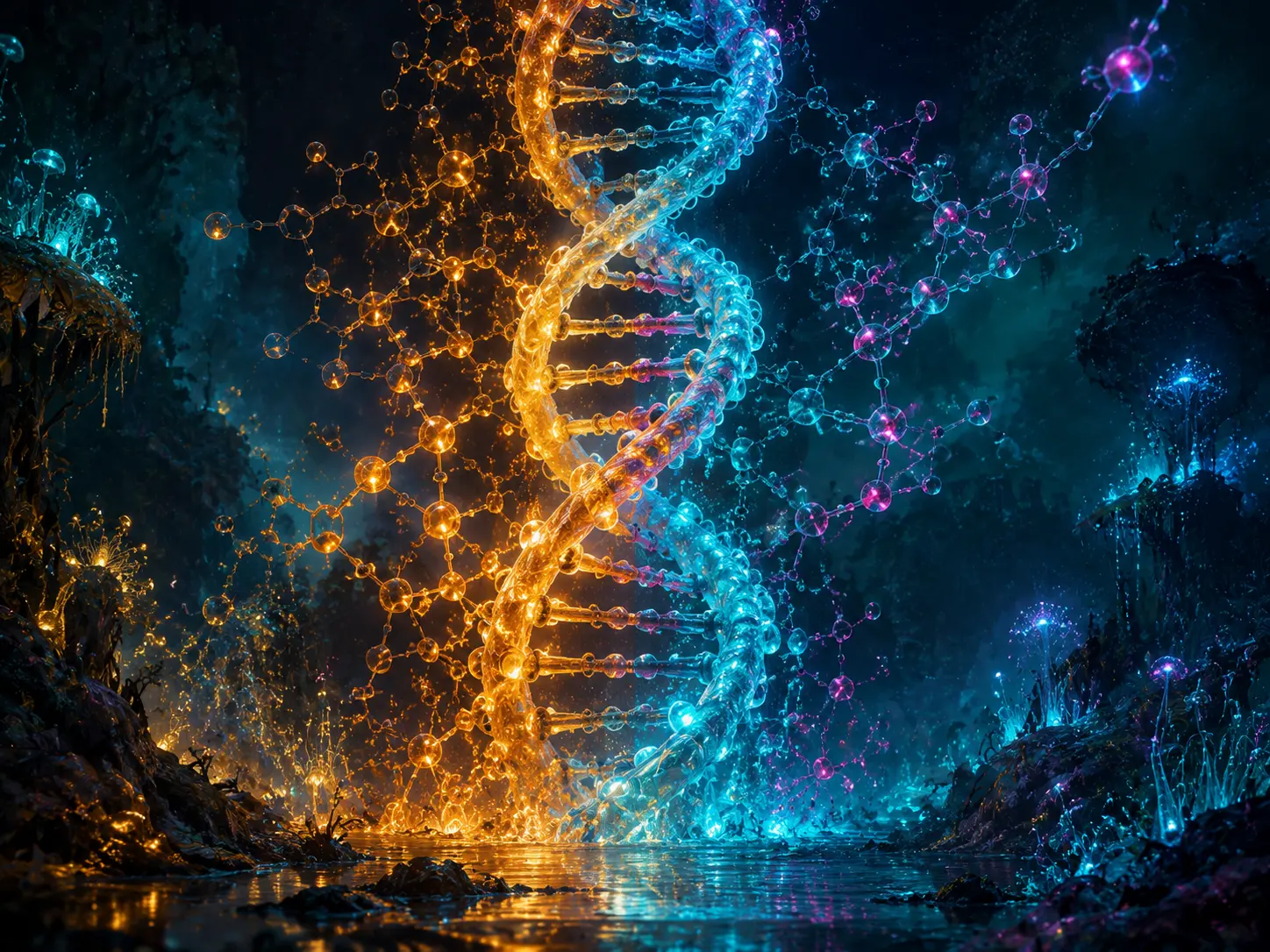
In a dim laboratory on Pandora, an impossible animal is sleeping in a tank. It is curled in pale amber fluid behind glass, longer than a man, blue-skinned, four-limbed, a feeding line trailing from its belly. It is not quite a Na'vi and not quite a human. It was grown from a single genome assembled out of both — human genetic material spliced directly into Na'vi DNA, the two woven together closely enough that the result is one body, one bloodstream, one developing brain. And the body works. It will grow to ten feet, breathe Pandora's poisoned air, run, hunt, and one day be driven like a vehicle by a human mind reaching across the link. Whatever else you think of the Avatar Program, pause on the raw biological fact at the bottom of it, because everything in this chapter hangs from it: two forms of life that arose on different worlds, four light-years and billions of years of separate evolution apart, can be cut together at the level of the gene and the join holds.
That should be much stranger than the film ever lets it feel. Think about what it demands. For human DNA to splice into Na'vi DNA and produce a working cell, the two molecules cannot merely be similar in spirit. They have to be the same kind of molecule — the same double-helical backbone, read in the same direction, written in a compatible code, built from building blocks of the same handedness. A single mismatch at any of those levels and the splice would produce not a hybrid but a smear: proteins that cannot fold, a code that cannot be read, a chemistry that seizes. The avatar in the tank is therefore a quiet, enormous claim about the universe. It says that life on Pandora is made of what life on Earth is made of. Not approximately. Exactly enough to interleave.
So this is the chapter where we ask the simplest and largest question in the whole book: what is life actually made of? And underneath it, the question that turns the answer into real science — when we find life that arose entirely on its own, how much of it is forced to come out the way ours did, and how much could have gone another way?
The same stuff, exactly enough to splice
Start with what the splice actually requires, because the requirements are precise and they teach the chemistry by themselves. Three things have to match between human and Na'vi life for a hybrid genome to function, and each one is a window onto a deeper fact about all life.
The first is the backbone. Both species' inheritance has to be carried on the same molecule — a double helix of nucleic acid built on a sugar-phosphate spine, the rungs of the ladder pairing the same way every time. The second is the code. A gene is a string of those rungs read three letters at a time, and each triplet specifies one amino acid to add to a growing protein. For a spliced human gene to mean anything inside a Na'vi cell, the cell's machinery has to read those triplets the same way the human cell did — the same dictionary translating the same words. The third is handedness, and it is the subtlest of the three. Carry it carefully, because it is where the chapter's first real principle lives.
Many of biology's molecules come in two forms that are mirror images of each other, like a left and a right glove. They are built from the same atoms in the same connections, but assembled in opposite three-dimensional arrangements, and no amount of turning will make one sit where the other does. Chemists call this property chirality, from the Greek for "hand." Here is the strange and important part: Earth life, all of it, from the bacterium in a hot spring to the tree outside your window, uses only one hand. Its amino acids are very nearly all left-handed; its sugars all right-handed. This single-handedness is called homochirality, and it is not a nicety — it is structural. An enzyme is a precisely folded shape, and it grips its target the way a left glove fits a left hand. Feed a left-handed enzyme a right-handed molecule and it simply cannot hold it; the geometry is wrong. A protein built half from left-handed and half from right-handed amino acids would not fold into a working shape at all. It would be gibberish in three dimensions.
Chirality
Same atoms, opposite hand — only one fits the enzyme
Avatar splice
compatible
Same molecular hand: the assembly line interlocks.
Notice what the splice has just told us, almost for free. Pandoran life is carbon-based, water-solvated, DNA-encoded, and — if the avatar in the tank is real — homochiral in the same hand as ours. That is a remarkable amount of deep agreement between two biospheres that never shared an ancestor. The obvious question is whether that agreement is a coincidence, a wild stroke of cosmic luck that just happens to make the Avatar Program possible. The answer, and it is the spine of this whole chapter, is that for the most part it is not luck. Some of it is very nearly forced. To see why, we have to ask why life is built from carbon in the first place — and what happens when you try to build it from anything else.
Why carbon, and why not silicon
Of all the questions in astrobiology, this is the one with the firmest answer, and it begins with a single atom's social habits. Carbon sits in the periodic table in a position that makes it almost suspiciously good at being the skeleton of life. It has four bonding slots, and it forms four strong, stable links at once — to other carbons, to hydrogen, to oxygen, to nitrogen. That four-handedness lets carbon assemble into chains, branches, rings, and three-dimensional cages of essentially unlimited size and variety. Every protein, every strand of DNA, every sugar and fat in your body is a carbon scaffold hung with other atoms. Nothing else in chemistry builds such large, varied, stable structures.
But size and stability are only half of it, and the other half is the part people miss. Carbon's bonds are strong enough to hold a large molecule together for years — and yet weak enough to be taken apart and rearranged by an enzyme in milliseconds, at body temperature, without a furnace. That balance is the real miracle. Life is not just architecture; it is architecture that must be continuously built, demolished, and rebuilt as fast as a cell can metabolize. Carbon's bond energies sit in a narrow, precious window: durable enough to make a stable body, reversible enough to make a living one. Too strong and metabolism would freeze; too weak and the body would fall apart. Carbon threads the needle.
This is why, when science fiction reaches for an alternative, it nearly always reaches for silicon — and why the reach so rarely survives contact with chemistry. Silicon sits directly below carbon in the periodic table, and it too has four bonding slots, so on paper it looks like a natural substitute. The trouble is that silicon's bonds, and the molecules they make, fail life's tests one after another. They are weaker, so long silicon chains tend to fall apart; it is hard to find a stable molecule with more than a few silicon atoms in a row, where carbon happily strings together thousands. And then there is the problem that decides it.
C–C bond strength
~348
kJ/mol — strong enough to last, weak enough to rearrange
Si–Si bond strength
~222
kJ/mol — long silicon chains fall apart
Waste product of carbon life
CO₂
a gas — you breathe it out
Waste product of silicon life
SiO₂
a solid — quartz, sand, in your lungs
When you burn carbon for energy — which is, in the end, what your cells do — the exhaust is carbon dioxide, CO₂. That is a gas. It dissolves in blood, rides to the lungs, and leaves on the next breath. Waste disposal is built into the chemistry. Now run the same logic on silicon. Silicon's great chemical love is oxygen; it bonds to oxygen so eagerly and so strongly that once joined, the two are almost impossible to pull apart. And the product of silicon meeting oxygen — the silicon equivalent of CO₂ — is SiO₂. Silicon dioxide. That is not a gas. It is quartz. It is sand. A silicon-breathing creature would, with every breath, manufacture solid rock inside its respiratory tissues, with no way to exhale it. The metabolism would brick itself shut. And because the silicon-oxygen bond is so brutally stable, even a cell that wanted to recycle that sand back into useful molecules would need a furnace's worth of energy to break the bonds, energy no warm body has. Silicon does not metabolize. It petrifies.
The breath that decides it
Burn each element and look at the exhaust — one leaves, one stays
That sorting is exactly what lets us read the avatar in the tank. The deep agreements — carbon, water, a nucleic-acid double helix — are the forced part. Any complex life, on Pandora or anywhere, was overwhelmingly likely to land on carbon and water, because the alternatives petrify or freeze. So it is not a cosmic coincidence that Na'vi biochemistry is carbon-and-water based; it is close to inevitable. But the splice needs more than that. It needs the accidental layers to match too — the same code, the same hand. And there the agreement is genuinely surprising, because those are the features that did not have to come out the same. Canon simply hands us a working hybrid and lets us infer that, against the odds, Pandora drew the same frozen accidents Earth did. That is either a staggering coincidence or a hint that the accidents are less accidental than we think. The film does not say which. The honest answer is that we do not know — and that uncertainty is not a flaw in the story, it is the live edge of real astrobiology.
When water is not the only ocean
Before we leave the forced layer, it is worth seeing that even "forced" has soft edges, because it sharpens what we mean by it. Liquid water is life's solvent on Earth for excellent reasons: it dissolves an enormous range of molecules, it stays liquid across a wide band of temperatures, and — the underrated part — it is what makes proteins fold. A protein folds because some of its parts flee water and huddle inward while others embrace it; take away the water and the folding logic that builds every enzyme disappears. Water is not just the pond life swims in. It is a structural ingredient of the machinery.
But astrobiologists, disciplined about not mistaking the familiar for the necessary, have asked whether other liquids could do the job on other worlds. The candidates are real and instructive. Ammonia is polar like water and stays liquid where water freezes solid, making it a plausible solvent for a cold world — though only under crushing pressure, and across a narrower temperature band. On Saturn's giant moon Titan, the seas are liquid methane and ethane, cold enough that ordinary biology would seize up entirely; if anything lives there, it cannot use our kind of cell membrane and would need a chemistry slowed to a geological crawl. None of these is as good as water. But the exercise matters, because it teaches the habit of mind the whole field runs on: separating what life needs from what Earth life merely has. Water looks close to a universal optimum. Yet "close to" is doing real work in that sentence, and a good scientist keeps the door open.
So hold the door open properly, and see what is standing behind it. Put the four seriously proposed solvents side by side and something uncomfortable shows up: on the two numbers that look most important, water does not win. Formamide — a small molecule of carbon, hydrogen, oxygen and nitrogen — stays liquid across a band more than twice as wide as water's, and pulls polar molecules apart even more strongly. It is also, awkwardly, a better medium than water for the phosphate chemistry that assembles a genetic backbone. Water's real advantage lies elsewhere, in the requirements that have nothing to do with either number: it is the only one of the four in which anybody has ever demonstrated a protein folding or a membrane assembling itself. That is the shape of the honest argument. Water is not the champion of every column. It is the only candidate that has been shown to clear the columns that actually build a cell.
The solvent bench
Set a world's surface temperature, then ask what could still flow there — and whether a cell could be built in it
Every polar biomolecule you are made of goes into solution in it — sugars, salts, amino acids, the phosphate spine of DNA.
Folding is driven by water: oily parts of a protein flee it and huddle inward while the rest embrace it, and that flight is what carves an enzyme's shape.
A lipid bilayer assembles itself in water for the same reason — oily tails inward, water-loving heads out. No instruction needed, only the solvent.
This habit — never mistake your one example for the rule — has a name and a cautionary history, and it is where we cross fully from Pandora into Earth's own laboratories, to the most useful story this chapter can tell.
The arsenic that wasn't
In 2010, a team of scientists announced, in one of the world's most prestigious journals and at a NASA press conference, that they had found life that broke one of biochemistry's deepest rules. The claim concerned a bacterium dredged from Mono Lake in California, an extremophile thriving in water so laden with arsenic it would kill almost anything else. The team reported that this microbe, starved of phosphorus, could do something thought impossible: build its DNA backbone out of arsenic instead.
To feel why that announcement detonated, you need to know what phosphorus does. The backbone of DNA — the rails of the spiral ladder — is a chain held together by phosphorus atoms. Phosphorus is one of the six elements life leans on most heavily, the famous CHNOPS set: carbon, hydrogen, nitrogen, oxygen, phosphorus, sulfur. Its job in the backbone depends on forming bonds that are extraordinarily stable in water — a DNA backbone bond, left alone, would take millions of years to fall apart on its own. That stability is the whole point. Your genome has to sit in a warm, wet cell for a lifetime without dissolving. Arsenic sits directly below phosphorus in the periodic table and forms superficially similar molecules, which is exactly why the claim was tempting — and exactly why it was wrong. An arsenic version of that backbone bond does not last millions of years in water. It falls apart in minutes. A genome built on arsenic would not be a strange new form of life. It would be a genome dissolving as fast as it was assembled.
So the claim collided with chemistry, and other scientists did what science is supposed to do: they tried to reproduce it. They could not. Careful work showed the bacterium was not incorporating arsenic into its DNA at all; it was a tough organism that tolerated arsenic while scavenging the tiny traces of ordinary phosphorus it still needed. The "arsenic life" was phosphorus life that happened to live in a poisonous lake. And the story has a final, telling coda: after fifteen years of failed replication, the journal that published the original paper formally retracted it — the retraction came through in 2025. The claim did not just fade; it was struck from the record.
Looking for life that doesn't look like life
The arsenic affair points at a deeper unease that astrobiologists have learned to take seriously. If we are so practiced at recognizing life that looks like us — carbon, water, DNA in the familiar hand — how would we ever notice life that doesn't? In 2007 a major scientific report set out, deliberately, to widen the search, urging researchers to imagine life with a different genetic backbone, or built on the mirror-image hand, or using a solvent other than water. It put a name to the boldest version of the idea: a shadow biosphere — a second, independent form of life that might exist on Earth right now, unnoticed, simply because none of our tools are built to detect it.
The thought is less paranoid than it sounds. Almost every method we use to find microbes is tuned to standard life. Our techniques amplify and read familiar genetic sequences; they assume the familiar backbone, the familiar code. A microbe using an alternative genetic molecule — a different backbone chemistry, or the opposite chiral hand — would be invisible to them, sitting in the same spoonful of pond water, returning no signal because the instruments were never designed to ask it a question it could answer. We might have been stepping over a second tree of life for a century without seeing it. This is why astrobiology pushes for biosignatures that don't presuppose Earth's chemistry — ways to detect that something is alive without assuming what it's made of.
Hold that thought beside Pandora and something clicks into place. Pandoran life is not a shadow biosphere — it is loudly, visibly alive, and conveniently built on chemistry close enough to ours that we can study it, splice it, wear it. In the great space of possible biochemistries the 2007 report tried to map, Pandora sits almost next door to Earth. That nearness is precisely what makes the Avatar Program thinkable, and it is worth seeing as the gift to the story that it is. A genuinely alien biochemistry — mirror-handed, or built on some backbone we'd need new instruments even to detect — could never have been spliced into a human genome. The drama of two species meeting in one body is only possible because, of all the ways life could have been built, Pandora was built almost exactly our way.
Reading Pandora against the chemistry
Take the chemistry's test — would this survive where it has to live? — and run each of Pandora's signature biological claims through it. They sort cleanly into three tiers, from all-but-inevitable to flatly impossible.
- Earth analog
- Earth's entire biosphere; the thermodynamics of carbon and water
The alternatives petrify or freeze. Any complex life was overwhelmingly likely to land here — so the deep agreement that makes the avatar splice possible is closer to inevitable than to coincidence.
What Pandora built that Earth could not — and what it couldn't
With the test in hand, we can finally read Pandora's body the way a xenobiologist would: not asking "is this real?" but "what would it cost, and does the chemistry allow it at all?" Three of Pandora's signature features make the case, and they line up from the merely expensive to the flatly impossible.
Begin with the famous one. The Na'vi, a colonel warns his troops, have bones reinforced with naturally occurring carbon fiber — which is why they are so hard to kill, and why a creature can fall through a canopy or draw a bow no human could bend and walk away. Companion material extends the claim to Pandoran animals generally: their skeletons are a grown carbon-fiber composite, lighter and stronger than our calcium-phosphate bone. A flying mount's wing bones are described as hollow tubes of this material, light enough to lift a creature the size of a small aircraft. Run the chemistry's test on it. Carbon fiber on Earth is made by cooking synthetic threads at temperatures that would carbonize any living cell, forcing the carbon atoms into the aligned graphite ribbons that give the fiber its strength. No known organism does anything like that at body temperature. And yet — life is an extraordinary builder of hard materials from soft, cool chemistry. Diatoms, single-celled algae, spin intricate glass shells out of dissolved silica at ocean temperature. Insects lay down chitin; we lay down bone; spiders extrude silk stronger by weight than steel. All of these are templated syntheses: the cell builds a molecular scaffold and lays the hard material onto it, atom by atom, at temperatures that would seem far too low for the job. Could a cell template graphitic carbon the way a diatom templates glass? No Earth cell does, and canon is silent on how a Pandoran one would. But it breaks no law of physics. It is expensive but conceivable — a real bet, not a fantasy.
Now the second feature, and here Pandora is on far firmer ground than the films ever claim credit for. Pandoran animals are said to navigate by sensing the planet's magnetic field — useful on a moon whose field is strong and, near the floating mountains, wildly distorted. Companion material attributes this to tiny crystals embedded in sensory tissue. Run the test, and this one passes with room to spare, because Earth already does it. There are bacteria — magnetotactic bacteria — that grow chains of microscopic magnetic crystals inside themselves, each chain a compass needle a few millionths of a meter long, and use them to align with Earth's field as they navigate toward the conditions they prefer. The structures even have a name: magnetosomes. Building magnetic crystals biologically is not exotic; it is cheap, ancient, and widespread. So when Pandoran fauna feel the planet's field through crystals in their flesh, they are doing a grander version of something a pond bacterium has done for billions of years. Of all Pandora's strange adaptations, its magnetic sense may be the most thoroughly real.
And then the third feature, where Pandora finally asks for something the universe will not give it. The same companion lore that gives the animals their magnetic sense sometimes goes further and imagines the planet's biology entangled with its superconducting ore — nerve tissue, in the boldest tellings, that carries signals with the zero resistance of a superconductor. It is a seductive image: a living wire that never loses a signal, a body plugged into the planet's strange physics. Run the chemistry's test on it, though, and it fails instantly and completely. Superconductivity, the real phenomenon, depends on electrons pairing up into delicate joint states — Cooper pairs — that glide through a crystal in perfect lockstep, never scattering, never losing energy. Those pairs are fragile almost beyond belief. The faintest thermal jostling shakes them apart, which is why even our best superconductors must be chilled to extreme cold and held in rigidly ordered crystals to work at all. Now picture the inside of a living cell: warm, wet, crowded, and crackling with the ceaseless traffic of charged ions doing the ordinary business of life. It is the single most hostile environment for a Cooper pair that one could design on purpose. The pairs would be destroyed the instant they formed. A superconducting nerve is not expensive, like the carbon-fiber bone. It is impossible, in the way that a perpetual-motion machine is impossible — not hard, but forbidden.
This is not a knock against the story — it is the most useful thing the body can teach. Notice that the three features fail the test by different amounts, and the differences are exactly the gradient this whole book is built to read. The carbon-fiber bone is a heavy biochemical bet that nonetheless plays by the rules: it is inference, plausible reasoning beyond what canon spells out. The magnetic sense is essentially confirmed Earth science wearing a Pandoran costume: it is as close to real as a fictional adaptation gets. The superconducting nerve is a beautiful idea that the laws of physics simply veto: it is speculation, and honesty requires us to name it as such rather than wave it through because it sounds wondrous. Same world, same body, three different verdicts — and being able to tell them apart, to say this is forced, this is a costly bet, this is forbidden, is the entire skill the chapter set out to build.
Honest edges
It is worth being plain about where this reading rests on solid ground and where it is reaching. The Earth science is firm: carbon's bonding chemistry, the silicon dead-ends, water's role in folding proteins, the CHNOPS toolkit, the arsenic-life retraction, the magnetotactic bacteria and their magnetosomes, the fragility of Cooper pairs. None of that is in doubt; it is textbook material, and it is the bedrock the chapter stands on.
The canon is also firm about a handful of things: that the Avatar Program splices human and Na'vi DNA into a working hybrid body, that the films and companion lore describe carbon-fiber skeletons and magnetic navigation. What sits between the firm science and the firm canon is inference, and it should be flagged as such. That Pandoran life is homochiral in the same hand as Earth's is not stated anywhere — it is forced on us by the bare fact that the splice works, and the reasoning, though sound, is reasoning rather than documentation. The same goes for the verdict that carbon-fiber bones are "conceivable": that is a judgment from materials science applied to a claim canon never mechanistically explains.
And there are real gaps where canon simply goes quiet, and they are more interesting left open than papered over. The films never name a single Pandoran biomolecule — not a luciferin, not an enzyme, not the supposed superconducting compound. They never address chirality directly. They never explain how a cell could graphitize carbon, and the boldest claim of all, the biological superconductor, is exactly the one that real physics forbids — which means either the lore is loose on this point, or Pandora's biology relies on something the films have not told us and probably could not. That last gap is not a flaw to hide. It is the precise spot where a careful reader can see the seam between a richly imagined world and the physics of the real one.
The sleeper in the tank, read again
Return to the laboratory, and the body in the tank. It is no longer merely a marvel of imagined engineering; it is a statement about the chemistry of the universe, and we can finally read what it says. It says that life, when it arises, is not free to be made of anything at all. The deepest layers are forced: carbon because nothing else builds so well and unbuilds so fast, water because nothing else dissolves and folds so well, a stable backbone because a genome has to survive a lifetime in a warm cell. Pandora drew those cards because, in all likelihood, any living world must. That is why a human gene can find a home in a Na'vi cell — not because the two worlds got lucky, but because there were never very many ways to build a living thing, and both worlds walked the same narrow road to get here.
But the body says something subtler too, in the features that did not have to match and somehow do — the shared hand, the compatible code. Those are the frozen accidents, the coin-flips of life's deep history, and there is no law that says Pandora's flips had to land as Earth's did. That they apparently did is the one thing the chapter cannot fully explain, and rather than invent a reason, it is better to leave the question standing, lit, where you can see it: maybe the accidents are not so accidental, or maybe the Avatar Program rests on a coincidence so large it should make us suspicious. The film does not choose. Good science, faced with one example, does not pretend to either.
The durable lesson is simple: strip away the blue skin and the six limbs and the glowing forests, and Pandoran life is, at the molecular level, startlingly like our own — the same element doing the same work for the same unanswerable reasons. The strangeness is real, but it lives in the upper storeys: the carbon-fiber bones, the magnet-sense, the one impossible superconducting wire that physics will not allow. The foundation is shared. Learn to tell the forced from the accidental from the forbidden, and the most alien creature in the tank turns out to be built, all the way down, from the same short list of things that built you.
What stays open
Canon never says — but it almost has to be. For human DNA to splice into Na'vi DNA and produce a working hybrid, both must use the same-handed amino acids and sugars, or their proteins could never be built on one shared assembly line. The functioning avatar forces the inference, but no official source states Pandora's handedness directly. If it were mirror-imaged, the Avatar Program would be impossible.
Unexplained. Canon asserts the carbon-fiber skeleton but never gives a mechanism, and Earth has no organism that graphitizes carbon at the temperatures a living body runs at. We can point to analogs — diatoms templating glass, the way cells build hard materials onto molecular scaffolds — but the specific chemistry that would lay down aligned graphitic fiber in a warm cell is simply not on the table. It is conceivable, not demonstrated.
No — this is where Pandora's biology meets a hard physical limit. Superconductivity depends on fragile electron pairs that are destroyed by heat and disorder, and a living cell is warm, wet, and electrically chaotic, the worst possible environment for them. Magnetic-crystal sensing is real and cheap; zero-resistance nerve tissue is forbidden by physics. Either the lore is loose here, or it relies on something the films never explain and likely could not.