

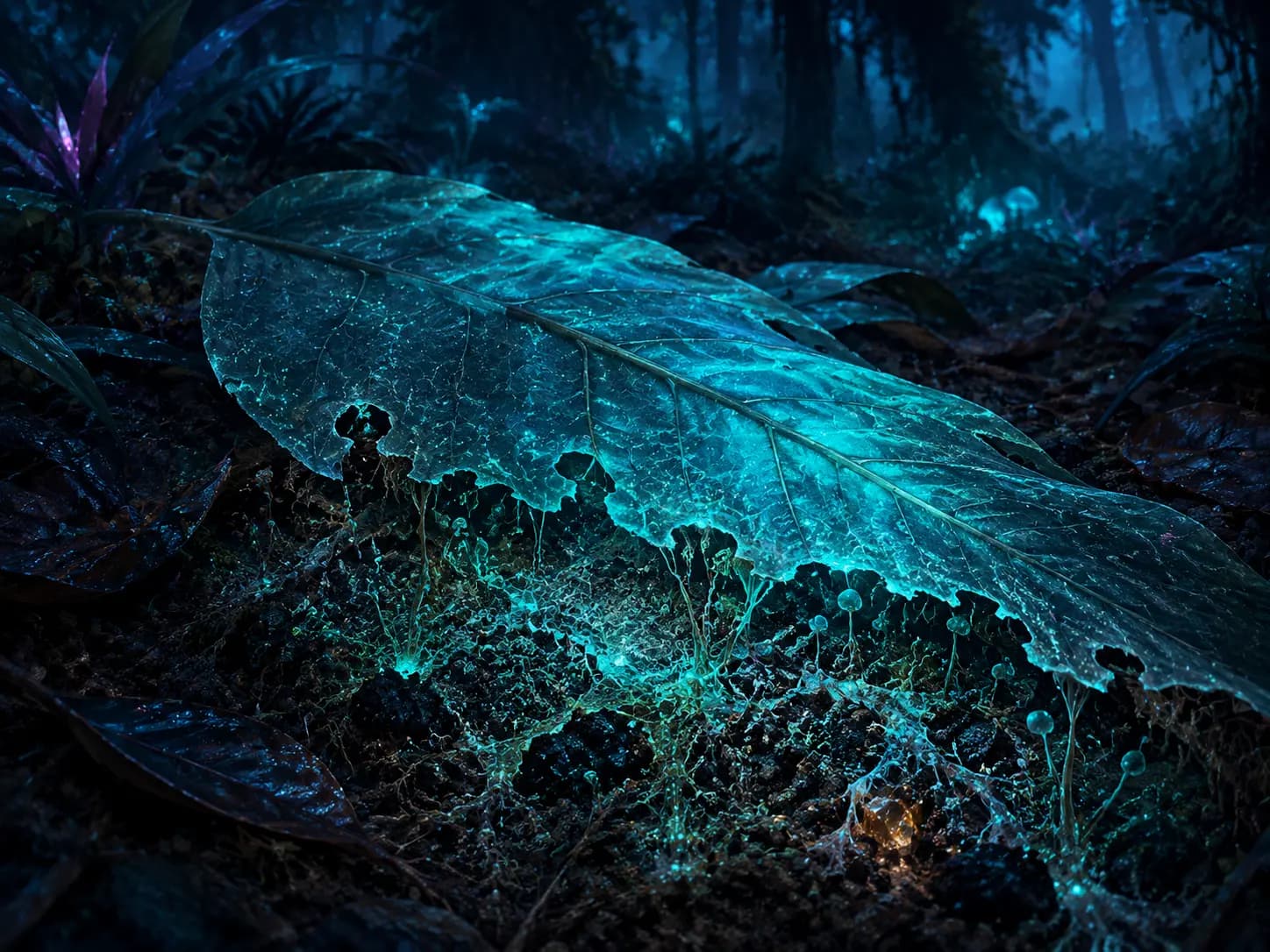
A leaf comes loose somewhere above Jake Sully's head.
It turns once through the cyan light, touches the forest floor, and is gone—not physically, only cinematically. The camera has a thanator to chase. Leaves are poor actors. Yet if we were reading Pandora as a specimen rather than a stage, this is exactly where we would stop following Jake and kneel down.
The leaf contains carbon pulled from the air, nitrogen once held in another organism, phosphorus weathered out of rock, and a small treasury of metals that enzymes require. A forest can afford to drop that material only if something retrieves it. Otherwise every generation of canopy would be a withdrawal from a finite account. The green would thin, growth would slow, and Pandora's famous abundance would quietly bury itself beneath its own litter.
Old forests avoid that fate by employing mouths too small for cinema.
That sentence is secure on Earth. On Pandora it is an inference, and the distinction matters because the films are curiously reticent about the smallest scale of their world. They give us anatomy at the scale of wings and jaws; they show roots coupling into a planetary network; they let luminous pollen-like bodies drift through the air. They do not give us one bacterium, one virus, one measured soil profile, or one unequivocal account of what digests a dead leaf. Companion catalogues and licensed stories populate some of that darkness with fungus-like organisms and illness. Much of the detailed material circulating online, however, leads back to a fan wiki rather than to a film or an official field manual. Detail is not the same thing as authority.
So this chapter begins with a negative specimen: a thing that must be there, whose actual form canon mostly declines to show.
The kingdom below the frame
The absence is easy to miss because Pandora looks so complete. A hexapede grazes; a nantang hunts it; a giant tree catches the light; Eywa links the roots. The food web seems closed. But a food web drawn only with living plants, herbivores and predators has no way to process its ending. Every arrow eventually points to a body that stops moving. Without decomposers, the diagram becomes a warehouse.
Earth's correction is the decomposer system: not a single guild but a relay. Beetles and other detritivores break a leaf into pieces. Fungi and bacteria secrete enzymes outside their bodies, cutting polymers too large to swallow into molecules they can absorb. Protists and nematodes graze on those cells. Their wastes return nitrogen and phosphorus to the water around roots. A predator eats the grazer; a root takes up the ion; another leaf is built. The forest does not recycle because it possesses a moral preference for thrift. It recycles because every discarded molecule is a vacancy, and evolution is very good at filling vacancies.
Pandora's warmth and wetness make the need sharper, not simpler. Warmth generally speeds enzymes; water lets dissolved substrates reach them. But a perpetually wet forest is not a vat in which everything disappears instantly. Flood a pore and oxygen crosses it roughly ten thousand times more slowly than it crosses air. Dry it and cells lose the connected water films through which nutrients diffuse. Activity lives between those failures. Even in one pinch of ground, distance and moisture can place an oxygen-breathing cell a fraction of a millimetre from a neighbour using an entirely different metabolism.
The useful unit is therefore not "the soil," as though it were brown flour. It is the pore.
A gram is geography
Pick up a crumb of healthy soil and it may hold billions of cells. The exact number is less important than the error our eyes make: we see a uniform particle where the organisms experience a landscape. Sand, silt and clay are glued together by root secretions, fungal threads, microbial polymers and organic debris into a soil aggregate. Around and through it run channels ranging from tunnels an earthworm could use to crevices narrower than a cell.
The large channels drain after rain and admit air. Smaller ones hold water by capillary force. Still smaller spaces can protect organic molecules from the enzymes that would dismantle them, simply because the enzyme and the molecule cannot physically meet. The surface of an aggregate may be oxygen-rich while its wet centre is anoxic. Soil chemistry is geography conducted at a scale where a millimetre is a continent.
A pore is a continent
Water connects microbial neighbours, then shuts the oxygen door
Move the pore from dry to moist in the figure. At first the microbes are not starving because food has vanished; they are stranded because the liquid roads have broken into islands. Add water and those roads connect. Substrate diffuses, cells move, grazers reach prey, and decomposition accelerates. Add still more until the air spaces flood and the road becomes a wall to oxygen. Anaerobic metabolisms take over. Some return nitrogen to the atmosphere. Others produce methane. "More water" has changed from remedy to regime shift without the pore moving anywhere.
That is the first piece of Earth science to carry onto Pandora. A lush surface does not imply a deep bank of fertile dirt. Old tropical soils on Earth are often heavily weathered and poor in freely available phosphorus and base cations. Rain leaches soluble nutrients downward. The forest remains extravagant because the nutrients do not linger in the mineral account: they are held in trunks, leaves, roots, microbes and surface litter, captured again almost as soon as decomposition releases them.
If Pandora's rainforest works anything like that—and this is an ecological inference, not a canonical measurement—then the brilliant canopy stands on a remarkably thin financial margin. The forest floor is not a reservoir so much as a high-speed exchange. Stop the turnover and abundance above would discover how little capital waits below.
How a forest eats its dead
Decomposition is usually described as destruction. At the molecular scale it is closer to disassembly followed by competitive shopping.
A fresh leaf begins with soluble sugars and amino acids that can be taken quickly. Cellulose and hemicellulose require enzymes that cut their long chains into manageable units. Lignin—the irregular material stiffening woody tissue—demands a harsher extracellular chemistry. No organism "eats a tree" in one move. Different specialists open different locks, and each opening creates food for somebody else.
For much of the twentieth century, textbooks taught that the dark, persistent fraction of soil formed as plant remains condensed into large, intrinsically resistant "humic substances." Modern measurements have made that story much less comfortable. Johannes Lehmann and Markus Kleber argued in 2015 that soil organic matter is better understood as a continuum of progressively altered compounds whose persistence depends on environment and access, not on a magical category of chemically immortal humus.
The stranger replacement is that much of the carbon stored for long periods in mineral soil has passed through microbes first. They eat plant compounds, build cells, die, and leave microbial residues that bind to clay and metal oxides or become sealed inside aggregates. Chao Liang and colleagues' global synthesis estimated that microbial necromass can account for more than half of soil organic carbon in the ecosystems they assessed. The small things do not merely clear the dead. Their own dead bodies help build the ground.
This makes the fallen leaf's route less circular than the familiar recycling symbol suggests. Some carbon returns rapidly to the air as respiration. Some becomes another organism. Some is held against a mineral surface for years or centuries. Some is flushed into water. Matter is conserved; routes are not. A forest persists because those routes together keep essential atoms available on timescales roots can use.
That distinction also changes how we read an RDA clearing. Heavy machinery does more than remove visible plants. Compaction collapses the large pores that admit air and drain water. Heat and exposed sunlight change temperature and moisture. Erosion carries away aggregates that took roots and microbes years to assemble. Canon shows us stripped ground and machinery; it does not measure microbial loss. Earth soil ecology tells us what the missing measurement would mean.
Every body brings a crowd
Follow the leaf's carbon into a grazer and the border between soil ecology and medicine becomes unexpectedly thin. A fibrous diet contains molecules an animal's own genome may not know how to dismantle. On Earth, termites, cattle, leaf-eating monkeys and humans outsource part of digestion to microbial communities. The habitat has changed from a pore between mineral grains to a warm tube inside a body, but the ecological questions remain familiar: who arrives, what they eat, which surfaces they occupy, and what keeps one population from taking over?
We call the community and its collective activity a microbiome. The term is useful provided we do not turn it into a halo. Gut microbes ferment compounds the host cannot digest, produce metabolites, occupy attachment sites and help educate immune systems. They also compete, cheat, invade damaged tissue and change when diet or inflammation changes. A member that behaves as a harmless commensal inside the intestine may become dangerous in the bloodstream. Mutualism is a relationship under conditions, not a permanent personality trait.
This is where the avatar programme creates a scientific question more interesting than most of its advertised technology.
An avatar body grows in a tank. Whatever its genetic construction, it does not pass through a Na'vi birth canal, nurse from a Na'vi parent or roll in the soil beside a family. Those are major routes by which Earth animals acquire microbes. Yet an avatar wakes, eats native food, heals wounds and lives in a forest without an obvious digestive crisis. What seeded it?
Canon gives no protocol. The films do not show a microbial inoculum being added to the tank or a quarantine team mapping colonisation after decanting. Claims that the laboratory supplied a designed community are therefore speculation unless a stronger source emerges. But the problem cannot simply be skipped. A functional body exposed to food and air will acquire organisms from somewhere. The possibilities are revealing: human-derived commensals maintained in the lab; native microbes acquired after waking; a deliberately constructed mixture; or a physiology that needs far less microbial assistance than an Earth mammal does. Each answer predicts different risks, and canon chooses none.
Licensed continuity does at least admit that illness exists. Dark Horse's Avatar: Adapt or Die centres on a virulent sickness following contact between Na'vi children and Hell's Gate. That is useful evidence about that continuity and a good reason not to write Pandora as biologically sterile. It is not a licence to invent a catalogue of film-canon viruses, nor does a plot summary establish the molecular identity or direction of transmission. "They became ill after contact" is the observation. "This named Pandoran virus crossed into them by this receptor" would be a mechanism the source does not provide.
The restraint matters because illness, infection and poison are different things. A foreign molecule can inflame or kill without reproducing. A microbe can live on a surface without causing disease. A pathogen must do more than be alien: it has to complete an ecological itinerary through a particular host.
Six locks on an alien door
Science fiction often offers two confident answers about alien infection. One says an alien microbe would wipe us out because we possess no immunity. The other says it could never infect us because it did not evolve here. Both answers jump over the mechanism.
For infection to occur, exposure must first put the organism at the right tissue. It must attach or persist rather than being washed away. It must tolerate temperature, pH, salts and the host's chemistry. It needs usable nutrients and a way to reproduce. It must survive broad defences—physical barriers, engulfing cells, destructive chemistry—even if it has never met the host's more specific immune system. Finally, it must escape in a viable form and reach somebody else. Failure at any lock ends the chain.
Shared ancestry makes many Earth host jumps possible because the machinery is already broadly compatible. Mammals offer one another related cell receptors, similar temperatures, familiar sugars and the same genetic code. Even then, most microbes cannot infect most species. A virus adapted to one receptor may find no handle on another animal's cells.
Two independently evolved biospheres add more locks. If their proteins have opposite molecular handedness, enzymes may be unable to grip substrates. If genetic information uses a different backbone or code, a virus that depends on host machinery may have nothing it can commandeer. A bacterium might arrive in a body full of carbon and still be unable to recognise a single edible molecule.
But "cannot infect" is not the same as "cannot harm." A native spore could carry a toxin. A cell wall could provoke violent nonspecific inflammation. An organism unable to invade living tissue might digest dead tissue at a wound. Earth life introduced to Pandora might fail inside native bodies yet thrive in RDA wastewater, consume a shared simple molecule, alter soil chemistry or occupy an ecological niche with no prepared competitor. Infection is only one form of biological contact.
Rather than take that on my word, try the locks yourself. Pick a pairing and open them one at a time; the interesting part is not the verdict but where the chain stops, and which routes to harm are still open when it does.
The infection chain, lock by lock
Try each lock in turn and find out where the chain actually ends
- Reach the right tissueUntried
Breath, a mouthful, a bite or a cut has to put the organism somewhere it can act. Landing on intact skin is not exposure.
- Recognise a surface it can holdUntried
Adhesins, pili and viral coat proteins have to fit particular molecules on the host's cells. This is a lock cut by shared evolutionary history, and nothing else cuts it.
- Survive the host's chemistryUntried
Temperature, acidity, salt, digestive enzymes. A microbe built for cool wet soil is not built for the inside of a warm animal.
- Copy itself using what is thereUntried
A virus borrows the host's ribosomes and enzymes outright. A bacterium at least needs molecules it can recognise as food. Mismatched machinery stops replication dead.
- Get past the broad defencesUntried
Engulfing cells, reactive chemistry and membrane-tearing peptides attack anything unfamiliar. These need no prior acquaintance with the invader, which is exactly why they catch strangers.
- Leave in a viable formUntried
One infected body is a dead end unless offspring get out and reach somebody else. Without this the outbreak has a population of one.
What stays open regardless
None of these need the organism to reproduce inside a living host, so failing every lock above rules none of them out. "Cannot infect" and "cannot harm" are different claims.
- A toxin it carries
- Violent unspecific inflammation
- Digesting dead tissue at a wound
- Fouling a membrane until it cannot work
To infect
To cause harm
This is why real missions use planetary protection. Forward contamination can carry Earth organisms to the destination; backward contamination can bring unfamiliar material home. The first danger is not only ecological. It is epistemic. Find a bacterium in a Pandoran soil core after landing dirty equipment and you may have discovered only your own passenger. Sterile tools, blanks, sealed cores and records of every organism found in the clean room are what make an alien result believable.
Hell's Gate is almost the opposite experiment. People, machines, food, waste and native samples repeatedly cross its boundary. The exo-pack solves atmospheric chemistry, not total biological isolation. The films do not linger on sterilisation because that is not their story. A microbiologist watching the airlock would nevertheless be counting every unrecorded journey in both directions.
The enemy learns your face
Suppose a pathogen has passed the locks. The relationship does not settle. It begins to edit both participants.
If one host genotype resists infection, its carriers leave more descendants. The resistance spreads. That new common host population is now the environment in which pathogen variants compete, so any variant that bypasses the defence gains an advantage. Host and pathogen become selective forces acting on one another: coevolution in its most intimate form.
There are at least two ways the chase can move, and popular accounts often blend them.
In a directional arms race, innovations accumulate. A host builds a thicker barrier; the pathogen evolves a stronger tool; the host builds thicker still. Older solutions are replaced as both sides ratchet along one axis. The result can be extravagant armour, toxins and counter-toxins.
In fluctuating selection, the direction keeps changing. A pathogen becomes efficient at infecting the host genotype it meets most often. That makes rarity valuable. A rare host genotype escapes—not because it is universally superior, but because the pathogen has practised on somebody else. As the rare type prospers and becomes common, it supplies the pathogen with a new repeated target. Another rare type inherits the advantage.
Ecologists call this negative frequency-dependent selection. Fitness is not a medal pinned permanently to a genotype. It depends on what else is common right now.
The target that will not stay still
Compare directional escalation with a Red Queen cycle
Host genotypes
Pathogen types
Move the generation slider. In the changing-target mode, no genotype reaches a permanent summit. The host that fills the population also paints a target on itself. Its matched pathogen rises; yesterday's rare host takes the opening; the cycle turns. Switch to the arms race and the picture changes: defence and countermeasure climb together, leaving earlier states behind.
Neither toy pattern proves that a real population will behave so neatly. Spatial structure, migration, multiple pathogens, resistance costs and chance can damp cycles or drive one type extinct. The point of the visual is narrower: "both sides evolve" does not tell you whether evolution is escalating in one direction or rotating through old alternatives. Those are different dynamics with different signatures in data.
Running to remain in place
In 1973 Leigh Van Valen gave this family of ideas its durable image. Borrowing from the Red Queen's country in Through the Looking-Glass, where running is required merely to remain in the same place, he argued that a lineage's biological environment continually deteriorates as other lineages adapt. Improvement is relative. A rabbit that becomes faster has not escaped evolution if the fox becomes faster too.
The later host–pathogen version of the Red Queen hypothesis asked a sharper question: could this moving target help explain why sex persists?
Sex is expensive in evolutionary accounting. A clonal female can pass a complete genome into offspring capable of reproducing; sexual reproduction breaks successful combinations apart and, in many systems, invests in males that do not themselves bear young. The cost is immediate. The proposed benefit must be immediate enough to pay it.
Recombination deals each offspring a new combination of alleles. Against an unchanging environment that can be wasteful. Against a pathogen trained on the common parental genotype, novelty may be cover. Sex does not guarantee a better child. It generates children who are different from the target the pathogen has just learned.
That prediction can be tested. In a lake, dormant eggs of Daphnia and spores of their bacterial parasite Pasteuria accumulate together in annual sediment layers. Ellen Decaestecker and colleagues revived material from different times and cross-exposed hosts and parasites. Parasites performed best against hosts from their own period, worse against hosts from the future. The mud preserved not simply organisms but moves in an evolutionary chase.
Levi Morran and colleagues ran a different test with the nematode Caenorhabditis elegans and the bacterium Serratia marcescens. When the pathogen was allowed to coevolve, outcrossing was favoured and obligately selfing host lines were driven toward extinction. A dead or evolutionarily fixed pathogen did not produce the same result. The moving enemy mattered.
These studies make the Red Queen more than a metaphor. They do not crown it the sole explanation for sex. Recombination can also help purge harmful mutations and unite useful ones; variable physical environments can reward diverse offspring; different organisms pay different costs. In nature, several mechanisms can operate together. A good hypothesis earns territory by making predictions, not by acquiring a memorable name.
And on Pandora? Sexual reproduction is evident among the Na'vi and much of the visible fauna. Parasites and infectious disease are thinly documented, particularly in film canon. That is not enough to conclude that Red Queen dynamics maintain Pandoran sex. It is enough to formulate the question properly: do pathogens infect common host genotypes better than rare ones, and do those advantages reverse through time? Until somebody samples the answer, the Queen remains a plausible visitor, not a canonical resident.
What Grace should have sampled
If Grace Augustine had handed us one sealed core from beneath Hometree, the first mistake would be to begin by searching for Earth-like bacterial DNA. That method is powerful precisely because it is biased: primers recognise familiar sequences; databases assign names by resemblance to organisms already catalogued. A truly unfamiliar lineage might return nothing and be mistaken for absence.
Start instead with structure and activity. Image the pores without opening the core. Measure gases and chemistry by depth. Add a carbon or nitrogen isotope in a form likely to be usable and watch whether it moves into cells, metabolites and roots. Include sterile blanks that make contamination visible. Only then ask what molecule carries inheritance. The sequence is observation before assumption—the same discipline this book applies to canon.
The single best experiment for this chapter would be almost offensively modest. Label one atom in a fallen leaf. Follow it.
Does it enter a fungus-like filament, a free cell, a tiny grazer? Does it leave as gas, bind to a mineral, pass into a root, or remain in a dead microbial wall? How long before it appears in another luminous leaf? That path would tell us more about how Pandora stays alive than another catalogue of its largest predators, because it would reveal the machinery that pays for all of them.
It would also expose the contamination problem immediately. If the labelled atom enters an organism whose closest match is a clean-room bacterium from Earth, the expedition has not discovered Pandoran ecology. It has measured its own footprint.
Honest edges
The imbalance is deliberate. The solid ground here is Earth science: soil pores and water films, decomposition, mineral-associated organic matter, microbiomes, infection filters, reciprocal selection, the Daphnia sediment experiment and the C. elegans coevolution experiment. Those claims have methods beneath them.
The canon portion is thin. The films establish a productive living world, laboratory-grown avatars that function outside their tanks, extensive contact across the base boundary, and bodies that can become sick or injured. They do not establish a microbial taxonomy, a soil carbon cycle, an avatar inoculation protocol or a cross-biosphere infection mechanism. Adapt or Die supplies a licensed disease narrative, not a microscope.
The inference is the bridge from those visible facts to ecological requirements: that dead material must be processed, that a tank-grown body exposed to the forest must acquire some community, and that machinery disturbing the ground also disturbs pore habitat. The speculation is fenced around the particular organisms and evolutionary dynamics Pandora might possess.
Auditing the claim
Three claims, three very different burdens of proof
- What the evidence shows
- A persistent productive biosphere cannot indefinitely sequester each generation's limiting elements in undecomposed bodies.
- The honest caveat
- The requirement is strong; the responsible organisms and chemistry are not shown.
What the smallest things have not told us
Canon gives no defensible inventory. Fungus-like forms are plausible candidates and companion lore names several, but bacteria, archaea, protists and viruses remain almost entirely undescribed. The function is required; the cast is open.
Unstated. A deliberate inoculum, human laboratory commensals, native acquisition after decanting and reduced dependence on microbes make different predictions about digestion and disease. The films show the successful outcome and skip the ecological assembly problem.
Licensed continuity says serious illness can follow contact, but the agent and mechanism are not established here. Biochemical compatibility, receptors, nutrients, immune escape and transmission would each need testing. Toxicity or ecological invasion could occur even if infection cannot.
We would need time-series samples showing pathogens tracking common host genotypes, or experiments demonstrating reciprocal adaptation. Visible diversity and sexual reproduction alone cannot distinguish Red Queen selection from the many other mechanisms that produce both.
Only rigorous blanks and a record of spacecraft bioburden can answer. On a world visited by humans for decades, the first Earth bacterium found in the forest would be simultaneously a discovery, a contaminant and evidence of a failed boundary.
The leaf returns
Go back to the leaf where the chapter began.
It has softened. Its outline is less exact. A filament crosses the surface; a cell takes a sugar; a grazer takes the cell. Carbon leaves as breath. Nitrogen becomes soluble and meets a root. A fragment enters microbial tissue, then survives that organism as residue pressed against a mineral grain. None of these events is large enough to make the film. Together they finance every large thing in it.
The journey also changes the meaning of "individual." The tree feeds a community around its roots. The grazer carries a community through its gut. A pathogen treats a host genotype as an environment to be learned. Every visible organism is both creature and landscape, and the borders remain useful without ever being as clean as they look.
That is why the Red Queen belongs at the end of a chapter that began in dirt. Recycling prevents matter from reaching a dead end. Coevolution prevents adaptation from reaching one. The forest persists not because it settles into perfect harmony but because its smallest participants keep moving atoms, changing alliances and revising the locks. Stability is the appearance produced by all that motion.
Pandora's grandest claim is that everything is connected. Its smallest things would add a less comfortable clause: connection does not mean agreement. The decomposer, the symbiont and the pathogen may be the same organism under different conditions. The neighbour that feeds a root can compete with it; the resident that guards a gut can cross a wound; the rare host that escapes today becomes tomorrow's favourite target.
The leaf does not vanish. It becomes the next round.
Read next
The Wood-Wide Web Revisited
On Pandora the roots are said to connect everything — an electrochemical network strung across a whole moon. But real roots barely reach past their own canopy, so a world-spanning web cannot be root touching root. There has to be a third party threading between them. On Earth that third party is fungi — and the story of how it links trees, of what it provably does and what is only a beautiful tale that outran the evidence, is one of the most honest lessons forest science has to teach.
32 min read
What Is Pandoran Life Made Of?
The avatar floating in its tank is an impossible animal: half human, half Na'vi, a single genome stitched from two worlds four light-years apart — and it lives. For that splice to work, Pandoran life and Earth life must be the same stuff at the deepest level. So what is life made of, and how much of it is forced?
28 min read
Hunters and the Hunted
A viperwolf pack closes its ring on a hexapede in the dark, and you watch a story - hunter, prey, a desperate sprint to safety. But pull back far enough to see not one hunt but ten thousand, and the story turns into a machine: the numbers of hunter and hunted rise and fall together but out of step, locked in a dance neither side chose to begin. The secret is not in the fangs or the speed. It is in a pair of equations simple enough to write on a napkin, powerful enough to explain why culling one species makes another explode, and universal enough to run identically on a moon four light-years from Earth.
34 min read
Hometree as Keystone, Foundation and Cultural Keystone
Everyone calls Hometree a keystone, and everyone is wrong in a useful way. Robert Paine's keystone was rare and worked by eating; Hometree is most of the biomass around it and works merely by standing there. Those are different mechanisms, and telling them apart is what explains how felling Hometree can leave a planetary network untroubled and still be a loss nothing can repay. The idea to carry away: biomass grows back in decades, structure takes centuries — some things only time can build.
38 min read