

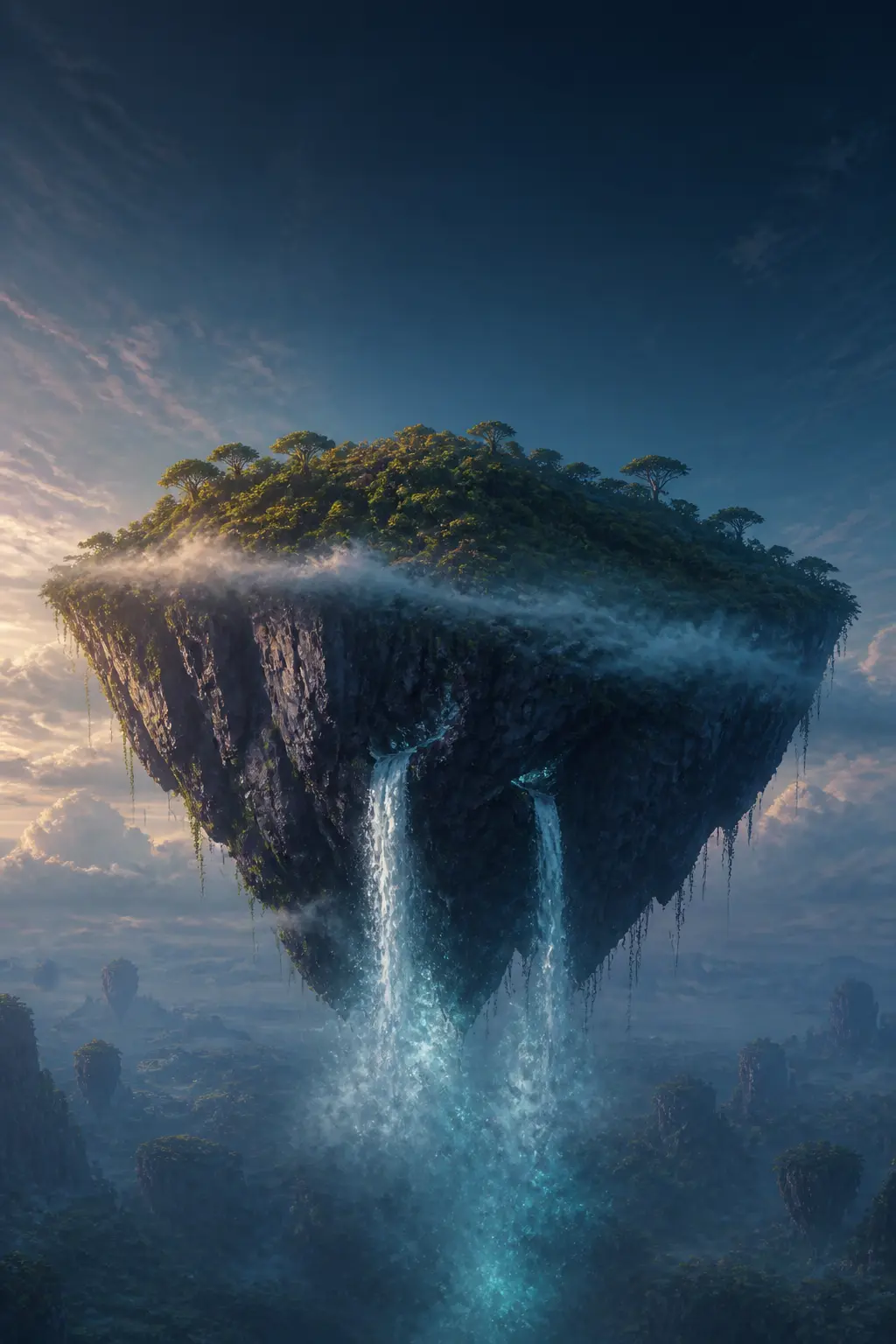
Find the underside of one of the floating mountains and look at what is happening there.
Not the top of it, which is the view everyone paints — the green plateau, the vines, the ikran rookeries on the crown. Look underneath, at the raw fractured belly of the rock where it hangs kilometres above the forest. Water is coming out of it. A seam opens somewhere near the lowest point of the mass and a ribbon of white water walks out of the stone into open air, falls for a while, loses its nerve, and comes apart into a drifting veil of mist long before it finds the ground.
It is one of the loveliest images in the whole of Pandora, and it is quietly one of the most alarming, because of what is not in the frame. There is no snowfield above that seam. No lake. No river arriving from somewhere higher. Above that rock there is nothing at all but sky. And yet water is leaving it, continuously, and has apparently been leaving it for as long as anyone has looked.
Every waterfall on Earth is the bottom end of something larger. Behind Angel Falls stands a tableland gathering rain across hundreds of square kilometres; behind Niagara stands a chain of inland seas. A waterfall is not a source. It is a drain — the visible place where a large invisible catchment finally hands its water to gravity.
Here there is no higher up. So the ribbon coming out of that rock is either arriving from somewhere the eye cannot see, or the mountain is draining itself dry — and if it were draining itself dry, the plateau on top of it would not be a rainforest.
The books have to close. That is not a poetic sentiment; it is the strictest rule in this chapter and the one we are going to use as a crowbar. Water is conserved. Whatever leaves must have arrived, and if the outflow is steady the inflow is steady too, and if you cannot see the inflow it is because you are not yet looking at the right thing.
So let us go and find it. Working out where that waterfall gets its water will take us up through the canopy of an entire moon, into the physics of how a cloud decides to rain, through an afternoon thunderstorm and the strange daily shadow that interrupts it, out over an ocean building a heat engine, and back down a river to the ground. By the time we return to that seam we will be able to do arithmetic on it — and the arithmetic, I should say now, does not entirely come out in Pandora's favour. That is fine. An honest shortfall tells you more about a world than a comfortable answer.
The books must close
Start with the least intuitive fact about water on any world: the sky holds almost none of it.
Take all the water vapour in Earth's entire atmosphere — every cloud, every haze, every invisible molecule of humidity in the whole column from sea level to space — and condense it out onto the surface as liquid. You would get a film about two and a half centimetres deep. That is the planetary reservoir of airborne water: a puddle you could step over.
Now set that against what falls out of it. Earth precipitates roughly a metre of water a year, averaged over its whole surface. A metre out of a two-and-a-half-centimetre store means the atmosphere empties and refills something like forty times a year — once every eight or nine days. That is the residence time of water in the air, and it reframes the sky entirely. The atmosphere is not a tank. It is a conveyor, running fast, holding barely a week's worth of cargo at any instant.
Hold the implication, because it is severe. A world where it rains hard every day forever cannot be drawing on some vast atmospheric savings account. There is no such account. Constant heavy rain requires constant heavy evaporation, running at almost exactly the same rate, all the time. A permanently wet world is not a world with a lot of water stored in its sky. It is a world with a very fast pump.
And Pandora looks, from every angle canon gives us, like a permanently wet world. The rainforests of the Omatikaya lowlands are never shown in drought — no seasonal leaf-fall, no dry-season browning, no fire scars from an annual dry spell. Rivers run through the understory year-round. The Clouded Forest of the Western Frontier sits under near-permanent fog immersion, its understory thick with epiphytes and hanging roots, plants that live by taking water straight out of saturated air. Nothing in the official record gives a rainfall figure, but the ecology on display is that of somewhere receiving several metres a year, comfortably more than the Amazon.
So we are looking for a pump, and we know roughly how big it has to be. On a world that is nearly all rainforest, what is doing the pumping turns out to be standing right in front of us, in a form so ordinary it takes an effort to see as machinery.
The forest is the pump
A leaf is a hole in a plant, and the hole is the whole problem.
To build sugar a leaf must let carbon dioxide in from the air, and the only way in is through pores in its surface. But a pore that admits gas also releases it, and the inside of a leaf is a wet space at nearly a hundred per cent humidity sitting in air that is drier. Open the pore and water walks out. This is transpiration, and it is not a leak the plant tolerates — it is the engine dragging the entire water column up the trunk, a chain of molecules pulled from the roots by evaporation happening tens of metres overhead.
Multiply one leaf by a canopy and you have a landscape-scale pump. In a wet tropical forest, transpiration is the largest single route by which water leaves the ground for the sky — around two-thirds of the total, with most of the rest coming from rain evaporating straight off wet leaves and bark before it reaches the soil. Only a small fraction comes from the ground itself; under a closed canopy the forest floor is dim and still and barely evaporates at all. The whole business together is evapotranspiration, and over a rainforest it is enormous.
What sets the rate? Not, as the intuition insists, how much water the plant has. What sets it is how thirsty the air is — and thirst is subtler than humidity.
Air has a ceiling on how much vapour it can carry before condensation starts, and that ceiling climbs steeply with temperature: roughly seven per cent more capacity per degree of warming, a relationship called the Clausius–Clapeyron relation and one of the few places in atmospheric physics where a clean exponential really does govern the world. Now take the gap between that ceiling and the vapour actually present. That gap is the vapour-pressure deficit, and it, not relative humidity, is the force pulling water out of every wet surface in a landscape.
The distinction matters because the two can move in opposite directions. Air at ninety per cent humidity sounds saturated and gentle. Warm that air by fifteen degrees while keeping the humidity reading identical and its capacity has nearly doubled, so the actual pull has nearly doubled with it. Hot humid air can dry a leaf faster than cool dry air. Gardeners know this in their hands; the physics is the bookkeeping behind it.
Now bring Pandora's air to the leaf, and the arithmetic does something interesting — though not the thing you would first guess.
Pandora's atmosphere is heavily loaded with carbon dioxide, at a concentration lethal to a human lung and luxurious to a leaf; What’s Really in the Air? is where that lethality gets its due. For a plant it means the currency it came to the pore to buy is abundant. It can take on all the carbon it needs while opening its pores far less than an Earth plant must — and a barely-open pore leaks far less water. Per leaf, per hour, a Pandoran canopy should be markedly stingier with water than ours.
Which sounds like it should throttle the pump. It does not, because a forest is not one leaf. When water is cheap to keep, a plant can afford to build far more leaf: more canopy layers, deeper tiers, more total surface standing in the light. What the individual pore saves, the sheer quantity of pores spends. The pump stays large; it is simply built from many efficient units rather than a few wasteful ones. And from the energy side: over a wet, densely vegetated surface the overwhelming majority of absorbed sunlight goes into evaporating water rather than heating air. A landscape like that converts light into vapour with brutal efficiency, and Pandora — wetter, greener, more thoroughly forested than Earth — should do it better than we do.
So the pump exists and it is strong. But a pump that lifts water straight up and lets it fall straight back down does not yet explain a continent. The water has to travel.
Rivers that run in the air
Here is a question that sounds like it has an obvious answer and does not. Why is the middle of the Amazon wet?
The coast is easy: the Atlantic sits there, trade winds pick up moisture off warm water and carry it inland, and the first stretch of forest gets rained on. But the rain does not stop at the first stretch. It keeps falling, hard, three thousand kilometres from any ocean, on the far side of a continent. Air travelling that distance over land should have wrung itself out and arrived dry. Something is topping it up as it goes.
The something is the forest. Rain that falls on the canopy is largely returned to the sky by that canopy within days, and the air — still travelling west — carries it inland to fall again. Then again. Isotope measurements can actually see this happening: rainwater carries a chemical signature of how many times it has been through the cycle, and the signature deepens steadily as you move inland from the Atlantic. Water crosses the basin in four to six serial hops, each one a rainfall and a re-evaporation, so that by the time it reaches the Andes a substantial share of the rain has already fallen at least once on the way. This is precipitation recycling, and in the Amazon it accounts for something between a third and a half of all rainfall. The moisture streams that do the carrying are wide enough and wet enough that people started calling them flying rivers, which is unscientific and entirely accurate.
The consequence is the part that unsettles people. The forest is not merely growing where the rain happens to be. It is upstream of its own rain. Cut down the coastal third of it and the interior does not stay wet on the strength of its own remaining trees — it dries out, because the machinery that was resupplying its air has been dismantled several hundred kilometres away, in a place its inhabitants would never think to look.
The rain a forest makes for itself
Follow one column of air inland and watch how much of the rain has already fallen once.
Each bar is the rain wrung out of the column over 500 km of fetch. The bright upper part is water a leaf sent back up; the dim lower part is vapour still on its first pass from the sea.
Set the world to Pandora and the case only sharpens. A moon that is very nearly all rainforest, with wide oceans and a warm, heavily humid, unusually dense atmosphere, is the ideal machine for this. Each pass returns a little more, because the pump feeding it is stronger; the recycled fraction accumulates faster with distance inland. On a world like that, essentially nowhere is truly far from water, because the forest carries the ocean with it.
This also settles something the geography chapter left standing. I.5 — Continents, Oceans and Climate argued that Pandora's slow spin widens its tropical circulation until the wet belt covers most of the moon and the subtropical deserts are pushed out to high latitudes and mostly starved of a chance to form. Recycling is why that wide belt stays wet all the way through instead of merely wet at its edges. The circulation delivers the water to the coast. The forest is what moves it inland.
Which brings us to a step in the cycle that everyone assumes is automatic, and which is in fact the hardest step of the lot. We have the water into the air. Getting it back out is a genuinely difficult trick.
Making a drop heavy enough to fall
A cloud is not rain waiting for permission. A cloud is a stable object, and it can sit over a landscape all day being conspicuously full of water without a drop reaching the ground. Understanding why is the most quietly surprising thing in this chapter.
Two separate barriers stand between vapour and a falling raindrop, and they fail in different ways.
The first barrier is starting at all. Suppose the air is saturated and a few water molecules happen to bump into one another and stick. They have made a droplet perhaps a nanometre across, and that droplet is in terrible trouble, because it is almost all surface. Surface tension curves the water so tightly that molecules at the outside are barely held — they escape far more readily than they would from a flat pond. To keep a droplet that small from evaporating instantly, the air would have to be not just saturated but wildly supersaturated: several hundred per cent humidity, four or five times saturation. No atmosphere on any world ever gets remotely that wet. By this route, rain is impossible.
The way out is that real air is filthy. It is full of specks — sea salt, sulfate, dust, and over forests a haze of organic compounds the trees themselves emit — and many of these specks are hygroscopic: they dissolve in water, and dissolved salt lowers the vapour pressure above a solution. So a droplet condensing on a speck is fighting curvature, which wants it to evaporate, while being helped by dissolved solute, which wants it to stay. These specks are cloud condensation nuclei, and the competition between the two effects is Köhler theory.
The shape of that competition is what makes it beautiful. Solute helps most when the droplet is tiny and the solution concentrated; curvature hurts most when the droplet is tiny too, but it fades more slowly as the droplet grows. Plot the humidity a droplet needs against its size and you get a curve with a peak. Below the peak, the droplet is stable: give it a little more humidity and it swells slightly to a new equilibrium; take humidity away and it shrinks back. That is haze — the slight milkiness of humid air, millions of tiny droplets breathing with the moisture and going nowhere. But push the humidity past the peak and there is no equilibrium anywhere to the right. The droplet finds itself always able to grow, and it goes. That crossing is called activation, and every raindrop that has ever fallen on any world began with it.
The second barrier is that growth quits. An activated droplet grows by vapour diffusing onto it, and that process has a mean streak: the rate at which the radius increases falls off as the radius rises. Early growth is brisk. By twenty micrometres it has become glacial. And a twenty-micrometre droplet is not rain — it falls at about five centimetres a second, so slowly that the gentlest updraught holds it up indefinitely. That is cloud. Wait as long as you like; diffusion alone will not carry it further.
What finishes the job is a completely different mechanism. Because fall speed rises with size, a slightly larger droplet descends slightly faster than its neighbours, and as it goes it sweeps them up. Every capture makes it bigger, bigger makes it faster, faster makes it sweep a longer path per second. The process accelerates into itself. This is collision–coalescence, and it is what makes warm tropical rain — the kind that dominates on a hot, wet, cloud-rich world.
The gap it has to cross is worth stating in numbers, because the numbers are absurd. A cloud droplet is around ten micrometres in radius; a raindrop is around a millimetre. That is a hundredfold in radius, which is a millionfold in volume. One raindrop is a million cloud droplets. Rain is not condensation continued a little longer. It is an entirely separate mechanism assembling a million pieces of cloud into one falling object.
Two barriers between vapour and rain
A drop must first be allowed to start, and then find a second way to grow.
Can it start? — the humidity a speck needs before a droplet runs away
Can it fall? — how fast the drop sinks as it grows
Both panels share one ruler along the bottom, so a droplet's place on the activation curve is its place on the growth track. Pure vapour would need roughly five times saturation to nucleate unaided — which is why every raindrop on any world begins on a speck of something else.
Now Pandora's two dials. The moon's gravity is around four-fifths of Earth's, and its air roughly a fifth denser. Both push the same way on a falling drop: less weight pulling down, more drag pushing back. Run it through and every hydrometeor on Pandora falls about twenty per cent slower than its Earthly twin at the same size.
Which sounds like a small correction and is not, because fall speed is what sets how long a drop stays inside the cloud, and time inside the cloud is what collision–coalescence spends. Drops on Pandora linger, sweeping up neighbours for longer before they leave. And when they finally arrive they arrive gently: a large Pandoran raindrop lands at a pace an Earth drop would consider a stroll. Combine that with the taller cloud columns a low-gravity atmosphere permits — thinner air pressure decline with height means more room to build vertically — and you get precipitation that is voluminous, soft, and slow. Not the stinging tropical downpour of an Earth monsoon. Something heavier and more patient.
The storm, and the shadow that interrupts it
Anyone who has spent a week in the tropics knows the rhythm. Clear bright morning. By eleven, small flat-bottomed clouds. By one, they have grown vertically and turned bruised underneath. By three, the sky has opened. By five it is over and the light is extraordinary. The same performance, near enough, every day.
That rhythm is a machine with a specific ignition sequence, and it is worth walking through because Pandora is going to break it.
Sunlight heats the ground; the ground heats the air in contact with it; warm air is buoyant and rises. As a parcel rises it expands into thinner surroundings and cools, and at some altitude it cools to the point where its water vapour begins condensing. That altitude is the lifting condensation level, and it is why the small clouds of late morning all have flat bottoms at the same height — you are looking at a contour line in the atmosphere, the level where the air's own moisture gives out.
Above that level the parcel gains an advantage. Condensation releases latent heat, so a saturated rising parcel cools more slowly than a dry one, which means it can stay warmer than its surroundings and keep rising under its own buoyancy. How much energy that gives it is measurable, and meteorologists call the total convective available potential energy. Read a morning sounding, integrate the buoyancy a parcel would gain over its whole ascent, and you have a number that predicts the afternoon: a few hundred joules per kilogram and you get harmless cumulus; a couple of thousand and you get a thunderstorm; four thousand and you get something people talk about afterwards.
Pandora should run this engine hard. It has heat, it has water without limit, and it has an atmosphere both denser and — with lower gravity stretching the pressure profile upward — deeper than ours, giving a convective tower more vertical room to work in. The lower gravity does trim the buoyant acceleration a little, so Pandoran updraughts should be broader and less violent than Earth's most extreme, but they should be enormously tall, and they should be reliable.
Except that on Pandora, the sun goes out in the middle of it.
Polyphemus is a gas giant and Pandora orbits close, so the moon passes regularly into the planet's shadow. The mechanics of that schedule belong to I.3 — Time on Pandora and I will not re-derive them; what matters here is the single meteorological fact that falls out. On a predictable, frequent basis, the shortwave energy driving the entire convective machine is switched off, in the middle of the day, and then switched back on.
Canon has nothing whatever to say about the consequences. Not a line. It is, by my reading of the record, the single largest unexamined meteorological question about the moon.
But we can say something, because Earth runs the experiment for us — briefly, and in miniature, at every total solar eclipse. Eclipse meteorology is a real and rather charming discipline, precisely because it offers atmospheric scientists something they almost never get: a large, clean, perfectly scheduled change in one variable. The measurements are consistent across campaigns.
The instant the disc is covered, incoming shortwave radiation goes to zero. The ground, which has little thermal mass, responds within a couple of minutes and drops by several degrees. The air a couple of metres up follows more slowly and less far, lagging the radiation minimum by ten to twenty minutes and cooling by perhaps a degree or three. Then the interesting part. The upward flux of heat from surface to air does not merely weaken; it reverses — and it does so ten to fifteen minutes before totality, while most of the sun is still visible. The engine stalls well before the fuel is fully cut. Turbulence in the boundary layer decays, thermals stop rising, and the whole convective layer collapses within fifteen to thirty minutes. Shallow cumulus clouds — the ones being actively fed by those thermals — begin dissipating when the sun is only fifteen to thirty per cent obscured. Observers have watched the sky clear as the eclipse approached. There is even a documented eclipse wind: surface winds slacken by a tenth to a third and swing direction, because the thermal gradients organising them have been withdrawn.
Apply that to a world where it happens on a schedule and a plausible daily rhythm falls out — inference, but inference with measurements underneath it. Morning heating builds convection normally. The eclipse arrives and the convective layer collapses ahead of it, the small clouds thin, and rainfall over land is suppressed for the duration. Then the shadow passes, the shortwave returns to a surface that is still warm and an atmosphere that is still loaded with water, and convection restarts into unusually favourable conditions. The likely signature is not less rain but bimodal rain: a morning build, an eclipse lull, and a vigorous late recovery. Whether the recovery overshoots — whether the pause lets instability accumulate and then releases it harder — is exactly the sort of question you would need a real circulation model to answer, and I am not going to pretend otherwise.
When the sea builds an engine
Over land, the daily storm assembles at dawn and is gone by evening. Over water, something with a longer memory can form.
In The Way of Water the Metkayina live with a sea that is genuinely oceanic — deep swell arriving from far off, squall lines walking across open water, weather that has to be read rather than merely endured. That is a different régime from the forest's afternoon shower, and it is worth understanding on its own terms, because a tropical cyclone is the most efficient machine any atmosphere builds.
The trick is that it is a heat engine in the strict thermodynamic sense. Warm sea water evaporates into air spiralling inward across the surface; that air is drawn up the eyewall, where its vapour condenses and dumps latent heat; the spent air flows outward near the tropopause and radiates the heat to space at a much colder temperature. Heat taken in hot, released cold, work extracted in between — the definition of an engine. And like any engine, its efficiency is capped by the temperature difference between where it takes heat in and where it puts it out. Kerry Emanuel built this insight into a formula for a storm's potential intensity: the strongest it could possibly get given the sea-surface temperature, the outflow temperature aloft, and how much moisture the sea can hand over. Real storms rarely reach it, but nothing exceeds it, and the ceiling has been rising in recent decades for the reason you would expect.
Which explains the notorious threshold. Cyclones need a sea surface above roughly twenty-six and a half degrees, and not because that is where evaporation becomes possible — it happens at any temperature — but because that is roughly where the engine's efficiency and moisture supply become sufficient to overcome the friction dissipating its own winds. Below it the machine cannot pay for itself. They also need a deep warm layer, because a storm churns cold water up from below and can strangle itself on its own wake, and they need weak vertical shear, because a storm leaning over cannot keep its warm core stacked above its centre.
And they need one more thing, which is where this section earns its place in a chapter about water on a spinning moon. They need rotation.
Now the Pandoran arithmetic, which pulls in two directions and is worth doing carefully rather than hand-waving.
The moon's air is denser than ours, and a denser fluid carries more momentum at the same speed. A given wind therefore hits harder — the pressure a gale exerts scales with density, so a hundred-kilometre-an-hour Pandoran wind lands like a considerably faster Earth wind. Seas built by such a wind should be correspondingly larger, which fits the deep swell the films show. But density also raises the friction the storm must overcome at its own base, and friction is the thing eating the engine's output. Denser air is both a better hammer and a heavier brake.
Meanwhile gravity, at four-fifths of Earth's, works on the other side. Weaker gravity means the pressure a given air column exerts is lower and the atmosphere stands taller, so a storm has more vertical depth to work with and its outflow can reach a colder altitude before it spreads — and a colder exhaust means a more efficient engine. Against that, weaker gravity makes it harder to sustain the steep pressure gradients that drive the fiercest winds.
The one thing that scales cleanly is size. The radius at which a cyclone's winds peak depends on the balance between the inward pressure gradient and the Coriolis deflection turning the inflow, and a slower-spinning world with a taller atmosphere favours broad over tight. Pandoran cyclones should be wide, deep, slow-turning systems — geographically enormous, less concentrated at the core than Earth's most vicious storms, and carrying vastly more total water. A storm you would see coming for a day and feel for two.
Down to the ground
Rain that reaches the surface has one more journey, and it leaves a signature that can be read from orbit.
Water running downhill collects: two rivulets make a stream, two streams a creek, two creeks a river. What is striking is how regular the collecting is. Count the channels of each rank in almost any drainage basin on Earth and you find that each rank has three to five times as many members as the rank above it, that each rank's channels are consistently longer than the last, and that each drains a consistently larger area. Robert Horton set these regularities down in the 1940s and they have held up across basins on every continent, in every climate, on every rock type. A river network is a fractal — the same branching logic repeating at every scale, which is why a satellite image of a catchment gives no clue to its size without a scale bar.
The reason appears to be economy. Water flowing downhill dissipates energy against its bed, and among all the ways a landscape could route its drainage, the arrangements that actually form are close to those that minimise total dissipation across the whole basin. The network is a solution to an optimisation problem nobody set. What varies between climates is not the branching pattern but its fineness: drainage density, the total channel length per unit area, which rises where rain is heavy and rock is weak and falls where the ground drinks water and the rock resists. A wet world on soft substrate should be finely, densely veined.
For Pandora this is a prediction with nothing to check it against. There is no official map showing a river's catchment anywhere on the moon — no headwaters, no divides, no basin outlines. The rivers exist on screen and end at the edge of the frame.
Between storms, rivers keep running, and the reason is underground. Rain that soaks in moves through rock and sediment slowly — through gravel in days, through fractured stone in years, through tight rock barely at all — and seeps out into channels long after the storm has gone. That slow contribution is baseflow, and it is what separates a perennial river from a wadi. Hold this idea, because it is about to matter a great deal: a landscape with subsurface storage can pay out water at a steady rate long after the inflow that filled it has stopped. Storage buys time. It cannot create water.
And rain, arriving, takes the land apart. Flowing water exerts shear on its bed; past a threshold it lifts grains and carries them; carrying them, it grinds. The rate at which a channel cuts down into bedrock scales with how much water it carries and how steeply it falls, which is the useful content of the stream-power incision law — and it is why mountains and rivers are best understood as opponents. Uplift builds relief; water removes it. Where they balance, a landscape holds its shape while every atom in it is in transit. What builds Pandora's relief in the first place is a separate problem, belonging to the moon's interior rather than its sky; here we take only the destruction side.
Which brings us to waterfalls, and to a fact that ought to be unsettling.
A waterfall is a step in a river's profile — a knickpoint — and it is not a permanent feature. Water plunging over a lip lands with concentrated force at the base, excavating a plunge pool, undercutting the rock face above it until the overhang collapses. The lip retreats upstream. Then it happens again. Niagara has walked some eleven kilometres up its gorge since the ice left, and it is still going; at its historical rate it will consume itself entirely in something like fifty thousand years. Every waterfall on Earth is a wound migrating up a river, and it survives only if something keeps renewing the step — resistant caprock, or ongoing uplift lifting the land faster than the water can saw through it.
Now hold that beside the image we started with. The cataracts on the floating mountains are not cutting back into anything. There is no gorge behind them, no upstream channel to retreat along. They simply leave the rock and fall into air.
Which means they are not knickpoints at all. They are something with no terrestrial equivalent, and we have run out of analogies to lend them. Time to do the arithmetic.
The impossible waterfall
We now have everything we need to go back to the seam in the rock.
Recall the constraint. There is no catchment above the massif; nothing higher up is collecting rain and sending it down. Whatever leaves that seam must have been taken directly out of the air by the rock itself — so the only mechanism available is the one the Clouded Forest already demonstrates: catching fog.
This is a real thing, not a dodge. Meteorologists call it occult precipitation — hidden rain — and it is exactly what it sounds like. Where cloud sits directly on a mountainside rather than above it, the microscopic droplets in that cloud do not fall; they drift, and they collide with whatever stands in the way. Leaves, moss, epiphytes, bare rock. Enough collisions and enough coalescence and the droplets become a film, the film a drip, the drip a flow. A standard rain gauge, which only catches what falls vertically, registers none of it — which is where the name comes from. The water is invisible to the instrument meant to measure water.
It matters more than its obscurity suggests. Cloud forests on Earth are quantitatively dependent on it. At Monteverde in Costa Rica fog deposition runs at one to three and a half millimetres a day and supplies twenty to thirty-five per cent of the catchment's annual water; in the Luquillo mountains of Puerto Rico, half a millimetre to a couple; on Hawaiian montane slopes it can reach five millimetres a day and account for up to half of dry-season recharge. These are catchments where the trees are, in a real sense, combing water out of the air — and where felling the forest cuts the water supply directly, because the comb was what collected it.
And Pandora should be unusually good at it. Its air carries more water and is denser, so a cubic metre of Pandoran fog delivers more liquid to whatever it hits. The massifs hang directly in the cloud layer, wrapped in it constantly. Their plateaus are covered in precisely what captures fog well: dense vegetation, hanging vines, epiphytes, a vast surface area of wet foliage. If any structure anywhere were built to harvest fog, it is a forested rock suspended inside a cloud.
So let us find out whether it is enough. Set the size of the massif, the water the fog carries, how briskly the wind drives it through, and how much of what arrives the rock catches. Then set the size of the cataract you are trying to feed, and see whether the two columns meet.
Paying for a waterfall with fog
A floating mountain has no watershed. Every litre leaving its rim was caught from the air.
Canon shows the waterfalls and never says how big they are, so the discharge is yours to set. The dark line across each column marks its split: on the left, plateau capture beneath face impaction; on the right, the forest's own thirst beneath the visible fall.
They do not meet. Not close.
Run it honestly with generous terrestrial numbers and a fog-wrapped massif a few kilometres across captures on the order of a cubic metre of water per second — and after the plateau forest takes its share, rather less than that is free to leave over the rim. That is a respectable stream. It is not the white cataract in the opening image, which if it has anything like the visual scale the films give it must be moving tens of cubic metres per second at minimum. The shortfall is not a matter of tuning a coefficient. It is more than an order of magnitude.
Two levers narrow it, and both are inference rather than canon.
The first is aerodynamic. The massifs hang in clusters, with gaps between them, and air forced through a constriction speeds up. Fog capture scales with wind speed twice over — faster air delivers more fog per second to the same rock face, and impacts it harder, raising the fraction that sticks rather than sweeping past. A massif in the throat between two neighbours could plausibly capture several times what an isolated one would. That is the switch on the model, and it moves the answer materially. But nothing in canon says the gaps do this. It is a mechanism I am proposing because the budget demands one, which is the weakest possible reason to believe anything.
The second is storage. If the rock is fractured and holds water internally — and canon describes the massifs as karst-like sandstone, exactly the sort of rock that stores water in fissures — then the plateau is not paying its bills from daily income but from a reservoir, filled over centuries and drawn down over centuries. That decouples outflow from inflow: the cataract can run at a rate the fog cannot sustain, for a long time, provided the reservoir is deep enough. But recall what baseflow taught us. Storage buys time; it does not create water. A massif running on stored water is not solvent. It is spending down, on a schedule too slow for anyone to notice.
So where does that leave us? With a verdict I would rather state plainly than soften.
The mechanism is right. Fog interception on a rock suspended inside a permanent cloud layer is the correct explanation for how a floating mountain gets water at all, and it explains a great deal: why the plateaus are lush rather than bald, why they carry forest and not just moss, why they are perpetually wet, why there is any flow over the rim whatever. Everything about the physics points the right way, and Pandora's thicker, wetter air makes it work better there than here.
The magnitude is wrong. The cataracts as filmed move more water than fog interception can deliver by roughly an order of magnitude, and no honest setting of the dials closes that gap. Something has to give: either the falls are considerably smaller than they look on screen, or the massifs are drawing down ancient internal reserves, or Pandora's fog is doing something we have no terrestrial measurement to justify.
I find the first of those most likely and least dramatic. A stream of a cubic metre per second, falling two thousand metres in dense air, would break up into spray almost immediately and drift for kilometres — which is exactly what the films show. Perhaps the cataracts only look like cataracts because we are watching a modest flow disintegrate spectacularly in thick air. That would reconcile everything, and it is not what the shot is trying to convey.
Which is a good place to be. We came to this with an image and no numbers, and we leave with a mechanism, a budget, and a specific quantified shortfall that names exactly what would have to be true for the picture to hold. That is more than the story gives us, and considerably more useful than either accepting it or dismissing it.
Reading the seams
A specimen is only honest if you read its cracks, so here are the ones this chapter has been walking around.
The largest is the one we just quantified, and it is worth being precise about what kind of gap it is. It is not a case of canon contradicting physics — canon simply never engages. There is no proposed mechanism to be wrong. The cataracts are shown, beautifully, and the question of what feeds them is not asked. The one sentence of companion material that touches it describes the loop rather than the work that drives it. So the shortfall is not a contradiction; it is an unexamined bill, and this chapter is the first attempt I know of to add it up.
Beneath that sit a set of silences that are ordinary but limiting. There is not a single quantitative figure anywhere in the official record about Pandora's water cycle. No annual rainfall. No humidity. No evaporation rate. No seasonality. Every number in this chapter is either Earth's or derived from Earth's using canon's atmospheric parameters, which is the best that can be done but is not the same as knowing.
There is no hydrological map. The released regional maps show terrain and named places, not catchments — no headwaters, no drainage divides, no basin outlines anywhere on the moon. So the river-network reasoning in this chapter predicts a texture nobody has drawn, and cannot be checked against anything.
The eclipse question is entirely open. Canon establishes the eclipses in detail and says nothing whatever about their weather. The bimodal daily rainfall pattern I argued for is inference from terrestrial eclipse measurements, and those measurements are of an atmosphere being surprised — not of one that grew up under the rhythm.
And there are two smaller uncertainties worth naming. It is unclear whether Pandora has a cryosphere at all: no confirmed polar caps, glaciers or permafrost, which matters because ice is where a world keeps its long-term water buffer. And there is a resolved contradiction worth mentioning for honesty's sake — early development material described Pandora's oceans as caustic, which would have wrecked every argument here. The Way of Water settled it by having humans and Na'vi swim in that sea without harm. The working solvent is ordinary water. That older claim is superseded, not competing.
What stays open
Canon never says, and this is the moon's largest unexamined hydrological question. Fog interception is the only mechanism available and it is certainly part of the answer — it explains why the plateaus are forested rather than bald. But run the budget with generous terrestrial numbers and it delivers roughly a tenth of the discharge the films appear to show. Closing the gap needs either wind acceleration between neighbouring massifs, or drawdown of ancient water stored in fractured rock, or falls that are much smaller than they look.
Unknown. Not one official source gives a rainfall figure, a humidity value, or an evaporation rate. The ecology on display — no dry season, no drought, no fire scars, permanent fog in the montane forests — implies several metres a year, comfortably wetter than the Amazon. But that is read off the vegetation, not stated anywhere.
Nobody has said. Earth's eclipse measurements give the direction of every response confidently: convection stalls ten to fifteen minutes before totality, shallow cloud dissipates at fifteen to thirty per cent obscuration, the boundary layer collapses within half an hour, and a measurable eclipse wind develops. That argues for a morning build, an eclipse lull, and a vigorous late recovery. But terrestrial eclipses are shocks to an atmosphere that has never had one, and Pandora's evolved inside the rhythm. What the adapted steady state looks like is genuinely unknown.
Undrawn. The released maps show terrain and settlements, not catchments — no headwaters, no divides, no basin outlines. So the drainage-network predictions here describe a texture the maps have never charted.
Unconfirmed. Na'vi oral lore refers to frozen lands and concept material has gestured at polar regions, but no primary source establishes permanent ice caps, glaciers or permafrost. It matters more than it sounds: ice is a slow reservoir, and a world without one has no long-term buffer against changes in its water budget.
Back to the seam
Go back, then, and look again at the water walking out of that rock.
It is no longer coming from nowhere. It is coming, by the longest possible route, from the sun. Light lands on an ocean and on several million square kilometres of forest, and most of that energy goes not into warming anything but into tearing water molecules out of the liquid state — an ocean evaporating, a canopy transpiring, a whole moon exhaling. That vapour rises into an atmosphere that can hold only about a week's worth of it, is carried inland and upward by the circulation, and where it meets the cold it condenses onto specks of salt and dust and organic haze into cloud. Some of that cloud drifts against a rock hanging in the sky. Droplets too small to fall collide with wet leaves and fissured stone, and combine, and run, and gather in the fractures of a suspended mountain until they find a seam near its lowest point and leave.
Which is to say: the waterfall is the visible end of a machine that spans an entire world, and the mountain having no catchment above it was never the problem. Its catchment is the sky, and the sky's catchment is everything below.
I like that the numbers do not quite work. A world where every sum balanced on the first attempt would be a world someone had finished designing. This one has a bill outstanding, and the bill is specific: about an order of magnitude, payable in fog, wind or stored water, and nobody has said which. That is a far better thing to be left holding than an answer.
And the machinery itself is not Pandora's. It is the general case. Take any world at all — one you will never visit, four light-years off, known to you as a dip in a star's brightness — and if you can estimate its temperature, its gravity, the density of its air and how much of its surface is wet, then you can say something real about its water. Whether it can hold vapour at all. How fast its atmosphere turns over. Whether its rain falls hard or drifts. How big its storms can get before thermodynamics stops them. Whether its rivers would run all year or only after storms. You will not have the map. You will have the physics that draws it — which, as this chapter has been quietly arguing all along, is the more portable of the two.