

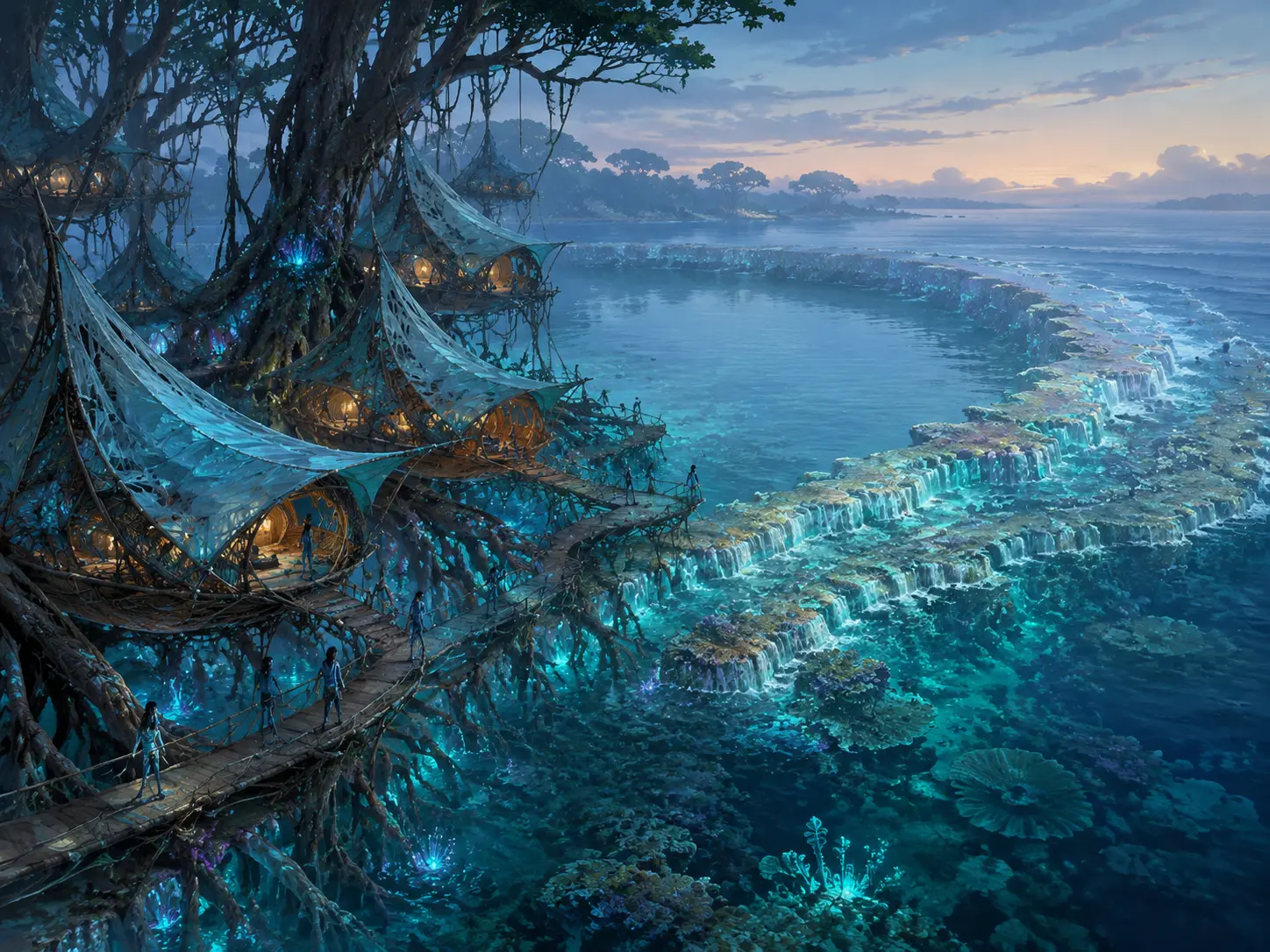
The Metkayina village of Awa'atlu is built on nothing that a geologist would call ground.
Walk out along one of the woven walkways at low light and you can see the whole arrangement. The homes — the marui pods — hang from the aerial roots of trees that stand in the water, their canopies lashed tight against the wind. Beyond them, a long pale rampart curves across the sea in cascading steps, breaking the ocean swell into a calm lagoon where children learn to dive. None of it was quarried. None of it was poured. The roots are alive. The rampart is alive, or was until recently. The floor of the lagoon is the accumulated skeleton of animals that have been dying in place, on top of one another, for longer than the clan has kept memory.
This is worth pausing on, because it inverts something we take for granted. On Earth we build on the land — we clear it, level it, drive piles into it, and treat it as the inert stage on which life happens. The Metkayina do the opposite. Their foundation is the single largest living thing in their world, and their whole settlement is a tenant inside it.
The obvious question is how that could possibly work. A house needs something rigid under it. Rigidity, on Earth, means stone — and stone means geology, tectonics, the slow crush of mineral processes with no biology involved. So what does it mean to stand on a floor that an animal grew? And if the floor is alive, what happens to the village when the floor gets sick?
What the reef is actually made of
Start with the rampart, because it is the clearest case.
Canon calls the seawall a reef, and shows it as a series of cascading, rimmed terraces — companion material puts the outer arc at a radius of something like six kilometres — that intercept the open-ocean swell and dissipate it before it reaches the lagoon. That is a real engineering function: a breakwater. What canon does not spell out is the chemistry. Is the terrace made of the same stuff as an Earth coral reef? Is it calcium carbonate at all? The films are silent, and it is worth being honest that this is a gap rather than a fact. But the shape — the branching and massive frame-building organisms carpeting the shallows, the rimmed terraces, the way the structure is described as accreting over "thousands of years" — is close enough to an Earth reef that the Earth comparison earns its place.
So let me make the comparison carefully, and flag where it stops.
On Earth, a biogenic reef is a geological structure built entirely by living organisms. That phrase gets said quickly and its strangeness slides past. Let me slow it down. A reef is a landform — it shows up on charts, it wrecks ships, it changes coastlines — and it was made without tectonics, without sediment settling out of a river, without any of the processes that make ordinary rock. It was made by animals pulling dissolved minerals out of seawater and laying them down as skeleton, generation after generation, until the skeletons piled into a wave-resistant ridge. The habitat is not around the organism. The habitat is the organism's accumulated body.
An ecologist has a precise name for a creature that does this, and it comes from the same 1994 paper by Clive Jones, John Lawton and Moshe Shachak that gave us ecosystem engineering in the first place. A coral is an autogenic engineer — an organism that modifies its environment through its own physical structure, its living and dead tissue being the modification. A beaver is the other kind, an allogenic engineer: it changes the world by moving things around, building a dam out of felled trees. A coral changes the world simply by existing and then dying in place. Its skeleton does not decompose and vanish. It stays, and the next coral builds on top of it.
The trees the homes hang from are doing a gentler version of the same trick. Canon puts the marui pods on the aerial roots of giant mangrove-like trees, and lashes tensile woven canopies across the living root curvatures rather than driving dead pilings into the seabed. That distinction is doing real work. A dead piling can only rot, be bored by shipworms, and work loose. A living root grows, and that is the whole of the advantage. Canon shows the pods lashed to living curvature rather than to driven piles; the rest — thickening where the load is greatest, knitting new tissue after a storm, spreading strain across a flexing matrix — is what an Earth root does under those conditions, and my inference about a Pandoran one. The clan's engineers, in effect, chose a foundation that maintains itself. It is the same bargain as the reef, one step up: build on something alive, and it repairs the damage you would otherwise have to.
But where does a soft-bodied animal get the energy to precipitate rock? This is the part that makes reef-builders extraordinary rather than merely persistent.
A reef-building coral is not one organism. It is a coral holobiont — the animal host, plus a population of single-celled photosynthetic algae living inside its cells, plus an associated crowd of microbes, all running as one biological unit. The algae are the famous ones: zooxanthellae, mostly dinoflagellates of the family Symbiodiniaceae. The deal between animal and alga is one of the best bargains in biology. The coral gives the algae a lit, sheltered home and a steady supply of its own nitrogen- and phosphorus-rich waste. In return, the algae hand over ninety to ninety-five percent of the sugar they fix by photosynthesis.
That flood of solar sugar is the energy budget that pays for the skeleton. Which is why reefs are confined to clear, shallow, sunlit water — they are, in a real sense, farms. The coral is an animal that farms light, and it spends the harvest on limestone.
How you lay down rock in water
The laying-down itself is a small chemical drama worth watching, because it explains why the whole structure is more fragile than it looks.
A coral secretes its skeleton as aragonite, a form of calcium carbonate, in a thin sealed space between its living base and the rock it already sits on. To make the mineral, it combines calcium and bicarbonate drawn from seawater. But the reaction has a catch: every time a unit of carbonate crystallises, it releases a proton — an acid — into that sealed space, and acid dissolves carbonate. Left alone, the coral would poison its own construction site within seconds.
So it doesn't leave it alone. The animal spends energy running molecular pumps that bail protons out of the calcifying space, keeping it alkaline enough for the mineral to keep forming. And here is where the algae earn their keep a second time: their photosynthesis supplies both the raw chemical ingredients and the fuel for those pumps. In daylight, corals lay down skeleton several times faster than in darkness. The rock of the reef is, quite literally, solar-powered.
Keep that mechanism in mind — a coral building against a chemical headwind, only winning because it can spend energy to bail acid out faster than it leaks in. Every threat to a reef later in this chapter is a version of that balance tipping the wrong way.
A reef is a balance sheet, not a rock
Strip the Pandoran setting away and one idea is left standing, and it is the one that travels to any world.
A reef looks like a thing. It is better understood as a rate — or rather, a difference between two rates. At every point on a reef, some organisms are adding carbonate and others are taking it away, all the time. Corals and coralline algae secrete it. Parrotfish scrape it off by the mouthful to get at the algae growing on it. Boring sponges, molluscs and worms tunnel into it from inside. Microbes and plain chemistry dissolve it. The reef persists only because, when it is healthy, the adding outpaces the taking.
Scientists make this literal. They go out and measure every term — how much each coral species lays down, how much the parrotfish and sponges remove — and add it up into a carbonate budget, in kilograms of calcium carbonate per square metre per year. A healthy Indo-Pacific reef runs a surplus of roughly four to ten kilograms. Push the live coral cover down far enough — below about ten or fifteen percent — and the same accounting flips negative. The bioerosion was always happening; it just used to be outrun.
A reef is a balance sheet
Builders add limestone; grazers and borers take it away. The sign of the difference decides whether the platform rises.
kg CaCO₃ per m² per year. Healthy reefs sit near +4 to +10; below roughly 10–15% live cover the budget flips negative.
The reason this matters for the Metkayina is direct. When net production is positive, the platform grows — it rises, it heals its own storm damage, it keeps its head near the surface. That is the version of the reef the clan can live on: a self-repairing foundation. When net production goes negative, the same structure starts breaking down faster than it rebuilds. The ground does not merely stop growing. It begins, slowly, to be dismantled by its own residents.
The slowest construction project on the planet
If the budget is positive, how fast does the ground actually rise? Slowly enough that "thousands of years" — the phrase canon uses for the Metkayina terraces — turns out to be exactly the right order of magnitude.
There is a trap in the numbers here worth clearing up. An individual branching coral can extend its tips by ten or twenty centimetres in a year, which sounds fast. But the reef — the consolidated, wave-resistant landform — accretes vertically at more like one to ten millimetres a year, with healthy reefs averaging a few. The gap between the two is all the breakage, grinding, and off-transport in between: most of what a coral builds is knocked loose, and only a fraction gets cemented into permanent framework, its voids packed with sand and bound by encrusting algae.
Run that arithmetic and a reef flat a few metres thick represents thousands of years of continuous accretion. Carry that rate across to Pandora and a Metkayina seawall large enough to break ocean swells is a structure older than most human civilisations, assembled one millimetre-year at a time. I flag the borrowed step plainly: canon never gives the Pandoran rate, and a faster-building reef would be a much younger one. Darwin worked out the grand version of this in 1842: as a volcanic island slowly sinks, a reef growing on its flanks can keep pace with the rising water, so that a fringing reef becomes a barrier reef with a lagoon behind it, and finally — when the island vanishes entirely — a ring-shaped atoll enclosing open water. The reef outlives the rock it started on.
Why the floor is crowded
There is a second reason the reef matters to the clan beyond simply holding them up, and it comes from the shape of what gets built.
Reef-builders do not lay down smooth pavement. They branch, they fold, they leave caves and overhangs and crevices at every scale. Ecologists measure this three-dimensional complexity as rugosity — roughly, how much more surface there is than a flat floor of the same footprint would have — and it turns out to be one of the strongest predictors of how much life a reef supports. Every crevice is a refuge from a predator, a nursery for something small, a surface for something else to grow on. Fold the structure and you multiply the number of ways to make a living inside it.
This is the link from "life builds structure" to "the structure feeds a village." The Metkayina subsistence is entirely marine — spearing fish along the reef crest, gathering from the terraced pools, riding ilu through the lagoon channels. All of that depends on the reef being complex, because complexity is what holds the fish. Flatten the reef and you do not just lose a pretty landscape; you lose the crevices, and the fish that lived in them, and the food the clan pulls out of them.
Rugosity is not a mood, though. It is a ratio you can go and measure: lay a chain over the reef, note how long the chain is, and divide by the straight distance it spanned.
The folds are the habitat
Lay a chain over the reef and divide its length by the distance it spans. That one number predicts how much life the ground can hold.
- Shallow crevices15
- Mid-sized hollows8
- Caves and overhangs3
A healthy branching framework runs at 2.5 or above; a rubble plain runs at 1.0. Notice which shelters go first as the index falls. The finest structure is the most fragile, so the shallow crevices vanish while the reef still looks like a reef — and the animals that fit only there have nowhere left to be. Notice also the second reading. The same folds that hold the fish are what dissipate the swell, so flattening the reef bills the village twice: once in food, once in the wave energy now reaching the lagoon.
A living, complex reef
A flattened, eroded reef
And there is a deeper puzzle sitting under all this abundance, one that reef scientists gave a name to long ago. Reefs blaze with life in exactly the waters that should be deserts — clear tropical seas so poor in dissolved nutrients that the clarity itself is a sign of scarcity. This is Darwin's paradox, and its resolution is that a reef is a nearly closed loop. Nutrients are not imported from rich water; they are held inside the system and recycled with ferocious efficiency — passed directly between coral and its internal algae, captured from passing water by sponges and handed back to the food web, trapped in the maze of cavities before they can wash away. The reef is not fed by its surroundings so much as it refuses to let go of what it already has.
What can kill a floor
Now return to the village, because everything above has a sharp consequence the Metkayina live inside.
Canon shows the reef being attacked in the ways you would expect from a war. RDA forces burn the coastal villages; because the marui pods hang from living trees, a canopy fire destroys the biological pilings and drops whole clusters of homes into the lagoon. Depth charges and sonar from the whaling ships shatter the fragile frame-builders, pulverise the shallow crest, and shear the fine neural tendrils of the communion sites. The Fire and Ash material adds volcanic fallout smothering the shallow shelves. These are all kinetic and thermal assaults — fire, blast, burial. They are real, and they are terrible, and they are also the easy kind of damage to understand, because they look like violence.
The lesson from Earth's reefs is that the deadliest threats do not look like violence at all.
The first is heat. The coral–algae partnership works only inside a narrow temperature window. Push the water just one or two degrees above the local summer maximum for a few weeks and the algae's photosynthetic machinery starts producing toxic byproducts faster than either partner can cope. The coral's response is to expel its algae — and with them goes the golden colour and, more importantly, ninety percent of its food. The bared white skeleton showing through translucent tissue is coral bleaching. A bleached coral is not dead; it is starving. If the heat relents it can take its algae back. If it does not, the animal dies, the skeleton is overgrown and bored, and the carbonate budget tips toward erosion.
The second threat is subtler still, and it goes after the chemistry of building itself. Remember the coral bailing acid out of its calcifying space, only winning because it can pump faster than acid leaks in. Now change the water it is pumping into. As the atmosphere fills with carbon dioxide, the ocean absorbs a share of it, and dissolved CO₂ makes seawater more acidic while eating away the carbonate ions the coral needs as raw material. This is ocean acidification, and its effect is measured by the aragonite saturation state — a number that says how strongly the water wants to let a skeleton form. The higher it is, the easier building becomes. Tropical surface water sat near four and a half before industrialisation and runs around three and a half today. Let it fall past roughly three and bare reef framework does not merely stop growing. It begins to dissolve.
When the water stops letting a skeleton form
More CO₂ in the air means less carbonate in the sea. Below a threshold, limestone dissolves faster than reefs can lay it down.
- Pre-industrial: pCO₂ ~280, pH ~8.18, Ω ~4.4
- Today: pCO₂ ~425, pH ~8.05, Ω ~3.7
- 2100 (high emissions): pCO₂ ~900, pH ~7.8, Ω ~2.1
That is the threat with no explosion. A reef can be dissolving under a village on a calm, sunlit day, with nothing visibly wrong, because the accounting has quietly gone negative and the ocean is now a net creditor calling in carbonate. Worse, the two threats compound. Heat kills the corals that were adding carbonate; acidification slows whatever survivors remain and speeds the dissolution of the bare framework they leave behind. Lose enough live cover and the reef crosses from a state where it grows into one where it flattens — the crevices fill, the rugosity collapses toward a smooth rubble plain, and the swell that the terraces used to break rolls straight through to whatever stands behind them. On Earth this is not hypothetical. Chris Perry and colleagues showed in 2018 that degraded reefs stop tracking sea level once it rises faster than about five millimetres a year — and then the water over the crest deepens, and the swell the reef used to break arrives at the shore instead.
Whether Pandora's reefs are vulnerable to this depends on their chemistry — which, as noted, canon never gives us. But the Metkayina's dependence on a living foundation is canon, and the Earth lesson is unambiguous: a foundation that is alive can be starved and can be dissolved, and neither looks anything like an attack.
Honest edges
The secure canon here is architectural. The Way of Water establishes that the Metkayina live on a reef — the terraced seawall, the marui pods on living mangrove roots, the lagoon, the Cove of the Ancestors — and that this world is attacked by fire, blast and, in later material, volcanic ash. Companion sources supply the six-kilometre radius of the seawall and the "thousands of years" of accretion, and name the reef organisms in broad strokes.
What canon does not give us is chemistry. It never states whether Pandoran reef-builders precipitate calcium carbonate or something else, whether the water is warm or acidic or well-buffered, how fast the structure actually accretes, or whether the reef's health is propped up by Eywa in ways an Earth reef's is not. Those blanks are why the fragility argument in this chapter is deliberately conditional: the form of the danger transfers from Earth, but the Pandoran particulars are left open on purpose rather than invented.
The real-science share is the largest because the Earth reef is one of the best-quantified ecosystems we have — measured budgets, known accretion rates, documented bleaching thresholds, mapped saturation states. Even there, honesty varies by claim. That reefs are engineered biogenic structures, and that they can flip from accreting to eroding, is settled. Exactly how a given reef will fare under combined warming and acidification is an active, contested field, and this chapter tries not to pretend otherwise.
What the tide has not told us
Canon shows coral-like frame-builders and travertine-like terraces but never states the mineral. If the skeleton is not calcium carbonate, the entire acidification argument may not apply — the Earth comparison holds for structure, not necessarily chemistry.
No canonical measurement of Pandoran ocean pH, temperature, salinity or carbonate saturation exists. Everything about the reef's chemical vulnerability is therefore an Earth-based inference, not a Pandoran fact.
A structure strong enough to break ocean swell and bear a Na'vi settlement would need far higher density or faster self-repair than Earth aragonite framework provides. Whether that reflects alien biomineralization or simply cinematic scale is unresolved.
The Cove of the Ancestors ties the reef to the planetary network, but canon never says whether that connection actively regulates the reef's health or chemistry. If it does, the fragility argument weakens; if it does not, the reef is as exposed as any Earth one.
The village on the body
Go back to the walkway at first light.
The homes still hang from their roots; the terraces still break the swell; the lagoon floor still lies pale beneath the divers. But the picture reads differently now. None of it is scenery. The roots are pumping, thickening where the strain is greatest, healing after storms. The terrace is running an account — adding carbonate faster than the fish and sponges take it away, and holding its head near the surface only because that account stays in surplus. The floor of the lagoon is the settled skeleton of a construction project that has been running, one millimetre a year, since long before anyone thought to build a home on it.
The Metkayina did not conquer this ground. They moved into a body and learned to live inside its metabolism — which is a more honest description of what every coastal people on Earth has done, whether they knew it or not. A reef town is not a town on rock that happens to be near a reef. It is a settlement whose foundation is alive, and whose safety is therefore conditional on that life continuing: warm enough, clear enough, chemically hospitable enough for an animal to keep farming light and spending the harvest on stone.
That is the transferable thing. We are used to asking whether an environment can support life. A reef asks the harder question in reverse — whether life can keep supporting an environment. When the builder falters, the ground does not wait. It goes back into the sea, one dissolved gram at a time, and takes the village with it.
Read next
Pandora’s Ocean
A diver leaves the bright reef water and drops into a colder blue. No wall appears, yet the body has crossed a physical frontier. Following that frontier reveals the paradox that feeds an ocean: where there is light, plant food runs short; where nutrients gather, there is no light with which to use them.
25 min read
Bodies Built for Water
Tsireya teaches the forest children to slow a heartbeat before they touch the water, and Ronal says their tails are too thin. Both are right — and the distance between those two sentences is one of the sharpest lines in biology: which parts of a body can be trained, and which have to be inherited.
30 min read
Hometree as Keystone, Foundation and Cultural Keystone
Everyone calls Hometree a keystone, and everyone is wrong in a useful way. Robert Paine's keystone was rare and worked by eating; Hometree is most of the biomass around it and works merely by standing there. Those are different mechanisms, and telling them apart is what explains how felling Hometree can leave a planetary network untroubled and still be a loss nothing can repay. The idea to carry away: biomass grows back in decades, structure takes centuries — some things only time can build.
38 min read
Amrita, Bioprospecting and Industrial Extraction
It is easy to read the tulkun hunt as simple greed. But do the arithmetic and a far more uncomfortable result appears: when a species breeds slower than money earns, and the price stays high as the population empties, hunting to the last individual is the financially optimal choice. That is a theorem, not a personality.
32 min read