

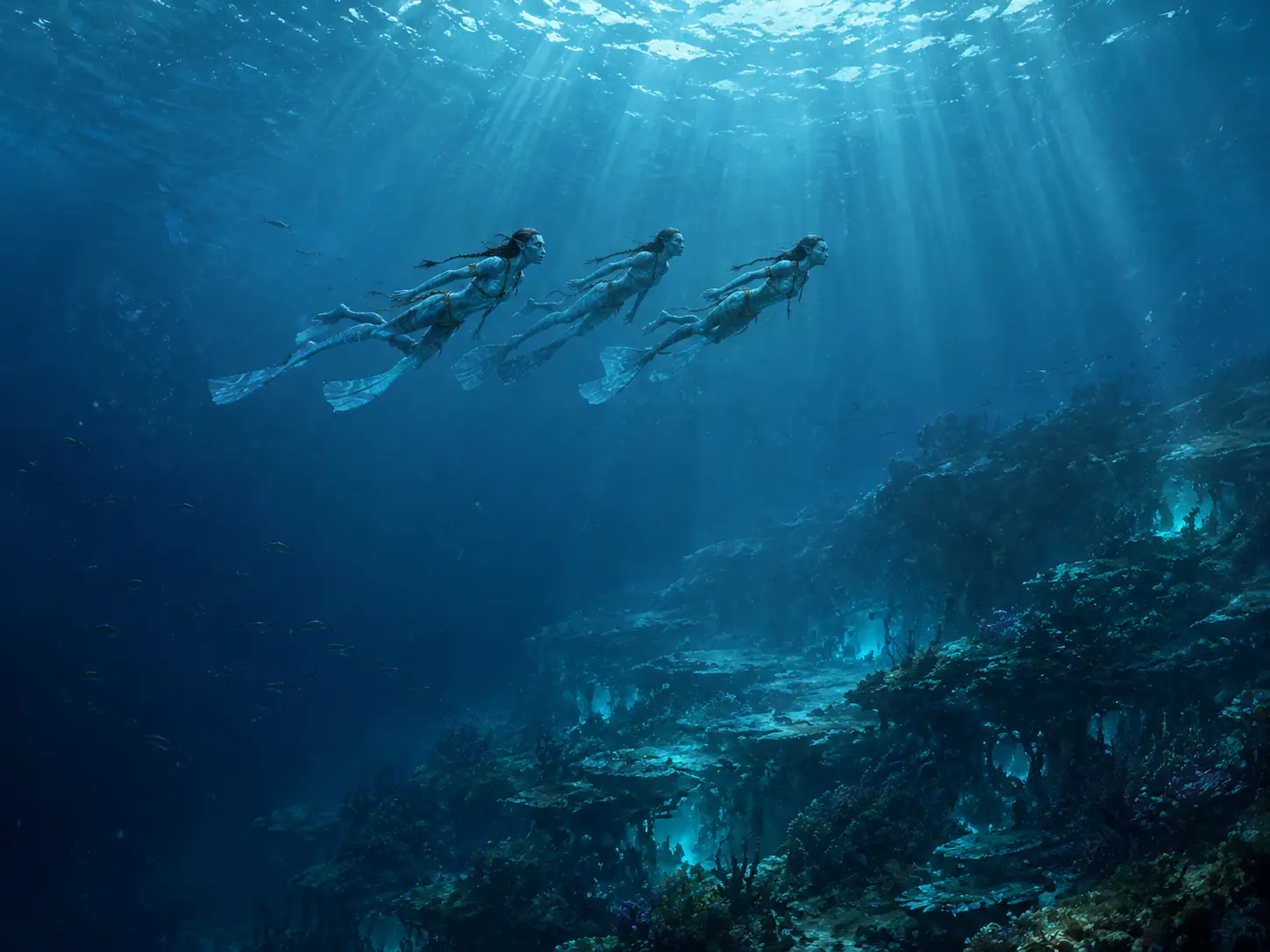
The first lesson is not in the water.
Tsireya sits the Sully children down in the shallows and teaches them to slow their own hearts. Breathe from here, she tells them; let the belly go loose; do not fight the feeling that comes. It looks like a meditation lesson and it is filmed like one, but every instruction in it is a physiological intervention with a name and a mechanism. She is teaching them to stop wasting oxygen before they have any reason to need it.
And it works. Over the months they spend at Awa'atlu, the forest children get measurably better. They stay down longer. They stop thrashing. They learn to move through a reef channel instead of across it.
But Ronal, watching them from the first day, has already delivered her verdict, and canon puts it plainly: they have thin tails, they will be slow in the water. She is not being unkind. She is being an anatomist. The Metkayina tail is a broad flattened blade; the forest tail is a slender rope. No amount of Tsireya's patience is going to change that.
So both things are true at once. The children improve dramatically, and the thing Ronal objected to never changes at all.
That is a more interesting sentence than it looks, because it means a diving body is made of two entirely different kinds of material. Some of it is negotiable — it responds to practice, on a timescale of weeks. Some of it is not negotiable at anything shorter than an evolutionary timescale. And the reason this chapter is worth writing is that on Earth we have actually measured where the line between them falls, in real populations of real human divers, and the answer is not the one most people would guess.
The part Ronal was right about
Start with the anatomy, because it is the visible thing and it is the thing canon is most confident about.
The Metkayina tail is not a longer version of the forest Na'vi tail. It is a different object. Canon and the companion material describe it as flattened top-to-bottom and compressed side-to-side into a paddle — a fluke — and it has lost the tuft of hair that terminates a forest tail. A forest Na'vi tail is a slender, gracile, prehensile thing built for balance in a canopy and for fast changes of direction on the ground. The Metkayina tail is a hydrofoil.
The limbs are modified too. Production design calls the flared structures on the Metkayina forearms and lower legs strakes — the forearm flexor and extensor compartments and the calf muscle complexes are broadened relative to forest Na'vi, with flared fibrous tissue giving each limb a wider, flatter profile. The chest is deeper and broader, particularly in adult males, which implies a larger thoracic cavity. The eyes carry a horizontal nictitating membrane that sweeps sideways across the cornea. The skin is turquoise where forest skin is cobalt, patterned with dark undulations and countershaded pale on the belly.
Every one of those is present at birth and universal across the clan. That is what makes them lineage rather than training, and it is the strongest statement canon makes about Metkayina divergence — though it is worth noting the exact word canon uses is adapted, not evolved, and it never says how long ago the split happened.
It is worth being precise about what the strakes are for, because the obvious reading is wrong. They are not oars. A limb held out into fast-moving water is a control surface: it sets roll, pitch and yaw. The tail supplies thrust; the limbs decide where the thrust points. Anyone who has watched a diver correct their line with a flick of one forearm has seen the principle, and any aircraft or submarine designer would recognise the shape.
Which brings up the cost. Broad flat surfaces are only useful in a dense fluid. On land they are extra mass, extra rotational inertia, extra drag through the air — all of it paid for on every stride. Earth's obligate marine mammals resolved that tension by abandoning the land entirely: the cetacean pelvis reduced to a vestige, the hindlimbs vanished, walking stopped being an option. The Metkayina did not. They keep a fully functional bipedal gait, which means their tail has to work as an oscillating thruster underwater and as a dynamic countermass on land, and their limbs have to be control surfaces in one medium and running gear in the other. That is a compromise, and it is the honest description of their body: not a marine mammal, and not a forest Na'vi either.
The reflex nobody has to earn
Now the other half of the body — the part that is not visible, and the part Tsireya is actually teaching.
Put your face in cold water and hold your breath, and something happens to you within seconds whether you asked for it or not. Your heart slows. The vessels in your skin and your limbs clamp down. Blood withdraws from the outside of you and gathers around the heart and the brain. You did not decide any of this and you cannot easily stop it.
This is the mammalian diving reflex, and it was worked out in the late 1930s and 1940 by Laurence Irving and Per Scholander, who noticed that a seal held underwater did something no textbook of the day predicted. The arc is short and hard-wired. Cold water touches the skin of the face — specifically the fields served by the ophthalmic and maxillary branches of the trigeminal nerve — and that signal runs to the cardiovascular centres of the medulla, which fire two opposing branches of the autonomic nervous system at the same time.
The parasympathetic side, running down the vagus nerve, slows the sinus node. In a human that means a heart rate drop of fifteen to forty percent — often down to thirty or fifty beats a minute in a trained diver. In marine mammals it is not a reduction so much as a near-shutdown: a Weddell seal drops from about sixty beats a minute at rest to fewer than ten on a deep foraging dive, and a sperm whale has been recorded at three to five. The sympathetic side simultaneously drives the smooth muscle of the peripheral arteries into hard constriction, shutting off perfusion to muscle, skin, kidney and gut until what circulation remains is essentially just the carotid and coronary loops. And as depth adds pressure, blood from the abdomen and the limbs is displaced up into the compliant vessels of the lungs, engorging the chest from inside.
The reason this matters for the Sully children is simple: none of it is Metkayina. It is mammalian. Every human reading this has the same reflex, complete, unused. What Tsireya is teaching is not how to acquire it — it is how to stop overriding it. Canon describes the Way of Water as an institutionalised training system aimed at exactly that: suppressing the panic that comes with rising carbon dioxide, deliberately lowering metabolic rate, deep somatic relaxation, and consciously slowing the heart before going under to bring the bradycardia on early. That last one has a name in the literature — anticipatory vagal bradycardia — and it is real. The lesson in the shallows is a lesson in getting out of the reflex's way.
Why a bigger breath is the wrong answer
Ask most people how to hold their breath longer and they will tell you to take in more air. It is an intuitive answer and it is close to useless, and seeing why opens up the whole physiology.
The relevant quantity is not lung volume. It is the total oxygen a body is carrying, divided by how fast it is spending it. That ratio is the aerobic dive limit — the point past which the muscles run out of their own oxygen and start burning fuel without it.
Now look at where different bodies keep that oxygen, because the pattern is the lesson. An untrained human carries around twenty millilitres of usable oxygen per kilogram of body mass, and roughly a quarter of it is simply air sitting in the lungs — with most of the rest bound to haemoglobin in the blood and a smaller share to myoglobin in the muscle. A Weddell seal carries eighty-seven millilitres per kilogram, more than four times as much, and keeps about five percent of it in its lungs. An elephant seal is higher still. A sperm whale stores fully half of its oxygen in muscle alone.
The animals that are extraordinary at this did not solve the problem by enlarging the air sac. They solved it in the blood and in the muscle. Human skeletal muscle holds four to seven milligrams of myoglobin per gram of tissue; a diving marine mammal's swimming muscle holds fifty to eighty, dark enough to look almost black when it is cut. That kind of protein density should be catastrophic — proteins at those concentrations normally self-associate, misfold and precipitate. Mirceta and colleagues worked out in 2013 how it is survivable, and the answer is beautiful: across cetaceans, pinnipeds, sirenians, beavers and muskrats independently, the high-myoglobin lineages all mutated their myoglobin's surface residues to positively charged ones. The molecules repel each other. They cannot clump because they are all the same charge.
A breath-hold is a division problem
Oxygen carried, divided by oxygen spent. Where the body keeps that oxygen matters more than how much air it swallowed.
No measured diving metabolic rate exists for these animals in the source, so the rate is set here and calibrated against an untrained human's known limit.
There is a second effect hiding in the numbers, and it is pure geometry. Oxygen stores scale directly with body mass, while metabolic rate scales as mass to the three-quarter power — the allometric relationship that governs most of physiology. Divide one by the other and the aerobic dive limit scales as mass to the one-quarter power. A larger animal dives longer for no reason other than being larger. A sperm whale would out-hold a human even with identical blood chemistry.
Which is a genuinely suggestive point for a three-metre Na'vi, and also where I have to stop. Canon gives no Na'vi body mass, so the scaling advantage cannot be turned into a number without inventing one. It gives no Na'vi haematocrit, no haemoglobin figures, no myoglobin content, no spleen mass — these are complete silences, not thin data. Everything about Na'vi oxygen chemistry is unstated. What the Earth physiology tells us is only the shape of the answer: if the Metkayina are exceptional divers, the exceptional part is almost certainly in their blood and muscle, not in their chest volume. That is inference, and I will label it as such rather than dress it up.
The blood bank in the abdomen
There is one more oxygen store, and it is the one that has been most badly misreported, which makes it worth getting exactly right.
The spleen holds red blood cells in reserve. When apnea and falling oxygen trigger the sympathetic system, the smooth muscle capsule of the spleen contracts and squeezes those cells out into circulation. In a human the organ loses fifteen to forty percent of its volume within thirty to sixty seconds of going under. Haematocrit — the fraction of blood volume made of red cells — rises from about forty-two percent to forty-five or forty-six. Haemoglobin concentration climbs half a gram to just over a gram per decilitre.
Add it up and the splenic contraction is worth fifty to a hundred millilitres of extra oxygen, which buys fifteen to thirty seconds of additional breath-hold. Real, measurable, and modest. We know it is causal rather than coincidental because people who have had their spleen removed show no progressive rise in haematocrit across a series of breath-holds, desaturate faster, and cut their dives shorter than intact controls.
Hold onto that number — fifteen to thirty seconds — because in a moment it is going to do some work.
The seal version shows what the same mechanism looks like when evolution leans on it for millions of years. A phocid seal's spleen is hypertrophied into an enormous contractile reservoir holding up to sixty percent of the animal's total red cell mass. On diving, contraction drives haematocrit from around forty percent to sixty-five or seventy. That is not blood any more so much as an oxygen slurry — and the elegance is in the timing. Thick blood is metabolically expensive to pump. By warehousing the cells and deploying them only on descent, the seal gets the dense blood exactly when it is diving and never pays the viscosity bill while resting at the surface.
What the water weighs
So far this is all chemistry. But the sea imposes a purely mechanical problem too, and here Pandora finally does something Earth cannot.
Air is compressible and a chest full of it is a balloon. Boyle's law says that for a fixed quantity of gas at constant temperature, volume falls in inverse proportion to pressure: double the squeeze, halve the gas. So take an untrained human with a six-litre lung filled at the surface and send them down. At thirty metres on Earth the ambient pressure is about four atmospheres, and the six litres have become one and a half.
One and a half litres is not an arbitrary number. It is the residual volume — the smallest the chest can physically fold to. Which means thirty metres is, for an untrained body, roughly the depth at which the air inside runs out of room to give.
Past that point the gas wants to occupy less space than the ribcage geometrically allows. If the chest wall cannot deform further and nothing moves in to fill the gap, intrathoracic pressure falls below the water pressing in from outside, and the result is a vacuum across the pulmonary capillaries — bleeding into the alveoli, fluid weeping into the lung, tissue tearing. Divers call it thoracic squeeze.
Elite human freedivers get past a hundred metres anyway, and they do it in two ways that are both worth knowing. They stretch the diaphragm until the chest tolerates volumes below its nominal residual, and they let more than a litre of blood shift into the pulmonary vessels, which reduces the airspace from inside so there is less gap to collapse. Some also perform glossopharyngeal insufflation — packing, in the vernacular — gulping extra air past a full breath to force vital capacity up to a hundred and twenty or thirty percent of baseline. Marine mammals take a different route entirely: flexible ribs that fold flat without breaking, reinforced cartilaginous airways, and controlled alveolar collapse somewhere between thirty and seventy metres, which pushes the remaining gas out of the fragile alveoli and into the rigid trachea where no gas exchange can happen. That last trick has a bonus — with the alveoli shut, nitrogen cannot load into the blood at all.
Now change the gravity.
Hydrostatic pressure is the weight of the water overhead: density times gravity times depth. Pandora's surface gravity is about eight-tenths of Earth's, roughly 7.84 metres per second squared. Assuming its tropical seawater is about as dense as Earth's — an assumption, and I will come back to it — every metre of Pandoran water weighs about a fifth less. On Earth you gain an atmosphere every 10.06 metres. On Pandora you have to descend 12.61 metres for the same gain.
The same depth, two different weights of water
Pressure is the weight of the water overhead, so weaker gravity means every threshold sits deeper.
Seawater density is assumed to match Earth's 1025 kg/m³ — canon never states Pandora's.
On this world, nitrogen turns narcotic at about 31 m.
That factor is roughly 1.26, and it applies to everything pressure does. A Pandoran diver reaches thirty metres at 3.38 atmospheres instead of 3.98. The squeeze that opens at thirty to forty metres on Earth opens nearer thirty-eight to fifty. Nitrogen narcosis — which follows from the physical solubility of inert gas in nerve membranes, and sets in above a nitrogen partial pressure of about 3.2 atmospheres, so around thirty metres on Earth — retreats by the same quarter. Every barotrauma threshold in the book slides deeper on a low-gravity world, purely because the water weighs less.
This is a genuinely satisfying result and I want to flag its one soft spot. It depends entirely on Pandoran seawater density, and canon never gives it. Salinity, exact density, gas solubility coefficients — all unstated. The 1.26 is what you get if Pandoran seawater is Earth seawater, and that is an Earth assumption wearing Pandoran clothes. The reasoning is sound; one of the inputs is borrowed.
The way up is the dangerous part
There is a piece of diving physiology that kills people, and it is almost entirely counterintuitive, and it explains why the training Tsireya gives is specifically about not panicking rather than about pushing through.
Oxygen's partial pressure is its fraction of the gas times the ambient pressure. So on the way down, compression drives the oxygen pressure in the lungs up — artificially high, high enough to keep oxygen diffusing into the blood even as the total amount of it is being steadily consumed. The diver feels fine. They are fine. Then they turn around.
On the way up the lungs re-expand, and the oxygen pressure inside them falls much faster than the oxygen is being used. Somewhere in the last stretch it drops below the pressure in the venous blood arriving at the lungs, and the gradient reverses: oxygen starts diffusing out of the blood and into the lung. Arterial blood heading for the brain is suddenly deoxygenated. Below a cerebral partial pressure of around twenty-five to thirty millimetres of mercury, consciousness stops — typically in the final ten metres, with no warning at all.
The cruelty is in the alarm. Human breathing is not driven by oxygen. It is driven by carbon dioxide, sensed by chemoreceptors in the medulla via the pH of cerebrospinal fluid. Hypercapnia is what makes you desperate to breathe — not hypoxia. So if a diver hyperventilates before going down, they purge carbon dioxide from the blood while adding essentially no oxygen to haemoglobin that was already saturated. They have not bought themselves any oxygen. What they have done is delay the urge to breathe past the moment their oxygen falls through the floor.
The danger is on the way up
Oxygen pressure rises going down and collapses coming back. The urge to breathe tracks carbon dioxide, which is the wrong alarm.
An illustrative single-compartment model: the thresholds are measured values, the consumption rate is yours to set.
Which is why the advice that sounds like toughening up is precisely backwards. The discomfort is the safety mechanism. A diving tradition that teaches its children to tolerate that discomfort calmly — rather than to eliminate it — is teaching them the thing that keeps them alive, and canon has Tsireya doing exactly that.
The same logic runs through the other gas hazard. A single breath-hold dive almost never causes decompression sickness, because the total gas volume involved is small. But repetitive deep breath-hold diving with short surface intervals loads nitrogen into poorly perfused tissue faster than it clears. The pearl divers of the Tuamotu archipelago named it taravana — to fall crazily — and the clinical picture is spinal cord ischemia, vertigo, joint pain, stroke. Similar lesions have been documented in the Japanese Ama and the Korean Haenyeo. The danger is never one dive. It is the fortieth dive of the day.
And the tail, properly
Back to the anatomy, now that the physiology is in place, because the fluke deserves a real explanation rather than "flat is better."
Water is about eight hundred times denser than air, and drag scales with density, with frontal area, and with the square of speed. In a fluid like that, how you generate thrust matters enormously. Paddling is drag-based propulsion: you push water backward on the power stroke and then drag your limb forward through the water to do it again, and the recovery stroke costs you. Peak efficiency for drag-based swimming is under fifty percent.
An oscillating hydrofoil works differently. A blade held at an angle to the flow generates lift — the same circulation-based force that holds up a wing — and it does so on the downstroke and on the upstroke both. There is no recovery phase, because both halves of the cycle are power. Efficiencies exceed eighty to eighty-five percent.
There is even a rhythm the whole thing converges on. The Strouhal number — beat frequency times stroke amplitude, divided by forward speed — describes how far apart each beat plants its vortex in the wake. Taylor, Nudds and Thomas showed in 2003 that across dolphins, tuna, sharks and penguins, animals as unrelated as it is possible to be — a case of convergent evolution as clean as biomechanics offers — peak propulsive efficiency lands in a narrow band between 0.20 and 0.40. Outside that band the vortices stop meshing and the wake turns into a churn.
So Ronal's assessment was not aesthetic. A cylindrical tail cannot generate lift; it can only push and drag. A blade can. That is a difference in kind, not degree, and it is the one thing on the list that a season of practice cannot touch.
What practice can change
What practice cannot
Three clocks
Here is the idea to carry out of this chapter, and it transfers to any body on any world.
A body can change on three separate timescales, and the timescale you have available decides which mechanism is even on the table. This is not a tidy academic distinction. It is the reason two of the sentences at the top of this chapter can both be true.
The first is acclimatization: reversible adjustments a single body makes within its own lifetime, over hours or weeks or seasons. Splenic conditioning is one. So is the way sustained cold immersion drives up heat production. So is the rise in red cells at altitude. The defining feature of this tier is not that it appears — it is that it disappears. And we have a clean demonstration of that, which is one of my favourite results in physiology.
The Haenyeo of Jeju Island and the Ama of Japan dived commercially for generations in nothing but cotton. Physiologists monitoring them through the 1960s — Hong, Rahn and colleagues among them — documented substantial non-shivering heat production, lowered shivering thresholds, and winter basal metabolic rates elevated fifteen to thirty percent above normal. Then, in the mid-1970s, the divers adopted neoprene wetsuits. Within two to three years, every one of those metabolic elevations was gone. Not reduced. Gone. Generations of cold tolerance evaporated in about as long as it takes to finish a degree, because it had never been in the genome at all — it was a setting, and the pressure that held it there had lifted.
The second tier is phenotypic plasticity: structural change laid down during a developmental window, usually irreversible once the window closes. Children raised at high altitude grow deeper chests and larger lung volumes, and keep them. And here the diving literature has its best experiment.
In 2003 Anna Gislén and colleagues measured the underwater visual acuity of Moken children in the Andaman Sea, who dive for food without masks. Water erases the cornea's refractive power — the air-to-cornea boundary supplies roughly two-thirds of the eye's focusing, and immersion replaces air with a fluid of almost the same refractive index, leaving the diver severely farsighted. The Moken children resolved 6.06 cycles per degree underwater. Untrained European children managed 2.95. More than double. They achieved it by constricting their pupils to under two millimetres — a pinhole aperture, trading light for depth of focus — while simultaneously accommodating the lens by fifteen or sixteen dioptres.
Then in 2006 Gislén's group ran the obvious follow-up, and the result is the reason this chapter exists. They gave European children a month of structured underwater visual training. The children reached exactly the same acuity and the same pupillary response as the Moken, and retained it months afterward. Not partially. Exactly. And adult Moken lose the ability as their lenses stiffen with age, which is what you would expect of something learned rather than encoded.
A month. Doubled underwater eyesight in a month, in children with no ancestral connection to the sea whatsoever.
The third tier is genetic adaptation, and this is where we finally leave the individual behind. Ilardo and colleagues published the case study in 2018, in Cell: the Sama-Bajau of Southeast Asia, who spend more than sixty percent of their working hours submerged. Ultrasound found their spleens roughly fifty percent larger than those of the neighbouring, genetically related Saluan, a farming population. Crucially, the enlargement was present in Bajau who did not dive as well as those who did — which is what makes it inheritance rather than training hypertrophy. Selection scans flagged PDE10A, linked in animal models to thyroid hormone regulation and, in mice, to splenic mass and red cell reserves, and BDKRB2, an established candidate in the cardiovascular dive-response pathway.
How long does a body need?
Every change to a diving body has a clock. Give it a month and one set of things becomes possible; give it a million years and another.
Generation length converts the two inherited traits from generations into calendar time; the placements are order-of-magnitude, not exact dates.
Now the caveats, because this study is the single most overstated result in the field. The popular framing was "mutations for superhuman breath-holding," and that is not what the paper says. The samples were modest: fifty-nine Bajau, thirty-four Saluan. The spleen-size distributions overlap substantially between the two populations. Resting haematocrit and haemoglobin did not differ significantly. And the functional chain from a PDE10A variant to human splenic red cell dynamics remains a hypothesis, not a demonstrated mechanism.
This is where that fifteen-to-thirty seconds becomes useful. A fifty-percent-larger spleen is a real inherited difference. It is also worth, at most, a modest extension of a mechanism whose full contribution is half a minute. The Bajau result is genuinely interesting — it is one of the clearest signals of recent selection in a human population, alongside the Tibetan EPAS1 adaptation, which Yi and colleagues found under selection in 2010 and Emilia Huerta-Sanchez and colleagues traced in 2014 to archaic Denisovan introgression. It is not a superpower. Those two claims are not in tension; conflating them is just bad reading.
And the timescales are the punchline. A detectable selection signal — the kind you find through population divergence statistics and extended haplotype sweeps — needs tens to hundreds of generations of sustained pressure. Gross skeletal remodelling needs millions of years. Earth's own record of a tail becoming a fluke runs from Pakicetus around fifty million years ago, a semi-aquatic wader with heavy ballast bones, through Ambulocetus paddling in estuaries at forty-eight, to Basilosaurus and Dorudon as obligate marine animals with horizontal flukes somewhere around forty to thirty-five million. Fifteen million years, give or take, from wading to a fluke — and the pelvis and the walking went with it.
Notice the order in that sequence, because it repeats across vertebrate lineages generally. Behaviour and physiology shift first: the dive reflexes, the splenic reservoirs, the myoglobin. Bone ballast comes early. Soft-tissue changes to the limbs — webbing, strakes, nictitating membranes — come next. Gross skeletal reorganisation comes last, if it comes at all. Semi-aquatic lineages like sea otters, marine iguanas and polar bears have stayed at intermediate stages for millions of years because their niches keep rewarding competence in both worlds.
Which places the Metkayina rather precisely. They have the soft-tissue tier — the flattened tail, the strakes, the nictitating membranes — without the terminal skeletal step, and they have kept full bipedalism. On Earth's own template, that is not a marine mammal. It is an amphibious compromise that has stopped, deliberately, one stage short.
Honest edges
The secure canon here is anatomical and cultural. The Way of Water and its companion material establish the flattened paddle tail, the flared limb strakes, the broadened chest, the horizontal nictitating membrane and the turquoise countershaded skin as universal, from-birth Metkayina traits. They establish the Way of Water as a taught discipline aimed at slowing the heart and mastering the urge to breathe. They give us Ronal's judgement on thin tails, Tsireya's instruction, and the Sully children improving over months without their tails changing. That is a real natural experiment and it is canon, not inference.
What canon does not give is every number. There is no stated breath-hold duration, no dive depth, no swim speed, no metabolic rate. The single depth figure anywhere in the source material is the roughly thirty-metre seafloor of the kelp forest at the Three Brothers — and that describes the setting, not anyone's limit. There is no Na'vi haematology, no spleen mass, no internal anatomy, no divergence date for the Metkayina, and no measurement of Pandoran seawater. Every quantitative claim in this chapter is therefore Earth's, applied to Pandora as a shape rather than a value.
Two smaller honesty notes. The gill mantle — the invertebrate rebreather canon shows draped over a diver's torso, diffusing dissolved oxygen straight into the bloodstream through a neural connection — defeats every oxygen-budget constraint in this chapter completely and trivially. A diver wearing one is not solving the problem I have spent this chapter describing; they have opted out of it. And the actors themselves are the reason some of the training claims land as hard as they do: under Kirk Krack's instruction for the production, Kate Winslet held a static apnea of seven minutes fourteen seconds, Sigourney Weaver six and a half minutes, Zoe Saldaña five. Those are dry or shallow-tank static holds under supervision, not working dive limits, and should not be read as either. But they are real people, and they demonstrate the size of the plasticity this chapter is about better than any diagram could.
What the water has not told us
Canon is completely silent on Na'vi haemoglobin, haematocrit, myoglobin and spleen mass. Every Earth deep diver depends on exactly these expansions, so this is the central unknown — and it is the difference between a clan with a hydrodynamic body and a clan with a genuinely reorganised diving physiology.
The breathing fans are visible but canon never says whether they close off underwater. If they seal, lung gas is isolated and the Boyle's-law reasoning here applies cleanly. If they do not, a Na'vi chest is open to the water in a way no Earth mammal's is, and much of this chapter's pressure physics needs rewriting.
Canon says 'adapted' and stops. Without a divergence date there is no way to tell whether the fluke and strakes represent deep speciation or rapid microevolution — and on Earth's timescales, soft-tissue limb remodelling of that magnitude is a millions-of-years proposition, not a few-thousand-year one.
The 1.26 depth advantage from 0.8 g assumes Earth seawater density, salinity and gas solubility. None of those is stated. The gravity term is canon; the density term is borrowed, and the whole two-world comparison rests on it.
What was ever up for negotiation
Go back to the sandbar at dawn.
Two forest children sit in warm shallow water with a Metkayina girl telling them to loosen the belly and let the heart slow. Ronal is not wrong about their tails; they will never generate lift with those, and their hydrodynamic ceiling is set the moment they are born. Tsireya is not wrong either; almost everything else about how well they dive is still open.
What the Earth evidence adds is how lopsided that split turns out to be. The reflex was already theirs — the bradycardia, the vasoconstriction, the blood shift, the spleen. The tolerance of the urge to breathe is trainable in months. Underwater acuity, on the strongest evidence we have, is trainable in a month. Cold tolerance appears in a season and vanishes in two years. What requires inheritance is the visible architecture: the shape of the tail, the flare of a forearm, the membrane across an eye — and those need tens of generations at the very least, millions of years at the most.
Which reframes the whole scene. When we look at a body that belongs in a place, we tend to read the whole thing as destiny, as though the shape and the skill arrived together in the same package. They did not. The shape is inheritance and the skill is practice, and on Earth the practice does far more of the work than the shape gets credit for. The Sully children will always be slower than the clan they live with. They will also, within a year, be better divers than any of us.
That question is worth more than any of the individual numbers in this chapter. Before asking whether a body is built for a place, ask which parts of it were ever up for negotiation. The answer is almost always more of them than it looks.
Read next
Pandora’s Ocean
A diver leaves the bright reef water and drops into a colder blue. No wall appears, yet the body has crossed a physical frontier. Following that frontier reveals the paradox that feeds an ocean: where there is light, plant food runs short; where nutrients gather, there is no light with which to use them.
25 min read
The Reef as Substrate
The Metkayina build not on land but on a living reef. Following that foundation leads to an idea that transfers to any world: a reef is not a rock but a balance sheet — builders and breakers contesting every gram — and when the balance tips, the ground itself dissolves back into the sea.
21 min read
Tulkun Beyond Whales
Tulkun look enough like whales to be legible, then differ enough to make the comparison dangerous. Following Payakan leads to an inheritance outside DNA: culture that is learned, transmitted, and capable of going extinct before a species does.
26 min read
Convergent, but Not Quite
The first human to walk Pandora's forest kept naming things - that is a panther, that is a wolf-pack, that is an eagle - and was almost always right about the job, never about the build. A moon with its own separate origin of life, built on a six-limbed body plan, keeps stubbornly reinventing Earth's cast of characters. The answer is not that Pandora copied us. It is a law that forces life anywhere to converge on the same short list of good answers - and the deeper truth in why it never converges all the way.
30 min read