

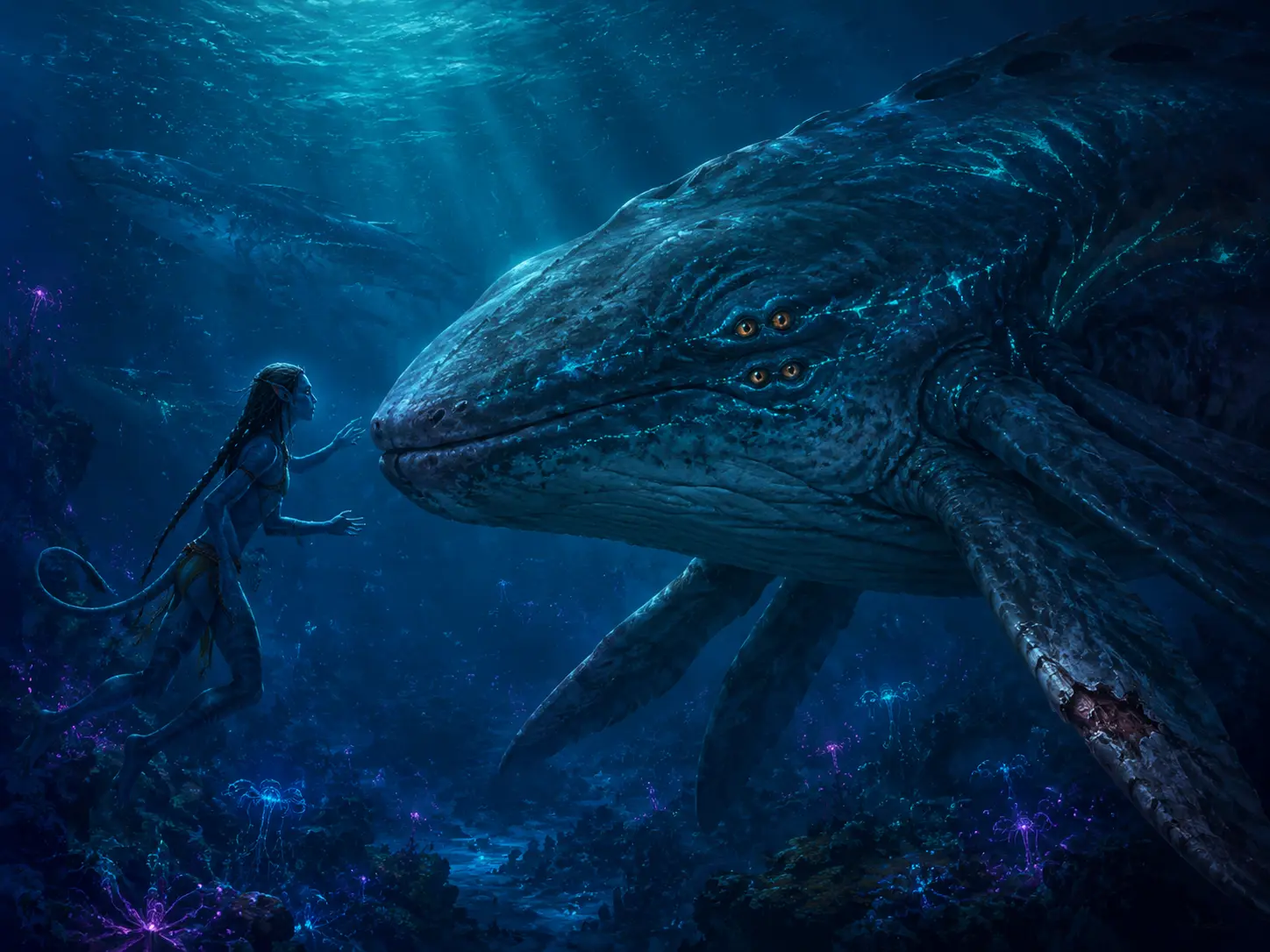
Payakan looks back.
That is the small event on which the whole tulkun idea turns. A young Na'vi hangs in blue water beside a creature large enough to make him negligible. The creature has four eyes, a scarred head and a ruined fin. Any naturalist could record those things. Then one eye settles on Lo'ak and holds. The shot lasts long enough for inspection to become encounter.
You have been shown clever animals before, and cinema has a small stock of ways to do it. It can make the animal solve a lock, rescue a child or understand a sentence nobody taught it. The Way of Water chooses something more intimate. Payakan is allowed a face, pauses in which to think, a name, a grievance and eventually a version of events. He is not introduced as a specimen awaiting classification. He is introduced as somebody whose neighbours have already classified him — and may have classified him wrongly.
Calling him a whale is useful for about three seconds. The broad flippers, surfacing breath, immense body and low calls give an Earth audience a familiar silhouette. The resemblance lets us walk into the water without a lecture. Then the film removes the handrail. Tulkun compose songs, maintain histories, form lifelong relationships with Metkayina individuals and live under a prohibition against killing. Payakan has broken that prohibition. His exile is not a response to an inconvenient reflex. It is a judgment about an act.
Earth's whales cannot certify any of this. They can, however, teach us what evidence is required before a field biologist uses a word as heavy as culture. The comparison becomes valuable precisely where it stops being easy.
A biography, not a behaviour
The film gives Payakan's history in fragments. The Metkayina first supply the public version: he is an outcast, dangerous because he has killed. Payakan's body supplies a second archive. The damaged fin and embedded tracker say that human machinery has met him before. Only later does Lo'ak receive the private version through their neural bond: hunters killed Payakan's mother; Payakan gathered others for a counterattack; the attack failed; the others died; the survivor was held responsible.
None of that sequence requires us to borrow physiology from whales. It is film canon. What matters is the architecture hidden inside it.
For exile to work, a society must identify one individual across time. It must retain an account of an absent event. It must connect an action to consequences, apply a shared expectation, and communicate the resulting status to others who were not all present. Payakan must also understand enough of that judgment to remain apart. Whether we call his inward state guilt, shame, anger or simply learned avoidance is less secure. The isolation itself is not.
The first hunt
A mother is killed
Payakan survives a human tulkun hunt and retains a memory of the event that Lo'ak later witnesses.
The answer
Payakan gathers a counterattack
Tulkun and Metkayina companions die. The distinction between causing a battle and causing every death becomes the moral knot of his story.
The judgment
The survivor becomes the offender
The tulkun reject Payakan for violating their way. The film establishes the sanction more clearly than the procedure that produced it.
A second witness
Lo'ak receives the private history
The bond does what no Earth field method can do: it gives another species direct access to a remembered episode.
The second intervention
Payakan chooses violence again
He attacks human machinery to save his companions. The wider tulkun judgment after that act is not settled by the film.
The timeline is a biography because each event changes the meaning of the next. A scar is not merely damaged tissue; it points backward. A choice in the present is not merely stimulus and response; it carries the weight of an earlier result. Payakan behaves as though the past remains available to him.
Scientists use the phrase episodic-like memory carefully with non-human animals. The suffix matters. A subject can act on the what, where and when of a past event without giving us a verbal report of mentally reliving it. Behavior can establish stored information; it cannot open the quality of recollection from the inside. Lo'ak has a fictional instrument for crossing that boundary. A marine biologist has a dorsal-fin photograph, a hydrophone and patience.
That asymmetry is one of the chapter's useful limits. Tulkun personhood is written into the world. Cetacean minds have to be inferred from traces left at the surface.
The inheritance outside the body
A calf inherits a body from its parents. The body arrives with flukes, lungs, sensory systems and developmental tendencies assembled under genetic instruction. Yet the calf also enters a particular group in a particular sea. It hears one repertoire of calls, follows one route and watches certain ways of finding food. Another calf of the same species may inherit almost the same anatomical equipment and grow into a different way of living.
That second stream is animal culture: information or behaviour shared within a community, acquired through social learning, and persistent enough to outlive the moment of invention. The definition is deliberately less glamorous than the word. It does not require galleries, constitutions or written poetry. It requires information to cross between lives without passing through DNA.
The simple version is tempting. Group A does one thing; Group B does another; therefore culture. Unfortunately, genes also travel in groups. So do currents, prey and seafloor types. Two populations may behave differently because their bodies differ, because their habitats pose different problems, or because each animal independently discovers the same locally useful answer. A map of difference is a clue. It is not yet a route of transmission.
This is why field researchers treat culture as a competition among explanations. If two groups use the same water but keep different traditions, a broad environmental explanation weakens. If genetic relatedness does not match the behavioural boundary, simple inheritance weakens. If a novelty then reaches close associates before distant individuals, the social explanation begins making predictions the others do not.
How a behavior becomes culture
One pattern, three explanations — add evidence until only one survives
One group performs a behavior that a nearby group does not. That is interesting, but genes, habitat and social learning can all produce the same map.
The groups may carry different inherited tendencies.
One group may encounter a resource or condition the other lacks.
The behavior may be copied through association. Nothing yet separates the options.
The last step is the most persuasive because it watches history happen. Researchers call the family of methods network-based diffusion analysis. First they build a social network from observed associations: who travels, rests or forages with whom. Then they record when each individual first performs a new behaviour. A model in which animals learn independently is set against one in which the chance of acquisition rises with contact to knowledgeable companions. If the second model better predicts the order of arrival, "they learned it socially" has survived an attempt to prove it unnecessary.
No mind has been read. No whale has filled in a questionnaire. The conclusion is built from timing, association and alternatives that failed.
Social learning itself comes in several depths. An animal may simply be drawn to a place because another animal is there. It may learn that an object is worth inspecting without copying the exact movement used on it. It may reproduce the result while inventing its own motion, or imitate the motion closely. These routes place different demands on attention and memory, but all can move useful information through a group. Culture does not wait at the top of a cognitive staircase for perfect imitation to arrive.
Teaching is a stronger claim. In the strict behavioural definition, the knowledgeable individual changes what it does in the presence of a novice, accepts some immediate cost or receives no immediate benefit, and thereby helps the novice learn faster than it otherwise would. A killer-whale mother lingering while a calf practices intentional stranding looks suggestive. Proving that she modified her behaviour for the pupil, rather than merely tolerated a clumsy companion, is harder. The word should be earned by the difference between those predictions, not by how much the scene resembles a lesson.
This matters for tulkun because the story gives them explicit histories and a moral rule but does not show us a classroom. A calf may learn the tulkun Way from a parent, a gathering, ritual participation or direct neural communion. Companion material is happy to name mechanisms; the released film leaves most of them outside the frame. We know a doctrine crosses generations because adults and young inhabit the same normative world. We do not know the curriculum.
There is also no requirement that every copied behaviour be adaptive. Traditions can be neutral, costly or useful only under conditions that later disappear. Humpback song may spread because males prefer novelty or conform to a common display; a foraging technique spreads because it finds food; a social convention may persist because everyone expects everyone else to follow it. Culture is a transmission process, not a guarantee of wisdom.
That sentence brings us closer to the tulkun than measuring Payakan's brain ever could. The film has Dr. Garvin invoke the size and complexity of a tulkun brain, but a large brain is not a receipt listing its contents. Culture becomes visible not inside tissue but between individuals: one life altering the repertoire of another.
Three oceans inside one ocean
Earth's cetaceans offer several unusually clean ways to see that second inheritance because water lets populations travel far while sound travels farther. The same ocean can hold overlapping communities whose learned lives remain distinct.
Sperm whales organise much of their social world through patterned sequences of clicks called codas. Stable family units share repertoires; units with similar repertoires associate into much larger vocal clans. In parts of the Pacific, different clans use the same broad waters yet preferentially associate with members of their own acoustic culture. Their movements and foraging patterns can differ alongside the clicks. The clan is not merely a regional accent painted onto identical lives. It is a social boundary with ecological consequences.
The evidence is strongest when the boundaries refuse to line up neatly with easy alternatives. Genetic ancestry does not fully reproduce the map of coda clans. Geography does not explain groups that overlap but do not socially merge. A calf acquires a repertoire inside a matrilineal social unit, and the repertoire helps determine which larger community that unit joins.
It is worth looking at what a coda actually consists of, because the answer is smaller than the conclusion drawn from it.
The message is the timing
Every click is the same sound. What separates one vocal clan from another is only where the clicks fall in time.
Nothing about the sound distinguishes these clans. Every mark on every track is the same broadband click. The difference is entirely in the spacing — five to eight even pulses, or two isolated clicks then a fast triplet, or a tight condensed burst — and that difference is enough to decide which units will travel together for decades. Switch to the tulkun row and the track refuses to resolve. Canon gives them rumbles that carry across an ocean basin and translates those rumbles into sentences, but never exposes a structure anyone could diagram. The blank band is the honest rendering of that gap.
Humpback whales provide a different shape. Males on a breeding ground converge on a complex song, then modify it over time. Occasionally a substantially different song enters from a neighbouring population and replaces the local version. Across the South Pacific, researchers have followed such song "revolutions" moving eastward from population to population over successive seasons. Genes do not sweep an ocean basin that quickly. Neither does the seabed compose a new sequence and hand it selectively to singers. Whales hear a novelty, learn it and participate in making it common.
Dolphins make the inheritance tangible. In Shark Bay, some dolphins protect their rostra with marine sponges while probing rough bottom habitat for prey. The behaviour is concentrated in particular lineages and is learned chiefly from mothers. Another technique, "shelling," uses large empty shells to trap and drain fish. Its observed spread among associates supplied a rare opportunity to test the social network itself. Different traditions can occupy the same species, the same bay and even the same broad task — finding dinner — while taking different routes from one mind to the next.
These examples are often piled together as proof that whales possess "human-like culture," and I think that phrase hides more than it reveals. A humpback song revolution is not a sperm-whale clan, and neither is a sponge carried over the snout. They differ in duration, function, transmission route and likely cognitive demand. Their shared feature is narrower and more useful: behaviour has a history that cannot be reconstructed from genes and habitat alone.
The same restraint should govern claims about language. Bottlenose dolphins develop individually distinctive signature whistles. Playback experiments show that familiar whistles carry identity information, and dolphins can copy a close associate's whistle in contexts consistent with addressing that individual. Calling these signals "names" is a productive analogy if we remember the invoice attached. A learned identifier is not proof of open-ended grammar. A sequence of clicks is not a poem merely because it is intricate. Complexity is a property of a signal. Language is a claim about what that signal can do.
Nor is cultural change automatically cumulative. Human technologies often ratchet: one generation preserves an improvement, the next modifies it, and eventually the product exceeds what any isolated inventor could reconstruct. Whale songs evolve and sometimes grow elaborate; techniques spread and diversify. That establishes change through social history. It does not yet establish an open-ended ratchet of increasingly complex solutions. "Culture" is supported at a lower evidentiary threshold than "cumulative culture," and keeping the two separate prevents the human version from quietly becoming the definition of every other one.
The distinction gives tulkun poetry and mathematics their proper place. Within the fiction, those are direct claims about a sapient civilization, not extrapolations from a difficult feeding trick. Earth comparisons can illuminate the scaffolding — vocal learning, social memory, group identity, transmission across generations — but cannot build the upper floors for us. The film places them there by authorial assertion.
Tulkun cross that line because the screenplay says they do. They have names, songs, histories and propositions the story translates for us. Earth cetaceans do not become lesser when the evidence stops earlier. They become real subjects of science rather than applicants for admission to humanity.
The matriarch is a map
Culture matters most when the learned answer cannot be reconstructed quickly after it disappears.
Resident killer whales in the northeastern Pacific live in stable matrilines. Mothers and offspring remain associated for decades. Older females, including individuals long past reproduction, often lead group movement. During years when salmon are scarce, the leadership of post-reproductive females becomes especially pronounced. Long demographic records also show what her death costs. Darren Croft, Lauren Brent and colleagues found in 2015 that when a post-reproductive mother dies, the mortality risk of her adult sons rises as much as eightfold in the following year.
The finding makes evolutionary sense without turning an elder into a mystical oracle. A long life has sampled more bad years. It has encountered irregular prey runs, remembered routes that are useless in ordinary seasons and retained social knowledge about where and with whom to forage. When familiar abundance fails, memory stored in an old individual can become food for descendants.
This is an example of culture entering evolution without becoming genetic. Suppose a matriline knows a reliable route to prey during rare lean years. Calves in that line survive partly because they inherit the route socially. They also inherit mitochondrial DNA from their mothers. Over many generations, the success of the tradition can raise the frequency of the genetic lineage travelling beside it even when the mitochondrial variant contributes nothing to navigation. Researchers call this possibility cultural hitchhiking. The learned trait pulls neutral genes through history as if they were tied to its wake.
The reverse is equally important. Genetic similarity does not guarantee cultural interchange. Killer-whale ecotypes living in overlapping seas can specialise on radically different prey and maintain distinctive call repertoires. Learned diets influence whom they travel with and eventually whom they mate with, so culture can help build the population boundaries that later appear in genetic data. Inheritance is no longer two parallel streams. Each can bend the channel of the other.
This is the cleanest Earth-science bridge back to the tulkun hunt. A population count treats individuals as interchangeable units: subtract one female, add one calf later, and recovery can appear complete. A culture does not balance so neatly. The dead individual may have held a migration route, an acoustic repertoire, a relationship with another community or the only remaining memory of an unusual ecological event. A newborn replaces a body before it replaces an archive.
The arithmetic of that mismatch is worth doing explicitly, because it explains why a hunt can look modest and be catastrophic.
What a pod loses with its oldest members
Some knowledge only exists in an animal that lived through a bad year. Take those animals away and the pod forgets far faster than it shrinks.
Experience accumulates linearly with age, so it is not spread evenly through a pod — it is concentrated at the old end. Take the three eldest animals from a group whose oldest members approach the tulkun lifespan companion material gives as a hundred and fifty to two hundred and fifty years and the head count falls by under a third while more than half of everything the pod has lived through leaves with them. Whether that matters depends on how rare the bad year is. Make lean years frequent and younger adults have crossed one too, so the pod is buffered. Make them rare and the memory exists in almost nobody else. Canon says Cet-Ops targets the mothers travelling with calves, because a mother will not dive away from her calf. Whether that also skews old is my inference, not the film's: in a species where calving is spread across centuries, an accompanied female is drawn from the long-lived part of the distribution rather than sampled evenly from it.
The distinction changes conservation. Protecting abundance remains essential; culture cannot persist inside a population that is dead. But abundance alone can miss socially distinct groups, rare traditions and elders whose effect is larger than their number. International conservation work has begun to recognise culturally significant units and socially learned behaviour as part of what is being conserved.
On Pandora the inference is sharper, and it is mine, so I will label it. The film establishes that tulkun exchange family histories and songs with their Metkayina counterparts. It shows mothers and calves selected for attack because a mother will not abandon her young. It shows the grief of the surviving community. From Earth cetacean science we may infer an additional kind of loss: killing a long-lived cultural individual can remove information that no census records. The film does not inventory Ro'a's unique knowledge. We should not invent the contents of her library. We can recognise that there was one.
What reaches the surface
A tulkun can give Lo'ak a remembered battle. A whale gives a scientist a breath, a back and then a descending tail.
That difference in access explains the odd patience of cetacean research. Photo-identification turns nicks, scars and fin shapes into names that can be followed for decades. Hydrophones record calls made in darkness and at distances an observer cannot cover. Suction-cup tags briefly attach movement and sound to the same second of a dive. Drones reveal body condition and the geometry of a social group near the surface. Biopsy samples test relatedness. None of these methods is sufficient. Together they let separate predictions meet.
Long duration is not a luxury here. Without it, an association may be mistaken for a family, a novelty for a tradition, or a temporary response for a cultural boundary. A single dramatic rescue can establish that the rescue occurred. It cannot establish a species-wide ethic of rescue. A dolphin carrying a dead calf can establish prolonged care toward a corpse. It cannot, by itself, translate the animal's subjective state into the human word grief.
The discipline cuts in both directions. Anthropomorphism assigns human motives too quickly. Anthropodenial rejects any continuity with human capacities merely because the subject is not human. The first turns an observation into a fable. The second pretends evolution placed a moat around our minds. Good comparative cognition walks between them by asking for the smallest capacity that explains the behaviour, then designing a test that could distinguish it from a simpler one.
Mirror self-recognition illustrates the difficulty. Dolphins marked on parts of the body they cannot see directly spend more time orienting those regions toward a mirror. That result is compatible with recognising the reflected body as one's own. Samples are small, the subjects are often highly experienced with humans, and a flipper cannot touch a mark the way a primate hand can. "Dolphins pass the mirror test" compresses a careful result into a trophy. The better question is what forms of bodily contingency the behaviour rules out, and what remains open.
Brain anatomy invites the same trap. Sperm whales have the largest brains on Earth; some dolphins have high encephalization quotients; cetacean cortices are organised differently from primate cortices. None of those measurements ranks a mind on a universal ruler. A brain is an evolved solution to a body's problems. Its mass does not tell us which memories it holds, which signals it understands or whether one group teaches a technique another group lacks.
Culture is useful here because it is measured at the scale where cognition meets the world. Instead of asking whether an animal possesses "intelligence" as a glowing internal quantity, we ask whether experience changes behaviour, whether information passes between individuals, and whether that passage shapes survival.
Where the resemblance breaks
Payakan's exile is often described with words such as law, trial, guilt and justice. Some of that vocabulary is earned by the story. The tulkun Way is presented as a shared prohibition against killing; Payakan is held responsible for breaking it; his social status changes. Yet the film does not show a courtroom, a voting procedure or the mechanism by which distant pods learn the decision. The sanction is canon. Its institutional machinery is largely blank.
No Earth cetacean evidence fills that blank. Dolphins form alliances, cooperate, harass rivals and remember partners. Killer whales coordinate roles during hunts and maintain group-specific diets. Sperm-whale clans preserve social boundaries. These are elaborate social systems. They are not evidence of a formal court judging an individual against an abstract pacifist doctrine.
What Earth cetacean evidence supports
What remains specifically tulkun
This is not the place where the analogy fails. It is the place where it becomes informative. If every tulkun capacity were relabeled whale behaviour, Pandora would shrink into an aquarium with decorative extra limbs. If every cetacean capacity were inflated until it matched tulkun civilization, Earth science would become promotional material for the film. Keeping the boundary lets both sides retain their scale.
It also protects a deeper ethical point that does not depend on a cognitive contest. Cetaceans do not need to write poetry before their cultures count as biological realities. A learned migration route can affect survival without being a map in the human sense. A coda can organise society without being a sentence. The scientific claim is not that whales are secretly people wearing hydrodynamic bodies. It is that genes are not the only material from which durable differences among animal communities are built.
When the library dies first
Industrial whaling taught biologists a cruel methodological lesson: a population can lose knowledge before it loses the capacity to reproduce.
Migration routes are not fully written into ocean geography. Calves follow mothers; companions follow experienced leaders. When hunters repeatedly remove animals from a route or calving ground, the chain of demonstration can break. Decades later, numbers may rise elsewhere while the old habitat remains empty. The bay has not changed. The route to it has vanished from living memory.
The effect resembles an ecological form of amnesia, but the metaphor should not imply a central archive. Information is distributed among relationships. One animal knows a route because another once led it. A group maintains a call because singers keep hearing one another. A technique survives because a novice can watch a practitioner at the right moment. Remove enough teachers, or remove the individuals positioned at the bridges between groups, and a tradition may pass a threshold from uncommon to unrecoverable.
This is why the death of a cultural individual has two clocks. The biological clock stops at once. The informational clock can continue briefly in everyone who learned from that life. If nobody carries a particular route or technique onward, it stops later and more quietly. Extinction at the level of culture can occur while the species name remains comfortably far from a red list.
Payakan complicates the pattern. Exile also removes information from a group, but without killing its carrier. His memories remain alive outside the pod. Lo'ak becomes a new social bridge because he is willing — and eventually able — to receive them. The story's neural bond makes that transfer spectacularly direct. The structural point is more general: knowledge isolated in one individual is fragile; knowledge moving through relationships can survive its originator.
That does not resolve the tulkun judgment. Payakan's second attack saves lives by violating the same prohibition for which he was cast out. The film closes without showing whether the wider tulkun society revises his status. Perhaps the code allows no exception. Perhaps the result forces reinterpretation. Perhaps the question belongs to a later story. Canon stops at the edge, and so should we.
Honest edges
The secure canon is narrower than a tulkun encyclopedia suggests. The Way of Water shows named tulkun, cross-species kinship, seasonal reunion, Payakan's remembered past, his exile, the shared prohibition against killing and the human hunt. It states that tulkun possess language, music, mathematics and histories. Those facts allow us to read Payakan as a cultural person inside the fiction.
The film does not specify a tulkun grammar, map every route by which a judgment spreads, establish that all ocean populations share one doctrine, or settle Payakan's status after the battle. Companion claims repeated through community sources may supply confident answers, but confidence in a summary is not source authority. This chapter leaves those details open.
The real-science share is larger because the evidence base is larger: decades of photo-identification, acoustic catalogues, social networks, genetic comparisons and observed diffusion. Even there, claims vary in strength. Socially learned foraging and song change are well supported. Open-ended cetacean language, human-like moral judgment and cumulative culture remain contested or unshown.
The inference bridge is the idea of a tulkun as a living library. Canon establishes that tulkun retain and exchange history; Earth science establishes that long-lived cetaceans can carry ecologically valuable learned information. What unique knowledge any named tulkun holds is not listed. The form of loss is defensible. Its unwritten contents are speculation.
What the ocean has not translated
The film translates meaningful exchanges and states that tulkun possess language, but it does not expose the structure of that language. Subtitles demonstrate narrative meaning, not a phonological or grammatical analysis.
The characters speak of it as a shared tulkun rule. Canon shown here does not survey distant populations, regional traditions or exceptions, so species-wide uniformity should not be expanded beyond the film's claim.
He initiated a violent counterattack whose participants died, and the tulkun hold him to their prohibition against killing. The film leaves room between causal responsibility, moral blame and survivor guilt; those are not interchangeable findings.
Sometimes an individual can reinvent a technique or a neighbouring group can reintroduce it. But a route tied to an extinct chain of teachers may be gone even when suitable habitat remains. Recovery of bodies and recovery of information run on different clocks.
They have stable social relationships, group-specific traditions, alliance behaviour and conflict. Current evidence does not establish abstract legal rules, courts or formal exile comparable to the tulkun story. The analogy ends before jurisprudence.
The eye again
Come back to the first look between Lo'ak and Payakan, and notice what you now bring to it.
At the beginning it seemed powerful because a giant animal noticed a small person. By the end, size is the least interesting asymmetry in the frame. One individual belongs to a species whose histories are spoken around fires and stored in objects, songs and institutions. The other belongs to a species whose histories move through water, bodies and relationships. Both arrive at the meeting already inhabited by other lives.
Culture is what makes that sentence scientific rather than sentimental. It is information with a social route. It can spread faster than genes, remain divided where oceans overlap, change how a group eats and determine which memory is available when conditions turn bad. It can also be interrupted. A harpoon can kill a body in minutes and finish erasing a route generations later.
Payakan survives, which means his archive survives. But survival alone leaves him outside the pod. The decisive event is that somebody listens. Lo'ak becomes the next place the history can live.
That is the lesson Earth's cetaceans carry into Pandora. A mind is difficult to observe. A culture leaves tracks between minds. Follow those tracks long enough and an ocean that looked occupied by one species separates into many inherited ways of being alive.
Tulkun are not quite whales. Whales, examined closely, are not quite what the word animal once allowed us to assume either.
Read next
The Pandoran Umwelt
Put a Na'vi and a human pilot in the same Pandoran forest at night and they will not share a world. The ground lights up beneath the Na'vi's every step; the pilot's instruments go blind in the churning magnetism. The question is not "who sees correctly?" but "why does neither of them see all of it?" — and the answer is an idea born from a tick, widened into a law that governs every sense that ever evolved.
31 min read
Convergent, but Not Quite
The first human to walk Pandora's forest kept naming things - that is a panther, that is a wolf-pack, that is an eagle - and was almost always right about the job, never about the build. A moon with its own separate origin of life, built on a six-limbed body plan, keeps stubbornly reinventing Earth's cast of characters. The answer is not that Pandora copied us. It is a law that forces life anywhere to converge on the same short list of good answers - and the deeper truth in why it never converges all the way.
30 min read
Hunters and the Hunted
A viperwolf pack closes its ring on a hexapede in the dark, and you watch a story - hunter, prey, a desperate sprint to safety. But pull back far enough to see not one hunt but ten thousand, and the story turns into a machine: the numbers of hunter and hunted rise and fall together but out of step, locked in a dance neither side chose to begin. The secret is not in the fangs or the speed. It is in a pair of equations simple enough to write on a napkin, powerful enough to explain why culling one species makes another explode, and universal enough to run identically on a moon four light-years from Earth.
34 min read
Amrita, Bioprospecting and Industrial Extraction
It is easy to read the tulkun hunt as simple greed. But do the arithmetic and a far more uncomfortable result appears: when a species breeds slower than money earns, and the price stays high as the population empties, hunting to the last individual is the financially optimal choice. That is a theorem, not a personality.
32 min read