

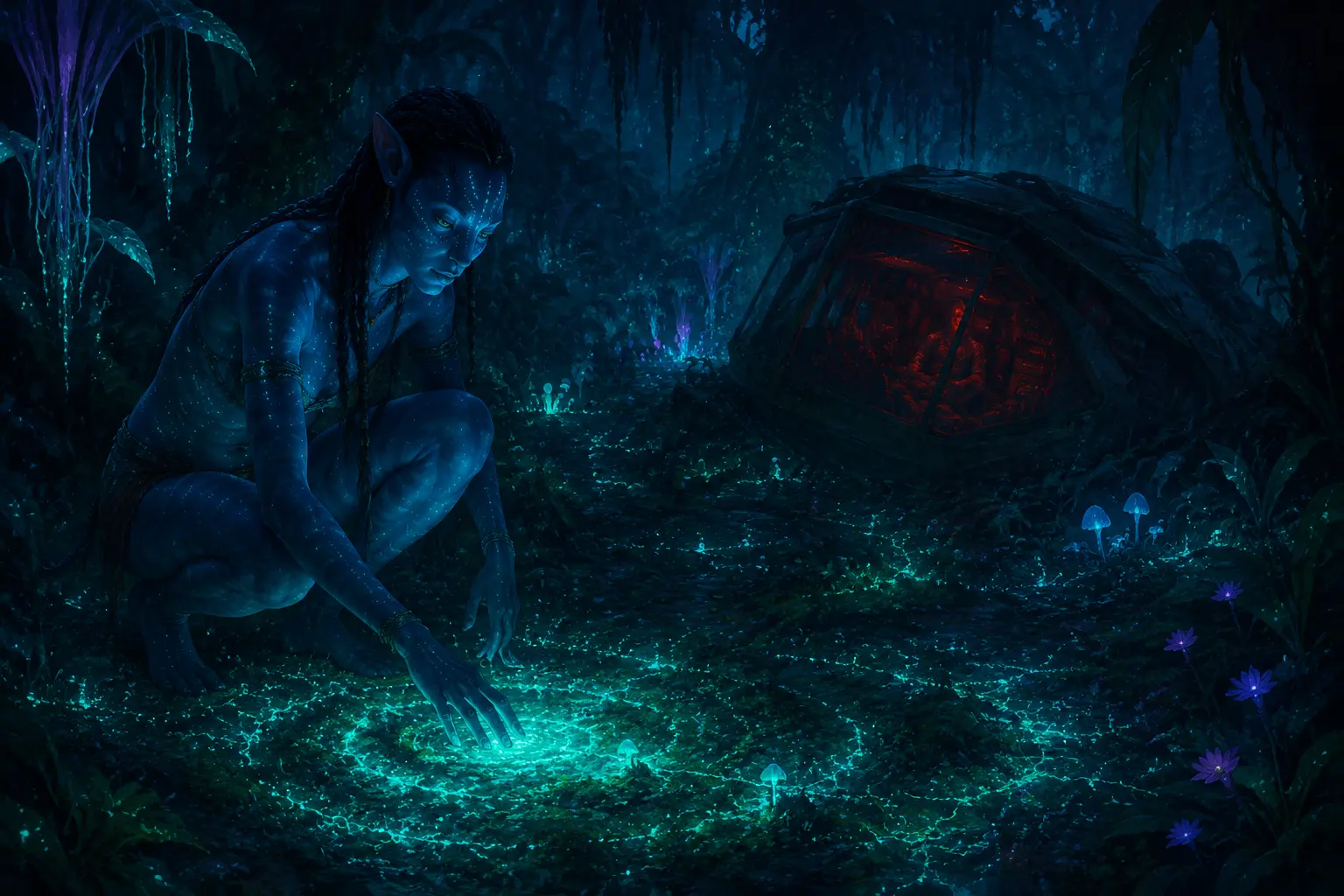
One square metre of night forest, two bodies standing in it, same trees and same air and same hour — and no shared world between them anywhere. That is not a figure of speech. It is where any honest account of Pandora has to start: at the point where you stop describing the moon and start describing the seeing of it. The Na'vi crouches and lays a hand to the moss, and the ground answers in a ring of cold light that spreads away between the roots; she feels the pull of the planet's magnetism the way you feel which way is down; the forest around her is talking in pulses of glow she was built to read. The human beside her, in the same square metre of forest, sees a dim tangle of shadow, hears a few night sounds, and — if he is flying — watches his instruments go quietly insane as the magnetic field claws at them. Two creatures, one forest, two utterly different worlds.
The easy thing to say is that the Na'vi simply has better senses. That is true and it is also the least interesting thing about the situation, and if we stop there we miss the real lesson. Because the human is not experiencing a worse version of the Na'vi's world. He is experiencing a different world — one built from the handful of signals his particular senses happen to admit, with everything else filtered out before it ever reaches him. So is the Na'vi. So is the viperwolf hunting them both, and the banshee overhead, and the glowing fern underfoot. Each of them lives sealed inside a private world assembled from its own narrow intake of reality, and none of them — not even the Na'vi, for all her gifts — perceives the forest as it actually, wholly is. That sealed private world has a name, and learning to use it is the single most powerful tool there is for reading an alien biosphere honestly. This chapter is about that idea, and Pandora is the place that makes it impossible to ignore.
The world according to a tick
The idea is almost a century old, and it began not with anything as grand as an alien moon but with a small blind parasite on a German forest floor. In 1934 the Baltic-German biologist Jakob von Uexküll asked a question that sounds childish until you sit with it: what is the world like, from the inside, for a creature that is not you? Not the world as a physicist measures it — the full spectrum of light, the whole register of sound, every chemical and field present in a forest — but the world as that particular animal actually lives it.
His example was the common sheep tick, and it remains the clearest teaching case ever found. A tick has almost no senses. It is blind. It is deaf. Lying in wait on a blade of grass, the entire perceivable universe of a tick is built from exactly three signals. One: the smell of butyric acid, a compound that seeps from the skin glands of every mammal — when that scent arrives, the tick releases its grip and drops. Two: warmth, the body heat of the animal it has hopefully landed on — this tells it it has found a host. Three: the touch of hair, which sends it searching for bare skin to bite. That is the whole list. Light, colour, the green of the leaves, birdsong, the shapes of passing animals, the entire roaring sensory abundance of a forest — none of it exists for the tick, because the tick has no organ to admit it. Its world is three signals wide, and within that three-signal world it lives a complete and successful life.
Von Uexküll gave this private, lived world a name: the Umwelt, a German word meaning, roughly, "the world-around" — but he meant something very specific by it. He drew a sharp line between two things people usually run together. There is the Umgebung — the objective physical surroundings, the forest as it really is in full, the same for everyone. And there is the Umwelt — that same forest as filtered, built, and inhabited by one particular animal, assembled entirely from the signals its senses can detect and its body can act upon. The Umgebung is shared. The Umwelt is private, and every species has its own. The tick and the deer share a forest; they do not share a world.
The crucial move — the one that makes this more than a charming observation — is realizing that you have an Umwelt too, and that it feels, from the inside, exactly like the whole of reality. It never feels like a filtered subset. It never feels like a bubble. The tick does not experience its three-signal world as impoverished; it experiences it as complete, because it has nothing to compare it against. And neither do we. The slice of the electromagnetic spectrum your eyes admit — that thin band you call "visible light" — feels like all the light there is, when in fact it is a sliver, with vast reaches of infrared and ultraviolet and radio crowding in on either side, invisible to you and obvious to other animals. Your Umwelt feels total. It is not. That is the quiet vertigo at the centre of this idea, and it is worth letting it land, because it is the lens we will hold up to everything on Pandora.
The philosopher Thomas Nagel sharpened the point in 1974 with an essay whose title became a kind of password among people who think about minds: What is it like to be a bat? His argument was that you could learn every physical fact about a bat's echolocation — every frequency, every neuron, the complete wiring diagram — and still not know what it is like, from the inside, to perceive the world as a rolling landscape of returning echoes. The subjective character of another creature's world is not something you can reach by piling up objective measurements from outside. And more recently the science writer Ed Yong, gathering up a century of sensory biology, framed the Umwelt in the most useful way of all: as an evolutionary bargain. No animal perceives objective reality, because perceiving all of it would be ruinously expensive and mostly useless. Instead, evolution builds each species a useful fiction — a curated, ruthlessly edited version of the world that includes the handful of things that matter for that animal's survival and discards the staggering remainder. Senses are not windows onto reality. They are filters, shaped by need.
Hold that — the Umwelt is a useful fiction, edited by evolution down to what survival requires — because it is the rule of the chapter, and every strange Pandoran sense we are about to meet is just another illustration of it. The Na'vi's world and the human's world differ not because one is right and one is wrong, but because their two species were edited by different pressures, on different worlds, toward different fictions. Now let us go and read some of those fictions.
Reading the eye
Begin with the sense we share, because it is where the differences are easiest to measure: the eye. The Na'vi have enormous eyes — large golden-amber spheres set in a face built for a forest that is, by Earth standards, perpetually dim. Their relatives the prolemuris share the trait. And the great fauna take it further: the mountain banshee, the ikran, carries not one pair of eyes but two, a large forward-facing primary pair and a smaller, independently swivelling secondary pair set behind them. To a sensory ecologist, none of this is arbitrary decoration. Eyes are among the most readable organs in all of biology, because their design is pinned down hard by physics, and you can very nearly predict an animal's eye from the world it has to see in.
Start with size, because the Na'vi's most obvious feature is the place to begin. A bigger eye means a bigger pupil, and a bigger pupil gathers more light — it is a wider bucket held up to a thin rain of photons. In a dim forest, lit mostly by bioluminescence and the reflected glow of the gas giant overhead, that light-gathering is everything. So a large eye is exactly what you would predict for a creature active in low light, and the Na'vi have precisely the eye their world calls for. But — and this is where it gets interesting — a big eye is not a free lunch. Physics charges for it on the way out, in three separate currencies, and a real eye is always a compromise between them.
The first cost is noise. In very low light, the limit on what you can see is not your eye's design but the grainy, flickering arrival of the photons themselves: light comes in discrete packets, and when only a few are arriving, their random patter is itself a kind of static. Nocturnal eyes fight this by pooling the signal from many light-detecting cells into one — trading fine detail for the ability to detect anything at all in the dark. The second cost is aberration: big lenses bend light unevenly at their edges, smearing the image, and correcting that demands a beautifully engineered lens. The third is depth of field: a wide pupil brings only a thin slice of the world into sharp focus at once, so an animal leaping through branches needs to refocus constantly and fast. Every nocturnal eye on Earth is a negotiated settlement among these three costs, and the Na'vi eye will be one too — a large aperture for light, paid for in the usual coin.
There is one more trick the Na'vi almost certainly use, because nearly every night-active animal on Earth converged on it independently: the tapetum lucidum, a mirror laid down behind the retina. Light that misses the photoreceptors on the way in strikes the mirror and is bounced back through them a second time, giving the eye two chances to catch each photon. It is why a cat's eyes flare green in headlights, why a deer's shine on a dark road — that is the tapetum throwing back the light it could not use. Canon attributes exactly this retroreflective layer to the Na'vi, and it is precisely what the rule predicts: a dim-world animal squeezing every photon twice.
Then there is the banshee's second pair of eyes, and here the design tells a story about division of labour. One pair of eyes cannot be optimised for everything at once — high-resolution colour vision and fast, wide, low-light motion-detection pull a design in opposite directions. The banshee's answer, in canon, is to split the job across two pairs: large primary eyes for sharp forward colour vision, and smaller secondary eyes, swivelling independently, tuned for motion and near-infrared and acting as a rear-warning system. This is not as alien as it sounds. Plenty of Earth animals run two visual systems at different resolutions; the banshee has simply put them in two separate sets of hardware. Each pair builds part of the bird's Umwelt; together they assemble a world far wider than ours, watched front and back at once.
The night eye: a bucket for light
Widen the pupil to drink more photons — and pay on the way out
But the eye also marks the first place where canon goes quiet, and honesty means saying so plainly. We know the Na'vi eye is large and light-hungry; what we do not reliably know is its spectral range — the actual band of colours it admits. Official material puts their visible range close to ours. A popular community claim insists they see deep into the ultraviolet and infrared, which would be a striking expansion of their world — but that claim has no official backing, and it would be a tier error to repeat it as fact. So we mark it honestly: human-like range is the canonical baseline; extended UV/IR vision is an appealing speculation, no more. The precise opsins in a Na'vi retina are simply not on record. We can read the eye's optics with confidence; the exact width of the window it opens onto the world is, for now, an open question.
And the eye is only one organ, on one kind of face. Look across the Pandoran fauna and the sensory hardware fans out into a catalogue of different solutions to the same forest. The thanator, the apex hunter of the forest floor, carries a fan of mobile sensory quills ringing the back of its armoured skull — almost certainly tuned to vibration or to fields, a way of feeling prey it cannot yet see. The viperwolf hunts in packs through the night on green, tapetum-bright eyes and a nose second only to the thanator's. The direhorse sweeps the grassland with long, mobile antennae that taste the air and read the ground ahead. The hexapede pivots a pair of thin, taut membrane-fans on its horns to gather the faint low sounds of an approaching predator. Six creatures, one forest — and six different cuts through it, each animal reading the channels its life depends on and ignoring the rest. The lesson of the eye repeats all the way down: every organ is a window shaped by need, and every window opens on a different world.
Senses we were never given
The eye is the comfortable case, because we have one and can argue about the details. Far stranger — and far more important for grasping the Umwelt — are the senses we lack entirely: whole channels of physical reality that some Earth animals perceive directly and we cannot perceive at all, not faintly, not with effort, not even in principle without instruments. These are the senses that make the bubble visible. And the one that matters most on Pandora, because the moon's own geography demands it, is the ability to feel a magnetic field.
The Earth's magnetic field is everywhere, passing straight through your body this instant, and you have not the faintest sensation of it. A great many animals do. Migratory birds, sea turtles, salmon, and monarch butterflies all navigate by it across thousands of kilometres, and the discovery of how is one of the loveliest and strangest results in modern biology — strange because the leading mechanism reaches all the way down into quantum physics. It is called magnetoreception, and the evidence points to two quite different machines, often working together in the same animal.
The first is a compass, and it lives, astonishingly, in the eye. Inside the retina of a migratory bird sits a light-sensitive protein called a cryptochrome. When a photon of blue light strikes it, it kicks an electron across the molecule, leaving behind two unpaired electrons — a radical pair — whose quantum spins are linked. Those linked spins flicker between two arrangements, and here is the magic: the rate of that flickering is sensitive to the angle of the surrounding magnetic field. So the chemistry of the molecule, and therefore the signal it sends to the brain, changes depending on which way the bird's head is pointing relative to the field lines. The current best guess is that this paints a faint pattern of light and shadow across the bird's vision — that the bird, in some literal sense, sees the magnetic field as an overlay on the world. It is a quantum compass wired into sight.
Two things about this compass are worth holding. First, it is an inclination compass: it does not read north and south like a hiker's needle, but reads the angle at which the field lines dip into the ground — steep near the poles, flat near the equator — which is enough to tell the bird whether it is heading poleward or toward the equator. Second, it is delicate. The quantum coherence that makes it work is fragile, and weak radio-frequency noise in just the wrong band can scramble it and leave a bird disoriented. This is a compass tuned to a quiet, steady field — which will matter enormously when we get to Pandora.
The second machine is cruder and tougher: tiny crystals of magnetite, a naturally magnetic iron mineral, embedded in specialised cells. These act like microscopic compass needles, physically twisting as the field changes and tugging on the nerve endings around them, sending a mechanical signal to the brain. Where the cryptochrome compass gives direction, the magnetite system is thought to read intensity — the local strength of the field — which is exactly what an animal needs to know not just which way it is heading but where it is. Direction plus position: a compass and a map, two senses for the price of one missing modality. And every bit of it is invisible to us. We walk through the same magnetic field the bird is reading like a chart, and we feel nothing, and our world feels complete anyway. That is the Umwelt, made unmistakable.
I want to teach this one sense well and then move quickly, because the point is not to catalogue every exotic sense but to feel how many of them there are. So, briefly, the others. There is electroreception — sharks and rays carry jelly-filled pores, the ampullae of Lorenzini, sensitive enough to detect the faint electric fields cast by a hidden animal's own muscles, letting them find prey buried in sand they cannot see. But that sense has a hard physical limit worth knowing: it works only in water, because seawater conducts electricity and air does not. In air, electric fields collapse over almost no distance, which is why no land animal hunts by electroreception — the physics forbids it. There is echolocation, the bat's and the dolphin's trick of active sensing: rather than waiting for the world to send a signal, the animal shouts and reads the returning echoes, building a sound-picture of distance, speed, size, and texture from the timing and pitch of what comes back. And there is the lateral line of fishes, a row of tiny hair-cell sensors down the flank that reads the push and swirl of water, letting a fish feel the wake of a neighbour it cannot see and a whole school turn as one body.
Each of these is a doorway into a slice of reality that is, for us, simply not there. Not dim — absent. And every one of them turns up, in some form, in the Pandoran research record: fauna that navigate magnetic chaos, reef-dwellers that map turbid water by sound, predators reading vibrations through the ground. The moon is crowded with creatures whose worlds are built on channels we would need machines to even confirm exist. Which brings us back to the magnetic one, because Pandora has a place where it becomes the difference between flying and falling.
Two machines for one missing sense
A quantum compass reads direction; a magnetite map reads where you are
One scene, four worlds
The same patch of night forest, re-seen through different senses
The compass that should not work
Here is the Pandoran fact that makes the magnetic sense more than a curiosity. The Hallelujah Mountains — the floating peaks — hang where they do because the moon's magnetic field, tangled together with the vast magnetosphere of Polyphemus above, concentrates into ferocious local knots that canon calls flux vortices. These same knots are why a deposit of superconducting ore can hang a mountain in the sky, a story told in its own chapter and not one to repeat here. What concerns us is what those magnetic knots do to navigation. For human technology, a flux vortex is a graveyard for instruments: it scrambles navigation grids, blinds avionics and targeting systems, and forces pilots down onto visual flight rules — fly by eye or do not fly at all. The field there is not the gentle, steady whisper that Earth's birds read. It is a roaring, shifting, contradictory mess.
And Pandora's flying fauna hunt through it without the slightest trouble. Banshees and the great leonopteryx wheel, dive, and strike inside the vortex with full spatial command, exactly where human machines go blind. That contrast is the clue. If these animals navigate by a magnetic sense at all — and their flawless command of a region defined by magnetic chaos is a strong hint that they do — then it cannot be the Earth version of the sense. Recall that the bird's quantum compass is delicate, tuned to a quiet field and scrambled by even modest interference. Drop an Earth bird into a flux vortex and it would be as lost as the RDA's instruments. So if a banshee thrives there, its magnetoreception must be built differently — and reasoning out how is a clean piece of inference, the kind of careful extrapolation from canon and real science that reading Pandora is all about. Let me be clear that what follows is inference, not canon: canon tells us the animals navigate the vortex; it does not tell us the machinery. But the machinery is constrained, and we can say useful things about it.
A magnetic sense that works inside a flux vortex would need to solve the exact problems that defeat the Earth version. It would need a compass whose quantum coherence is not shattered by a strong, noisy field — a more robust chemistry, holding together where the bird's would fail. It would lean heavily on the magnetite machine rather than the delicate cryptochrome one, because solid magnetic crystals reading raw field strength would keep working in conditions that scramble the subtle quantum compass. And it might use the geometry of those two independent eye-pairs to triangulate the field from more than one angle at once, turning a chaotic field into a navigable three-dimensional map. None of that is in the films. All of it follows from taking the canon fact — they fly the vortex clean — and the real science — here is what magnetoreception is and here is exactly how it breaks — and asking what kind of sense would have to sit between them. The honest label on the whole construction is inference, and we mark it as such. But it is inference with physics behind it, which is the most a reader of Pandora can ask for.
The bonded sense
So far every sense we have met, ours and Pandora's alike, ends at the skin. Light, sound, scent, magnetic field — all of it has to be caught by an organ at the body's boundary, converted into nerve signals, and carried inward to a brain that reconstructs a world from the coded pulses. That is the universal architecture of perception on Earth, without exception: the nervous system runs to the edge of the body and stops, and everything beyond the edge must be sensed across a gap. Pandora breaks this rule, and it is the moon's single most radical sensory idea.
The queue — the kuru, the neural braid trailing from the back of the skull — is, in canon, not hair. Inside its sheath runs a bundle of fine neural tendrils that are direct, exposed extensions of the central nervous system itself: the brain, reaching past the skin and out into the air. When two such queues are brought together and their tendrils interlace, they form a direct synaptic connection — tsaheylu, the bond — a living bridge wiring two nervous systems into one circuit. And the very first thing to do with this idea is to strip away the wrong word for it, because almost everyone reaches for that word and it poisons the whole understanding.
Read through the Umwelt, tsaheylu becomes something precise and astonishing: a way to temporarily merge two perceptual bubbles into one. When a Na'vi bonds with an ikran and takes to the air, she does not send the banshee steering commands like a pilot working controls. The animal's body becomes, for the duration of the bond, part of her own. Its wings register as her limbs; the air pressure across its flight membranes arrives as her own proprioception, the bodily sense of where your parts are and what they are doing; its motion is corrected by her reflexes as if it were her own balance. And, crucially, its senses flow into her — the banshee's wider visual field, its motion-tracking secondary eyes, its near-infrared, and quite possibly whatever magnetic sense lets it read the vortex. For as long as the bond holds, the rider's Umwelt swells outward to enclose the mount's. She is, briefly, perceiving the world through two bodies at once. There is no Earth analogue for this — no creature on our planet can lend another its senses through a living cable — and the closest we come is the cold prosthetics of our own technology, the brain-machine interfaces that let a person move a robotic arm by thought. Pandora grew the interface, and made it run both ways, and wired sensation back across it.
The bond also has a darker side that proves how real the connection is, because you can measure a thing by what its destruction costs. To sever a queue is, in canon, a catastrophe — not the loss of an ornament but a neurological maiming, inducing shock, agony, paralysis, or death, and leaving any survivor locked out of the shared sensory world for good. That is not how losing a decoration works. It is how losing a piece of your nervous system works. The pain is the proof: the queue is wired deep enough into the self that tearing it out is tearing out part of the perceiving mind.
There is one honest gap to flag, because it is genuinely open and genuinely interesting. We do not know whether tsaheylu carries raw sensory data — the unprocessed firing of the mount's eyes and nerves, which the rider's brain must then learn to decode — or whether the mount's brain pre-digests the world and sends across only finished, high-level impressions: a sense of there is the ground, bank now, rather than the raw torrent. The difference is real and the films never settle it. It is the kind of question that, on Earth, would launch a decade of experiments; on Pandora it stands as one of the richest unanswered problems of the whole sensory system.
A skin that speaks, a forest that answers
Two last channels, quickly, because both show the Umwelt operating not in a single creature but between creatures — perception as a shared, social medium.
The first is written on the Na'vi's own skin. Their luminous freckles — the fine bilateral lines of light tracing the paths of their vessels and nerves — are not only beautiful; they are a signal, and a peculiarly honest one. Because the pattern follows the body's own wiring and brightens with the body's inner state — flaring with exertion, fear, the rush of feeling — it is very nearly impossible to fake. You cannot easily counterfeit a glow that is plumbed directly into your nervous system. On Earth, signals that are costly or physically impossible to fake are the ones other animals learn to trust; a signal that can be faked gets faked, and stops being believed. The Na'vi wear a continuous, involuntary readout of their own inner weather, legible to anyone who can see it. And in a dark forest where a spoken word can carry to a predator's ears, a silent channel of light that broadcasts your state to your companions without making a sound is not romance — it is a quietly brilliant piece of social engineering by evolution. It lets a hunting party stay coordinated and silent at once. It is also, surely, part of what the Na'vi greeting I see you is reaching for: not the bare fact of the body in front of you, but the inner state written in light across it — a claim to perceive the other truly, on a channel built for exactly that.
The second shared channel is the forest floor itself. Step on the Pandoran ground at night and light races outward from the footfall — the reactive bioluminescence that its own chapter treats in chemical detail. Read as a sense, though, it becomes a planet-scale signalling network that no single animal owns. A footstep writes a pulse of light into the ground; a predator downwind reads that pulse and knows where its prey is; the prey's herd reads the same pulse and knows to scatter. The forest is a shared display surface, and many creatures' Umwelten are tuned to read it at once. It is worth being precise about what kind of light this is, because two different phenomena get muddled.
Honest edges
It is worth drawing the line cleanly between what we know and what we are reasoning toward, because that line is the discipline of reading Pandora honestly. The framework itself — the Umwelt, the tick's three-signal world, the useful fiction edited by evolution — is settled Earth science, a century old and well-founded. The sensory biophysics is equally solid: the radical-pair compass and the magnetite map, the optics of large eyes and the tapetum's second pass, the water-only physics of electroreception, the honest-signal logic of an un-fakeable glow. These are real, cited, and as firm as this kind of science gets.
The canon is firm on a different set of things: that the Na'vi carry large light-hungry eyes and luminous nerve-wired freckles; that the queue forms a real, physical, devastatingly important neural bond; that the flying fauna command the magnetic chaos of the flux vortex; that the night forest signals in reactive light. What sits between the firm science and the firm canon is inference — the reconstruction of how a magnetic sense could survive a flux vortex, the reading of tsaheylu as a merging of perceptual worlds, the cascade of logic by which an honest skin-signal earns trust. That bridge is sound, but it is reasoning, and we have marked it as reasoning every time we crossed it. And a few things canon simply never says, and we have left them open rather than invent answers: the true spectral range of Na'vi vision, the actual machinery of the fauna's magnetic sense, whether tsaheylu ships raw data or finished impressions. Those gaps are not failures of the account. They are the account being honest about its own edges.
The two worlds, seen again
Come back to the forest we started in — the Na'vi and the human, side by side in the same night. Nothing about that scene has changed, but everything about how we read it has. They were never going to share a world, because sharing a stretch of ground is not the same as sharing an Umwelt. The human's senses admit one narrow slice of the place: a band of visible light, a register of sound, a little scent, and nothing of the magnetism clawing at his instruments or the glow racing under his feet or the inner weather flickering across the skin of the person beside him. The Na'vi's senses admit a wider slice, and through her queue she can briefly borrow still more. But — and this is the humbling part, the part that keeps the idea from being mere Na'vi-worship — her world is a filtered fiction too. She does not perceive the forest whole either. No one does. No creature ever has, on any world. There is no view from everywhere; there is only the particular, edited, useful world each set of senses builds, and the vast unsensed remainder that every creature mistakes for nothing-at-all simply because it has no organ to admit it.
That is the gift Pandora hands a careful observer, and it is a gift about Earth as much as about the moon. We tend to assume our world is the world — that what we see is what is there, full stop. The Umwelt says otherwise, and Pandora makes the lesson impossible to dodge by parking two creatures in one forest and letting us watch their worlds diverge. The magnetic sense the banshee flies by, the electric fields a shark reads in the dark, the merged perception of a bonded rider, the honest light on a hunter's skin — every one of them is a reminder that the reality you move through is far larger than the reality you perceive, and that the boundary between the two is not the edge of the world but only the edge of your senses. Learn to feel that edge, learn to suspect there is always more reality pressing in just past the rim of your bubble, and you have learned the one thing a strange moon is best placed to teach. The Na'vi have a phrase for the act of truly perceiving another. The deepest reading of I see you may be the simplest: an admission that seeing is always partial, and a vow to reach across the gap anyway.
What stays open
Official material puts their visible range close to a human's, but a popular community claim holds that they see well into the ultraviolet and infrared — which would dramatically widen their world. The claim has no canonical backing and the actual photoreceptor pigments in a Na'vi retina are never specified. We can read the eye's optics — large, light-hungry, almost certainly tapetum-backed — with confidence; the exact width of the window it opens stays unconfirmed.
Canon establishes that banshees and other fauna navigate the magnetic chaos of the flux vortex flawlessly, where human instruments fail. It never says how. A delicate Earth-style quantum compass would be scrambled there, so the machinery must differ — likely a more robust radical-pair chemistry, a heavier reliance on rugged magnetite crystals, or two-angle triangulation across paired eyes. All of that is physics-constrained inference, not documented fact.
Unresolved, and genuinely important. When a rider bonds with a mount, does the queue transmit the raw, unprocessed firing of the animal's senses — leaving the rider's brain to decode a foreign torrent — or does the mount's brain pre-digest the world and send across only high-level spatial maps and emotional states? The subjective character of the bond depends entirely on which it is, and canon never settles the question.