

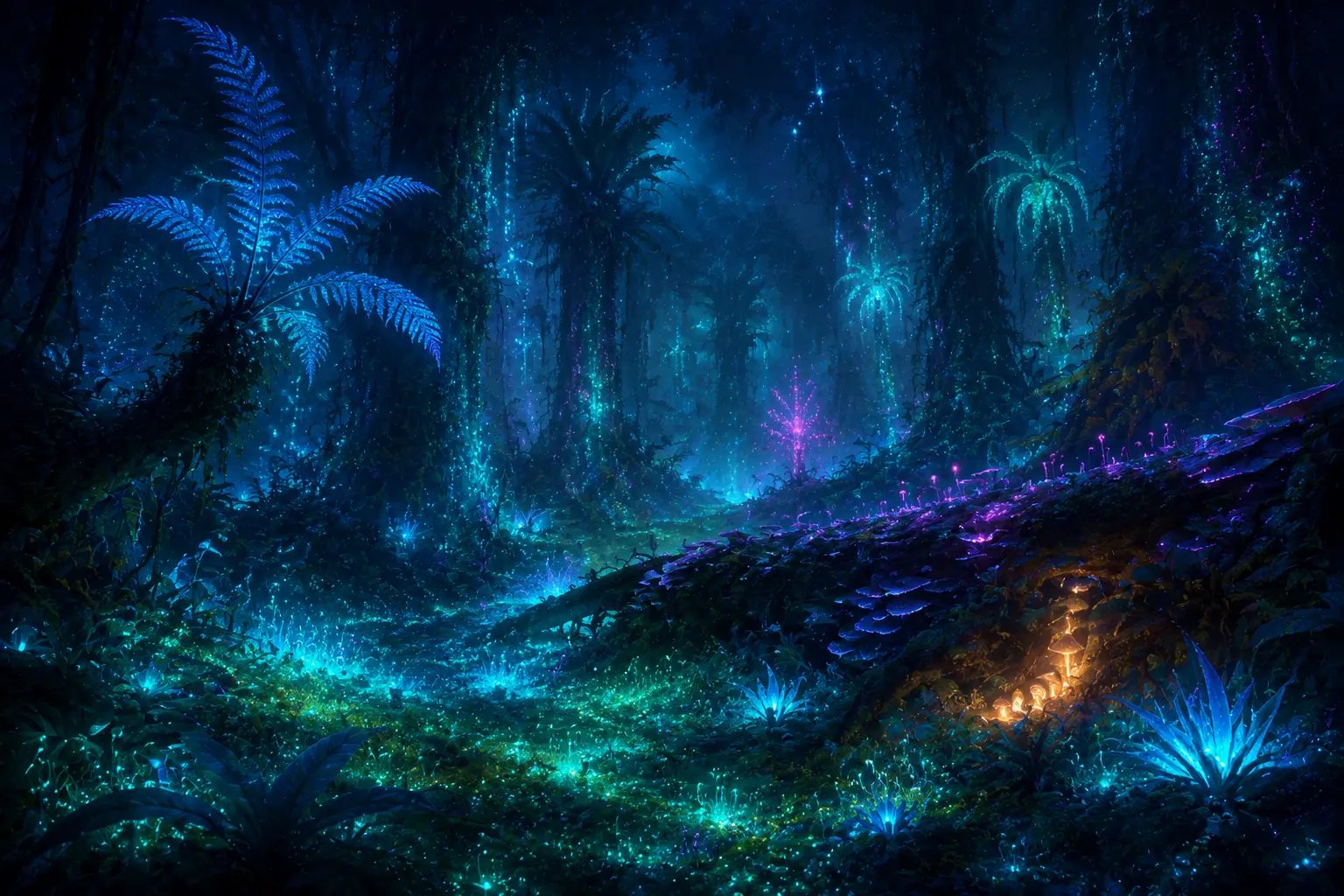
Walk into the forest at night on Pandora and the first thing you learn is that the dark is not dark. Press a foot to the moss and a ring of light spreads out from where you touched, racing away between the roots like a rumour. Overhead the ferns carry their own steady blue. A fungus on a fallen trunk holds a low violet coal. Spores drift past trailing faint green wakes. None of this is moonlight or starlight reflected back at you — every one of those lights is being made, on the spot, by something alive. The whole forest is its own lamp.
To a visitor from Earth this is precisely backwards. We have a word for a living thing that makes its own light — bioluminescence — and on our planet it names a rarity. A few beetles we call fireflies. A scattering of fungi that make rotting logs glow with what country people once called foxfire. A handful of worms, a click beetle or two. Step into an Earth forest at night and you will see, on a good evening, the blink of a courting firefly and almost nothing else. The dark is the rule; the spark is the exception you remember precisely because it is rare.
On Pandora the ratio is inverted. It is not that a few special creatures glow. It is that glow is the baseline condition of the living world after the sun goes down — flora, fungi, the drifting spores, the great animals, and, as we will see, the Na'vi themselves. Darkness, here, is the anomaly. And that inversion is the whole puzzle of this chapter, because it is not a small one. To explain it we need to answer two different questions that are easy to run together. First: how does anything make light from chemistry at all? And second, the harder one: why would a whole biosphere come to treat light-making as the norm, when on Earth it stayed a curiosity of the deep?
A light that does not burn
Start with the how, because it is the part where the real science is settled and beautiful, and it disciplines everything that follows. The light a firefly makes — and the light a Pandoran fern makes, if canon is to be believed — is not a glow of heat. This matters more than it sounds. Most light humans had ever made, until about a century ago, was the light of burning something or heating it white: a candle, a filament, the sun. That kind of light is incandescence, and it is mostly waste. A traditional bulb pours something like nineteen-twentieths of its energy out as heat you cannot see, and gives you light almost as a by-product.
Living things cannot afford that. A firefly that heated its abdomen to filament temperature to make light would cook itself. So life found another road to light entirely — a chemical one. Chemiluminescence is light released directly from a chemical reaction, with no heating step in between, and bioluminescence is simply chemiluminescence performed inside a living cell. The trick is to build a molecule that, when it reacts, lands not in an ordinary calm state but in an excited one — an electron hoisted up onto a higher rung — and then lets that electron fall back down by spitting out the energy difference as a single particle of light. No flame. No glowing filament. Just a molecule, reacting, and a photon leaving.
The machinery for this comes in two parts, and they have plain names once you meet them. The fuel is a small molecule called a luciferin — from lucifer, "light-bringer." The tool that handles the fuel is an enzyme called a luciferase. The enzyme takes the luciferin, joins it to oxygen, and shepherds it through a reaction that leaves the product briefly excited; the excited product then drops back down and releases its photon. Luciferin is the candle; luciferase is the hand that strikes and steadies it. That is the entire principle, and you can watch it run, one step at a time.
The cold-light reaction
Luciferin + O₂
The enzyme luciferase takes a small fuel molecule — luciferin — and joins it to oxygen. No light yet; this is only loading the chamber.
Where the energy goes
The efficiency is the part that should stop you. Early measurements suggested the firefly reaction was very nearly perfect — that almost every molecule of fuel that reacted produced a photon, a so-called quantum yield close to one. Later, more careful work with calibrated instruments brought that number down — the true figure is more modest — but the headline survives intact: compared with anything that makes light by getting hot, biological light is extraordinarily cheap in energy and almost free of waste heat. That cheapness is not a footnote. It is the reason a living thing can run a lamp continuously without burning through its budget, and we will need it badly when we come back to Pandora and ask how a whole forest can afford to shine all night.
It happened again, and again, and again
Here is the fact that turns the chemistry into a real clue about Pandora. On Earth, bioluminescence is not a single invention that spread through the tree of life from one glowing ancestor. It is a trick that life has stumbled onto independently, over and over, in lineages that share no recent common ancestor and no common machinery. The current estimates put the number of separate origins somewhere between forty and fifty — and possibly higher. Bacteria found it. Dinoflagellates, the single-celled drifters that make the sea sparkle in a boat's wake, found it on their own. Fungi found it. Jellyfish and their kin found it. Beetles — the fireflies — found it. None of them inherited it from the others.
We know they are separate inventions because the fuel is different every time. If all glowing life shared one ancestral lamp, they would all burn the same luciferin. They do not. The bacterial system runs on a reduced flavin molecule; the dinoflagellates burn an open-chain tetrapyrrole built from the same raw material as chlorophyll; the fungi use a compound derived from caffeic acid, the stuff in plant cell walls; the jellyfish use coelenterazine; the firefly uses its own unique luciferin found nowhere else. Different fuels, different enzymes, different chemistry — arriving at the same end. That is the signature not of inheritance but of convergent evolution: the same solution, reached again and again by separate roads, because the problem keeps making it worth reaching.
One trick, invented dozens of times
Each branch glows with a different fuel molecule and a different enzyme. They did not inherit light from a shared glowing ancestor — every lineage stumbled onto it on its own.
This is worth sitting with, because convergence on this scale carries a message. When evolution finds the same answer once, it might be luck. When it finds it forty times over, in creatures as unlike as a bacterium and a beetle, the answer is telling you something about the questions life keeps being asked. A trait that arises this often must be, first, chemically easy to stumble into — and, second, useful enough that natural selection keeps it once it appears. Both halves matter for Pandora. The chemistry, we have seen, is cheap. The usefulness is the half we have not yet examined — and it turns out to depend almost entirely on one thing: how dark it is where you live.
What the light is for
Before we ask where glow pays off, it helps to see how it pays off, because the uses are wonderfully varied and every one of them turns up, in some form, on Pandora. Earth's glowing creatures have bent their light to four or five distinct jobs, and the catalogue reads like a field guide to the night.
The first job is hiding — which sounds backwards for a light, until you think like a deep-sea fish. Down in the twilight of the open ocean, faint daylight still filters from above, and anything swimming below you sees you as a dark shape against that glow. The answer many midwater animals hit on is counter-illumination: they grow lights on their bellies and tune them to match the brightness of the water overhead, erasing their own silhouette. The Hawaiian bobtail squid does this with a borrowed lamp — it farms glowing bacteria in a special organ on its underside, and the bacteria only switch their light on when they are packed densely enough inside the squid, a chemical headcount called quorum sensing. The squid supplies room and board; the bacteria supply the camouflage.
The second job is alarm. Many dinoflagellates flash when the water around them is disturbed — the sparkle in a breaking wave — and the flash is not for them but against whatever jostled them. A sudden burst of light startles a small grazer, and worse, it advertises that grazer's position to the larger predators hunting it: a burglar alarm that summons something big to deal with the intruder. The third job is warning. The blind, cyanide-laced millipede Motyxia, which lives on land in California, glows a steady greenish light that says, in effect, do not eat me — a luminous version of the bold stripes a wasp wears by day. Biologists call that honest advertisement of a defence aposematism, and field tests with glowing and non-glowing clay models confirmed the lit ones get bitten far less. The fourth job is conversation: the firefly's flashing code, each species with its own rhythm, a lantern-lit personal column for finding the right mate in the dark.
The Earth turn: why the deep sea glows and the land does not
So glow is cheap to make and easy to evolve. Then why, on Earth, is it still rare? Why didn't the whole living world light up?
The answer is the most useful thing this chapter has to teach, and it comes from noticing where Earth's bioluminescence actually is. It is not spread evenly over the planet. It is overwhelmingly in the sea — and specifically in the deep, open ocean, where by some surveys the majority of animals, on the order of three-quarters, can make light. The land, by contrast, is nearly dark: a few fireflies, a few fungi, almost nothing else. The ocean surface and the shallows sit somewhere between. The distribution is not random. It tracks one variable with brutal consistency: darkness.
Where glow happens — and why
Glow density →
Think about why the deep sea is special. Below a few hundred metres the sun gives out entirely, and the dark is total, vast, and permanent — the largest habitat on Earth by volume, and almost all of it black. In that blackness, light is not decoration; it is the only long-range signal an animal has. Sound travels, but to make and hear it well is its own expensive specialism. Smell drifts slowly and tells you little about direction. But a flash of light can be seen across open water instantly, aimed, timed, coloured. In a world with no daylight to drown it, a photon is the most valuable currency there is — for finding a mate, for luring prey, for startling a predator, for hiding your own silhouette. So in the deep sea, where darkness is the permanent condition, evolution reaches for light again and again until light becomes the norm.
Now look at the land, and the same logic runs in reverse. On land the sun returns every morning and floods everything; a faint biological glow is simply washed out for half of every day. Worse, land animals already have cheaper channels that work well in air — they can call and listen across a meadow, they can lay down scent trails, they can see each other in daylight at high resolution. With daylight to compete against and good alternatives already in hand, the payoff for evolving a lamp is small, and so it rarely happens. The trick is just as cheap to invent on land as in the sea. It simply is not worth as much there.
The Pandora flip: a land that behaves like the deep sea
Now turn the rule on Pandora, and watch the inversion fall out of it for free. The thing that makes Earth's land dark — the sun returning each morning to wash out any feeble glow — is exactly the thing Pandora's surface is missing. Pandora is not a planet orbiting its star in the open. It is a moon, circling the gas giant Polyphemus, which circles the star. That arrangement keeps the surface in a state Earth's land never knows: chronic, structural dimness. The great bulk of Polyphemus throws Pandora into regular, lengthy eclipses. The moon's steep tilt swings the balance of day and night hard across its year. And true blackness is itself rare, because when the star is hidden there is still the enormous lit face of Polyphemus, and the second sun of the Alpha Centauri pair, and other moons, holding the surface in a long, dim, shifting twilight rather than honest night.
Read that against the rule and the conclusion writes itself. Pandora's surface is chronically dim — never flooded with the kind of overhead daylight that drowns a glow on Earth — and it is rich in life that needs to find mates, lure prey, warn off enemies, and hide. Both conditions of the rule are met on the land. So Pandora's forests are not behaving like Earth's forests at all. Ecologically, they are behaving like Earth's deep sea: a permanently dim world where a photon is the most valuable signal an organism can spend. The deep-sea norm of glow has been lifted up out of the ocean and laid across the surface of an entire moon. That is the inversion, and it is not magic. It is the same rule Earth obeys, applied to a place where the dark never fully lifts.
From there a plausible chain follows — and here we cross from settled science into reasoned inference, so let me mark the line clearly. The likely starting point is the plants. In chronic dimness, a plant that needs a pollinator to find it at night has the same problem a deep-sea animal has, and the same cheap solution: make light. Glowing flowers and leaves would draw night-flying pollinators the way a daylight flower's colour draws a bee. Once the plants light up, though, the background of the whole forest is luminous — and any animal that does not glow now stands out against that glow as a dark silhouette, the way a fish without counter-illumination shows up black against the bright water above. That turns light into camouflage: an animal that matches the glowing background hides in it. The pressure to light up cascades from the flora into the fauna, until glow is not a special adaptation but the default state of everything, and the genuinely interesting animals are the ones that have evolved ways to dim themselves — to mask their light when hunting or hiding. This cascade is an inference, not canon; what canon gives us is the end state, a biosphere where glow is the norm. The rule is what tells us that end state is exactly what a dim, living moon should produce.
The light on their skin
Which brings us, at last, to the Na'vi — because the most striking glow on Pandora is the one the People carry on their own bodies. Their skin is marked with fine luminescent dots, the freckle-like points sometimes called by a Na'vi name of their own, arranged not at random but in precise, bilateral lines that run along the paths of the body's blood vessels and nerves. They are not paint and not decoration laid on top. They are organs — small light-making structures set into the skin, the Na'vi's own version of the light organ that biologists call a photophore, the same word used for the lamps studding the flank of a deep-sea fish.
What they do is the quietly beautiful part. The Na'vi photophores do not blink or flash in codes the way a firefly does. They glow steadily, and their brightness tracks the body's inner state. At rest the light is low. As feeling rises — exertion, fear, the adrenaline of a fight, the charge of a bond forming — the photophores flare brighter, lit from within by the body they are wired into. The light is a readout of the nervous system, written on the skin. And it is, by the official account, a single colour: a blue-white that does not change hue. You will hear it said that the markings shift colour with mood, glowing one shade in anger and another in love, but canon does not support that. The light is monochrome; what changes is its intensity. A perceived shift in colour is an illusion — the eye fooled by changing brightness, or by warm firelight thrown across blue skin.
Photophore
Brightness follows arousal; the hue stays constant.
MONOCHROME
One blue-white colour; only intensity changes.
It is worth pausing on one popular story precisely because it is so appealing and so wrong, since telling canon from wishful thinking is part of reading Pandora honestly. The tale goes that when two Na'vi form a lifelong bond, their photophore patterns rearrange to mirror each other, so that mated pairs carry matching constellations. It is a lovely idea. It is also a community invention with no support in the official material, which says something far less romantic and far more biological: photophore placement is set by genetics and by the body's own vascular and neural architecture. The pattern you wear is the one your vessels and nerves laid down, shared in its broad strokes with your kin because you share their build, growing more intricate as you age, and fading to nothing at death when the body that powered it stops. The pattern is a family resemblance and a life history. It is not a wedding ring.
Honest edges
It is worth being plain about the seams in this reconstruction, because the line between what we know and what we are reasoning toward is the whole discipline of reading Pandora. The chemistry is rock-solid Earth science: luciferin and luciferase, cold light, the near-free photon, the forty-odd independent origins, the deep-sea-versus-land distribution. The rule we drew from it — glow floods in where it is chronically dim and a photon pays — is as well-supported as ecology gets. The canon is also firm on the end state: that Pandora's biosphere glows pervasively, that the Na'vi carry intensity-modulated, gene-placed, single-colour photophores. What sits between those two firm things is inference: the claim that Pandora's land glows for the same reason Earth's deep sea does, and the pollination-to-camouflage cascade that would drive glow from the flora into the fauna. That bridge is sound reasoning, but it is reasoning, not documentation.
And there are two places where canon goes frankly silent, and honesty demands we leave them open rather than paper over them. The first is chemistry: canon never names Pandora's luciferin or its luciferase. We are confident the kind of process is the same — enzymatic cold light — because nothing else makes biological light cheaply, but we cannot hand you the molecule. The second is energy, and it is the sharper puzzle. A single firefly flashing for a few seconds is cheap; an entire forest of plants glowing brightly, all night, every night, is an enormous standing energy bill, and canon does not explain how the flora pays it. One may speculate — and it is only speculation — that Pandora's planet-spanning root-and-neural network lets organisms share the metabolic load, or that the moon's high-radiation environment first selected these light-making reactions as a way to mop up damaging molecules, the way some think Earth's bioluminescence began as an antioxidant trick before it was ever a signal. Those are guesses worth naming and not worth believing. The gap is real.
The lit footprint, read again
Come back to where we started, to the ring of light spreading out from a footstep in the moss. It is no longer mysterious, but it is, if anything, more remarkable for being understood. The light is cold — a chemical reaction wasting almost no heat, the same trick a firefly uses, cheap enough to run all night. It is everywhere because Pandora's dim, eclipse-shadowed surface turns its forests into the ecological equivalent of Earth's deep sea, where a photon is the most valuable thing alive can spend; and once the plants lit up, everything else had to follow, into light or into the art of hiding from it. And it is on the Na'vi's own skin for the plainest reason of all — they are animals of this world, wired like the rest of it, carrying the same lamp the whole moon carries, tuned to flare with the beat of their own hearts.
The beauty of the glow is the easiest thing about it to notice, and the least of what it has to tell you. Pandora did not break any rule of Earth's to become a world of light. It obeyed the same rule, harder. Make light cheap, make the dark permanent, make a photon worth more than a sound or a scent — and life will reach for light again and again until light is simply what living looks like. Earth keeps that world hidden in its deep ocean, out of sight beneath the waves. Pandora wears it on the surface, in the open air, where a visitor can stand in it at night and watch the ground answer her footstep. Learn to read the light, and the strangest thing about Pandora turns out to be something Earth has had all along — we just had to go down into the dark to find it.
What stays open
Canon confirms the glow is enzymatic cold light but never names the molecules — no Pandoran luciferin or luciferase is identified. We can be confident of the kind of process, because enzymatic chemiluminescence is essentially the only way to make biological light cheaply, but the specific fuel and enzyme are unrecorded. On Earth there are at least forty different luciferins; Pandora's is simply not on the table.
This is the chapter's sharpest unresolved gap. A brief firefly flash is cheap; continuous, bright, forest-wide light is a massive standing energy cost, and canon does not explain how the flora pays it without exhausting its carbon budget. Speculative answers — a shared planet-wide network spreading the load, or a radiation-defence origin for the chemistry — are guesses, not canon.
Unconfirmed. Canon establishes that brightness tracks physiological and emotional state — flaring with adrenaline, dimming at rest — but whether a Na'vi can consciously control the light like a switch, or whether it is purely involuntary and driven by the autonomic nervous system, is left open. The intensity is clearly state-linked; the question of deliberate control is not answered.