

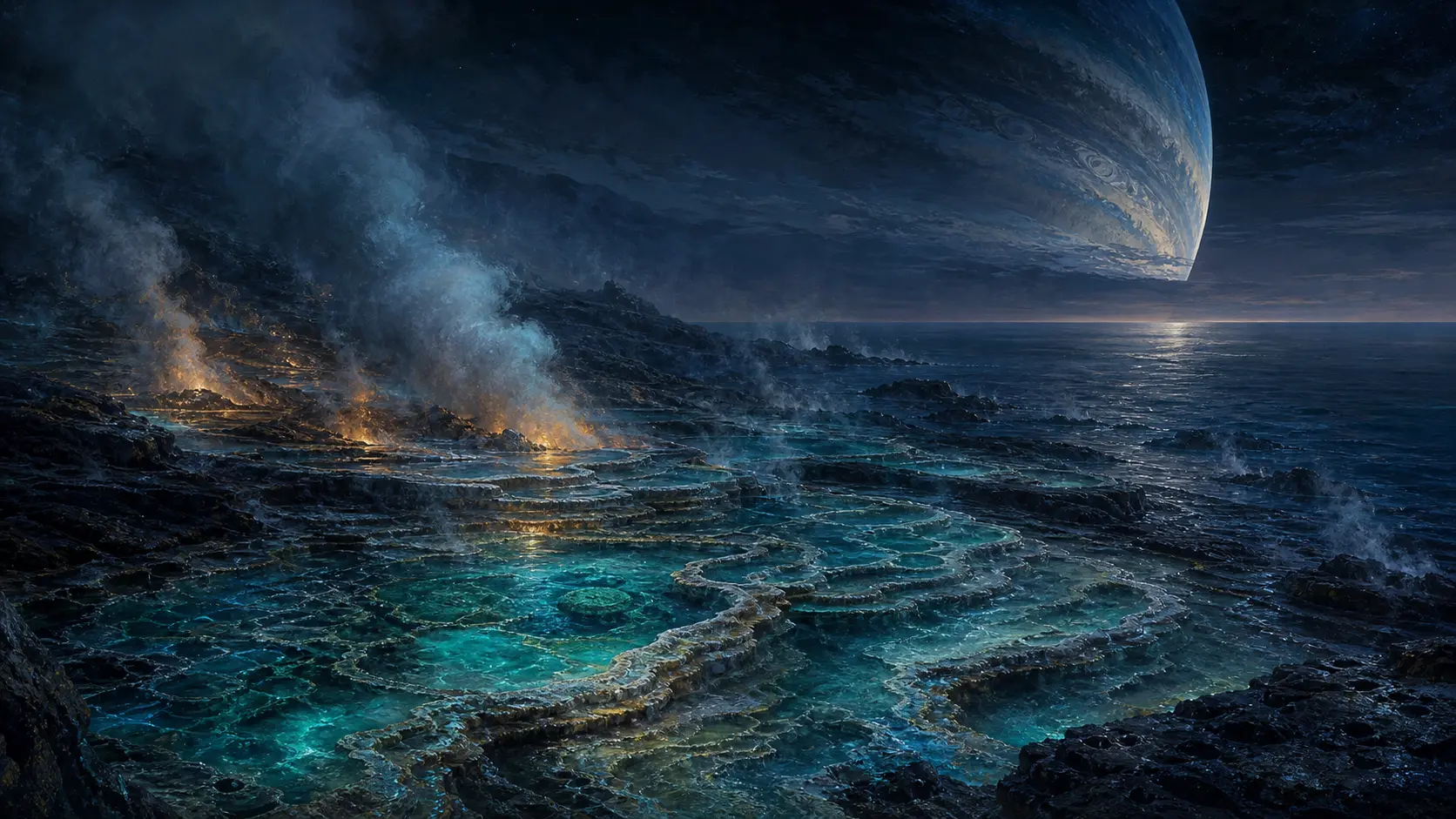
Somewhere on the floor of a Pandoran ocean, in water that has never seen light, a chimney of soft pale mineral is growing about as fast as a fingernail. It is not built by anything. Warm water rises through the rock beneath it, carrying dissolved metals and a great deal of hydrogen, and when that water meets the cold ocean the difference in chemistry makes solids fall out of solution — iron and sulfur, mostly, precipitating into a porous mineral froth. The chimney is a few metres tall and full of holes, each one a chamber the width of a cell, and through every hole two fluids are pressed against each other without quite mixing: alkaline water from below, acidic water from the sea.
Nothing in that description involves life. It is plumbing and precipitation, the same physics that furs up a kettle. And yet if you put an electrode on either side of one of those mineral walls, you would measure a voltage — a real one, of the same size and sign as the voltage your own mitochondria are maintaining right now, as you read this, to keep you alive. The rock is running a battery. It has been running it since before there was anything on Pandora to care.
This chapter is about what that battery can and cannot buy. Because Pandora, on paper, should have had an easier time getting started than Earth did. Its interior is kneaded continuously by the gravity of the gas giant it orbits, so its volcanoes and its vents have never had to run down. Its atmosphere is thick with carbon dioxide and carries hydrogen sulfide not just at scattered volcanic seeps but everywhere, globally, as a standing component of the air. Its oceans are warm and chemically loaded. Its light comes and goes in an intricate rhythm of stellar day, reflected planetlight and frequent eclipse. Every ingredient on the standard shopping list for the origin of life is present on Pandora in greater abundance, and for longer, than it ever was here.
So we should be able to ask a clean question and get a clean answer. Did life start more easily on Pandora?
The answer is no, and the reason it is no is the most useful thing in this chapter.
What has to happen, and in what order
Let us be precise about what we are asking, because "the origin of life" is one phrase covering at least six different problems, and almost every confident claim you will ever read about abiogenesis is a claim about one of them being solved, mistaken for the whole.
The first problem is making the parts. Life is built from a modest inventory of small molecules — amino acids, sugars, the bases that spell out a genetic code, the fatty acids that make membranes — and every one of them has to appear out of ordinary geology: volcanic gas, seawater, light, rock. The second is joining those parts into chains, because a single amino acid does nothing and a hundred of them in a specific order is an enzyme. The third is copying a chain accurately enough that whatever worked in one generation is still there in the next. The fourth is wrapping the whole business in a bag, so that a useful molecule stays near the other useful molecules instead of diffusing into an ocean. The fifth is keeping the system fed, continuously, for however long all of this takes — because every one of these steps runs uphill and something has to keep pushing. And the sixth, the one nobody has ever watched happen, is the moment a repeating chemical system stops merely repeating and becomes a population: varying, inheriting, being selected, alive.
Six problems. The trap — and it has swallowed a great many popular accounts — is that each of them can be attacked separately, and some of them have been brilliantly solved in isolation, which makes it very easy to write a sentence like "we now know how life began" that is not true of any of the others. Worse, the conditions that solve one step are often exactly the conditions that ruin the next. Hold onto that. It is the whole shape of the problem, and it is where Pandora's apparent advantages go to die.
Six things an origin has to do
Three settings proposed for where life began, graded honestly on each step — and what Pandora changes
| What must happen | Spark | Vent | Pool | Pandora |
|---|---|---|---|---|
| Shown | Partly | Shown | Better | |
| Weak | Weak | Shown | Better | |
| Weak | Weak | Partly | No change | |
| Weak | Partly | Shown | No change | |
| Partly | Shown | Partly | Better | |
| Weak | Weak | Weak | No change |
Copy a sequence faithfully
A sequence must be copied accurately enough that what worked is still there next generation. Nobody has demonstrated a molecule that copies itself without help, and the accuracy needed to encode such a molecule is the accuracy it would provide.
Nothing about Pandora helps. Copying accuracy is a property of the chemistry, not of the planet, and no amount of energy or feedstock buys any of it.
Lightning and open sky
Electrical discharge through a volcanic atmosphere makes the small molecules easily — but leaves them dissolved in an ocean too dilute to build anything from.
Alkaline vents on the seafloor
Warm alkaline fluid meeting cold acidic water across mineral walls supplies free electrical drive for as long as the rock lasts. The same warmth shreds long chains.
Drying pools on a volcanic shore
Evaporation concentrates and joins; refilling selects and wraps. The strongest answer for polymers, and the most vulnerable to simply drying up for good.
Read down that last column and you have the chapter in miniature. Pandora is better supplied than Earth on feedstock and better supplied on energy, and on the two rows that are actually load-bearing — copy a sequence faithfully, start evolving — being the most geologically alive moon in the neighbourhood earns precisely nothing. But the argument only lands if you first understand why the energy row was ever thought to be the hard one. So we go back to the chimney.
The battery in the rock
Start with where the hydrogen comes from, because it comes from a reaction that is one of the great underappreciated engines of a rocky world.
Deep beneath the seafloor, on Pandora as on Earth, sits olivine — a green magnesium-iron mineral that makes up much of a rocky planet's mantle and is, from water's point of view, chemically unfinished. Where a fracture lets seawater down into hot olivine, the two react. The rock takes up the water into new minerals, releases heat as it does so, and strips the oxygen out of some of that water to rust its own iron. What is left over from the stripped water is hydrogen, which dissolves into the fluid and rides it back up toward the seafloor. The reaction is called serpentinization, after the scaly green serpentine minerals it leaves behind, and it is remarkable for how much it does unasked: it generates its own heat, it manufactures its own fuel, and it makes the outflowing water strongly alkaline. A vent field fed this way needs no magma chamber beneath it. It needs only water, olivine, and time.
That alkaline fluid arrives at the seafloor and meets an ocean loaded with dissolved carbon dioxide, which makes seawater acidic. Now recall what pH actually measures: it is a count of the free protons in a fluid, on a logarithmic scale, so each step down the scale means ten times more of them. An alkaline vent at pH 10 and an ocean at pH 6 differ by four steps, which is to say the ocean has ten thousand times the free protons the vent fluid does. And the two fluids are separated, inside the chimney's pores, by mineral walls a fraction of a micrometre thick.
A wall with more protons on one side than the other is not a chemical curiosity. It is a store of energy, in exactly the way a raised reservoir is. Protons want to cross to the emptier side; they cannot cross the mineral easily; and so the pressure of them wanting to sits there, available, to anything that opens a channel.
If that arrangement sounds familiar, it should, because it is how you are powered. Your mitochondria spend most of their effort pumping protons across a membrane to build up precisely this kind of imbalance, and then let them fall back through a molecular turbine that spins and assembles ATP. The mechanism is called chemiosmosis, and it is not one strategy among several — every living thing on Earth does it, which is a strong hint it goes back to the very beginning. The energy available is measured as a proton-motive force in millivolts, and a modern cell runs on somewhere around 150 to 250 of them.
Here is the part worth sitting with. A vent does not need to pump. The gradient is simply there, made by geology, renewed continuously for as long as the rock lasts. And when you work out what it comes to in millivolts, it does not fall short of what a cell uses. It overshoots.
The battery in the rock
Set the two fluids and the temperature, then read the voltage the pH difference alone produces
And it gets better than a bare voltage, because the walls are not inert. The minerals precipitating in a vent chimney are iron-sulfide and nickel-iron compounds, and if you look at the business end of some of the most ancient enzymes in biology — the ones that handle hydrogen and carbon dioxide — you find small clusters of iron and sulfur atoms doing the actual chemical work, held in a protein scaffold. The protein positions them; the metals do the reaction. Which raises an obvious and slightly vertiginous question: if the metal cluster is what matters, does the reaction need the protein at all? Put hydrogen and carbon dioxide across a fresh iron-sulfide surface with a proton gradient pushing, and you get formic acid and acetic acid — the first steps of the Wood-Ljungdahl pathway, which is the carbon-fixing route that the reconstructed last universal common ancestor appears to have used, and which is downhill in energy the whole way. The rock is not merely supplying power. It is doing a rough version of the chemistry, on mineral surfaces that look like the insides of our own enzymes.
Pandora's engine never switches off
Now add the thing that makes Pandora different, and it is not a small thing.
Earth's internal heat has two sources, and both are running down. Some is left over from the violence of the planet's formation, leaking away steadily ever since. The rest comes from radioactive elements in the mantle decaying, and every one of those decays is a coin that cannot be flipped twice. Earth's engine has been cooling for four and a half billion years and will keep cooling. Vent fields come and go on a geological schedule set by that decline.
Pandora has a third source, and it does not decline. It orbits a gas giant, close enough that the giant's gravity pulls harder on the near side of the moon than the far side — and because the orbit is not a perfect circle, the strength and direction of that pull shift as the moon goes round. Pandora is therefore being continuously kneaded. Rock flexes, rock rubs against rock, and friction turns orbital motion into heat, in a process called tidal heating. We have watched this happen: Jupiter's moon Io is the most volcanically violent body in the solar system, not because it is large or young but because Jupiter will not stop squeezing it, and Europa keeps a liquid ocean under its ice by the same means, far outside any distance where sunlight could do it.
The consequence for our question is direct. Pandoran serpentinization does not have to run on a budget that is being drawn down. As long as the moon holds an eccentric orbit around its giant, the interior stays hot, the fractures stay open, water keeps reaching fresh olivine, and vent fields keep being built. Where Earth had a window of a few hundred million years in which its early oceans and its most vigorous hydrothermal activity overlapped, Pandora has had essentially the age of its own orbit. Billions of years of continuously renewed batteries.
The trouble with a warm, wet place
Here is where the vent starts to work against itself, and the reversal is worth following carefully because it is the same reversal that appears in every scenario.
Joining two small molecules into a chain nearly always means expelling a water molecule from between them. That is how amino acids link into a peptide and how nucleotides link into a strand. Which means the reaction is reversible in the obvious way: add water and it runs backwards. And a vent chimney is, definitionally, surrounded by water — not a little water, an ocean of it. In a fluid where water is everywhere, the chain-breaking direction is favoured. Molecules do not sit patiently getting longer; they are pulled apart about as fast as they are put together, and the population never gets past very short fragments.
Then there is the heat, which is worse. The vent's warmth is what makes its chemistry go, but chemistry does not distinguish between reactions you want and reactions you don't. Consider ribose, the sugar that forms the backbone of RNA and one of the more fragile molecules biology relies on. At the temperature of a cool ocean surface, a ribose molecule survives on the order of weeks. Warm it to the temperature of vent effluent and its half-life collapses to hours. Push it to the temperature of a hot vent and it is gone in minutes — ring-opening, fragmenting, browning into tar. This is not a marginal effect, and it follows the ordinary exponential temperature dependence of any chemical rate: a modest rise in temperature multiplies the destruction rate, and the multiplication compounds.
So the vent presents a genuinely awkward bill. It is the best place on any world to find continuous free energy, mineral catalysts, and concentrated reactants. It is close to the worst place to keep a long, delicate, information-bearing molecule intact. The features are not separable — the warmth and the flow are the same warmth and flow.
And notice what Pandora does to this trade. It does not soften it. A moon with more tidal heat has hotter interiors and more vigorous circulation, which means Pandoran vents are, if anything, further into the regime where long chains cannot survive. The advantage on the energy row is bought with a deeper deficit on the polymer row. This is the first place where more turns out not to be better.
What a shoreline can do that an ocean cannot
The way out of the water problem is almost comically simple once you see it: stop being underwater.
Take a shallow pool on a volcanic shore. The sun comes round, or in Pandora's case the sun and the reflected light of the gas giant come round, and the pool evaporates. As the water leaves, everything dissolved in it becomes more concentrated — and, more importantly, the reaction that expels water stops running backwards. In a drying film, joining molecules together is no longer fighting the solvent; it is favoured. Chains form. Then the tide comes in, or it rains, and the pool refills. Most of what was built comes apart again in the returning water.
Most, but not all. Some chains happen to fold into shapes that shield their own vulnerable joints. Some end up sandwiched between layers of fatty molecules, which stack into films as they dry and close into bags when they rewet — so a chain that formed in a drying film can find itself, on rehydration, sealed inside a protocell without anything having intended it. Those survivors are the population that the next dry phase starts from. Each cycle destroys most of its own product and keeps a little, and the little it keeps is the floor for the next round.
That asymmetry is the entire mechanism, and it deserves its metaphor: it is a ratchet. Neither phase builds anything on its own — a permanently dry pool is dead chemistry, and a permanently wet one is a solution at equilibrium. It is the alternation that does the work, and it does it in one direction only.
The ratchet on the shore
Watch a pool dry and refill, and watch what survives each round
This is where Pandora earns a real advantage, and it is worth being precise about what kind. The moon's rhythms are more intricate than Earth's: tides raised by a gas giant rather than a small moon, a stellar day, the reflected light of the giant itself, and frequent eclipses when the giant passes between the moon and its star. A shoreline pool on Pandora is wetted and dried and warmed and cooled on more overlapping schedules, more often, than a pool on Earth. More cycles per year means more turns of the ratchet.
Remembering is harder than eating
So the parts get made, and on a shoreline they get joined, and they end up inside bags. Four of the six problems have plausible answers and Pandora improves two of them. Now we arrive at the row that does not move, and I want to build it slowly, because it is the most important argument in the chapter and it is easy to nod along to without feeling.
A chain of nucleotides is only useful if it can be copied. Not approximately copied — copied well enough that whatever advantage the original had is still present in the copy. And copying, done by bare chemistry with no enzyme helping, is sloppy. A nucleotide lines up against its partner on the template strand and joins the growing chain, and some fraction of the time the wrong one lines up and joins anyway. Non-enzymatic copying gets it right maybe nine times in ten, or nineteen in twenty on a good day.
Now think about what that does over the length of a chain. Errors do not politely stay put; each generation adds its own crop on top of the last. Manfred Eigen worked out the consequence in the 1970s and it is one of those results that reorganises a whole field: for a replicator copying at a given accuracy, there is a maximum length of sequence it can maintain. Beyond that length, mutations accumulate faster than selection can weed them out, and the information dissolves — not gradually, but past a threshold, like a rope fraying through. The relationship is simple enough to hold in your head: the tolerable length goes roughly as one over the error rate. Copy at ninety percent accuracy and you can hold about ten to thirty units of sequence. That is the error threshold.
Ten to thirty units. Hold that number and consider what we need it to be.
For copying to get more accurate, something has to catalyse it — a folded molecule that grips the template and the incoming nucleotide and puts them together properly. In the RNA world picture, that something is RNA itself, folded into a ribozyme that copies RNA. This is not a fantasy; ribozymes are real, the catalytic core of your own ribosome is one, and laboratories have evolved RNA molecules that copy other RNA. But the smallest such molecule that actually works is somewhere around 170 to 200 nucleotides long, because that is how much chain you need to fold into a structure with a functioning active site.
So: bare chemistry can protect about twenty nucleotides. A molecule that would improve the accuracy needs about two hundred. The thing required to escape the limit cannot exist under the limit.
The ceiling on remembering
How long a sequence can a copier protect, if it makes mistakes at this rate?
Sit with what that figure is telling you, because the shape of the problem is the payload. This is not a shortage. A shortage is something a richer world fixes. This is a circular dependency, and circular dependencies are indifferent to abundance. You cannot pour energy into it. You cannot dissolve more feedstock into it. Pandora's tidal engine, its global hydrogen sulfide, its extra billions of years, its four overlapping clocks on the shoreline — every one of those buys you more attempts, and not one of them makes any single attempt more accurate. Copying fidelity is a property of the chemistry of nucleotide pairing, not a property of the planet the chemistry is sitting on.
Which is why the honest answer to "did life start more easily on Pandora?" is no. It started, evidently — the moon is covered in it. But the step that is hard here was exactly as hard there, and everything Pandora is unusually rich in helps only with the steps that were never the obstacle.
The one place Pandora might genuinely be ahead
Having spent the chapter arguing that Pandora's abundance buys nothing where it matters, honesty requires flagging the one candidate exception — and flagging equally clearly that it is speculation rather than established science.
Recall from the chapter on what Pandoran life is made of that many biological molecules come in two mirror-image forms, and that life uses only one of them. Earth's amino acids are left-handed, its sugars right-handed, and this homochirality is not decoration — a chain built from a mixture of both hands cannot fold into a working shape, and a mirror-image nucleotide slipping into a growing strand stops the copying dead. So an origin does not merely need to make molecules; it needs to make them all the same hand. Ordinary chemistry, left alone, makes both in equal measure.
How the symmetry got broken on Earth is unsettled. Meteorites arrive carrying small excesses of one hand, which shows that abiotic processes can produce a bias. Certain crystallisation and grinding processes can amplify a small bias toward purity. Circularly polarised starlight in star-forming regions can favour one hand slightly. None of these is agreed to be the answer.
One line of laboratory work concerns magnetic surfaces. Electron spin turns out to be coupled to molecular handedness, so a magnetised mineral surface can preferentially adsorb one mirror form over the other — a real effect, actively studied. Now, Pandora carries something Earth does not: large deposits of a room-temperature superconducting mineral, and regions where the local magnetic field is not the fraction of a gauss we live in but tens or hundreds of gauss. It is a genuinely interesting thought that prebiotic chemistry on mineral surfaces in such a place might have been sorted by hand more efficiently than anywhere on Earth.
I want to be careful here. That the effect exists is real science. That Pandora has extreme local fields is canon. The joining of the two — that Pandora's magnetic anomalies drove its biosphere to homochirality — appears nowhere in official material and has not been demonstrated for any real biosphere. It is a plausible-sounding synthesis, which is exactly the kind of claim that deserves the speculation label rather than a quiet promotion to inference. File it as an interesting possibility and no more.
What would prove it happened twice
Step back from Pandora for a moment, because the chapter has been circling a question that matters here regardless of whether any of this moon exists.
We have one confirmed origin of life. One. Every living thing we have ever studied descends from the same event, which means every generalisation we make about what life requires is drawn from a sample of a single instance. That is a genuinely difficult epistemic position, and the field has been admirably honest about it. The tempting argument — life appeared on Earth quickly, within a few hundred million years of there being oceans, therefore abiogenesis must be easy — does not survive careful treatment. We are necessarily on a planet where it happened; we could not be observing from anywhere else. Formal Bayesian analyses of the timing come out favouring "early rather than late" but leaving the underlying probability spread across orders of magnitude. From one data point, that is about as much as can honestly be said.
Which is what makes a second, independent biosphere so valuable — and what makes it worth asking how we would even know one when we saw it. The observables are concrete. Does it use the same genetic code, the same mapping of triplets to amino acids? Does it use the same twenty amino acids, or a different inventory including ones Earth life never adopted? Is its nucleic-acid backbone the same chemistry, or a different backbone entirely? And above all: which hand? A biosphere running on right-handed amino acids would settle the question in an afternoon. Independent origins have no reason to make the same arbitrary choices; shared ancestry has no way to make different ones.
The alternative to independent origin is panspermia — that life was carried from one world to another. Within a single planetary system this is unremarkable: impacts genuinely do throw rock between neighbouring planets, and some organisms survive the trip. Between star systems the arithmetic simply fails. A journey across the four-odd light years to the nearest star takes something between a hundred thousand and ten million years for any naturally ejected fragment, and across that span the accumulated cosmic-ray dose to an unshielded passenger runs to millions of grays — enough to shred any genetic polymer many times over. Nothing arrives with its information intact.
Honest edges
Almost everything load-bearing in this chapter is Earth science, and it is firm. Serpentinization and its hydrogen; the pH difference across vent chimney walls and the millivolts it comes to; the resemblance between vent minerals and ancient enzyme active sites; ribose's collapse with temperature; wet-dry cycling driving polymerisation; fatty-acid vesicles that grow and divide unaided; Eigen's error threshold and the length a folded replicase needs; the radiation arithmetic that rules out interstellar panspermia. None of that is in dispute. What is genuinely open, and I have tried to say so wherever it arose, is the big one: no continuous route from geochemistry to a Darwinian cell has been demonstrated, and no molecule has been shown copying itself unaided. The field has strong partial results and no complete story.
The canon is thinner than the science, and thinner than the research on it sometimes suggests. Official material establishes Pandora's atmosphere as carbon-dioxide-heavy and hydrogen-sulfide-bearing, the moon as tidally worked by its gas giant, its volcanism as active, its oceans as extensive, and its magnetic anomalies as locally extreme. From The Way of Water and Fire and Ash we have oceans and volcanic provinces on screen. All of that is enough to place Pandora's environment on the axes this chapter cares about.
What canon does not say is nearly everything else, and the gaps are more interesting than any invention would be. There is no canonical date for Pandoran abiogenesis — not even whether it preceded or followed Earth's, though the Alpha Centauri system is a few hundred million years the elder. There is no Pandoran microbiology at all: no described single-celled organisms, no archaeal analogues, no fossil record of the early biosphere. Canon never addresses Pandoran handedness directly. And it never explains how the planet-wide signalling network originated, though the fact that the same neural interface appears across plants and animals alike suggests it is ancestral rather than a late addition — that is an inference from distribution, not a stated fact.
One tier call is worth stating plainly, because a reader comparing sources might otherwise catch me at it. Material on Pandoran biochemistry sometimes presents the handedness of its molecules as established canon, on the strength of the Avatar program working. I have kept it as inference, which is how the chapter on what Pandoran life is made of treats it too. The reasoning is sound — a functioning human-Na'vi hybrid all but forces shared handedness — but reasoning from canon is inference, not canon, and the two chapters should not disagree about which.
The chimney, read again
Go back down to the seafloor, and look at the chimney with what we now know.
It is still growing, still pale, still full of pores the width of a cell, still holding two fluids apart across walls a fraction of a micrometre thick. The voltage is still there — more than your mitochondria trouble themselves to maintain, supplied at no cost by the reaction between water and rock, and on this moon renewed for billions of years by a gas giant that will not stop squeezing. Iron-sulfide clusters in those walls are still doing rough versions of the chemistry that our oldest enzymes do carefully. Everything the popular account promises is genuinely present.
And it is not enough, and now we can say exactly what it is not enough for. The chimney solves a quantity problem with enormous generosity. What stands between that chimney and a living cell is not a quantity at all — it is a molecule that can copy itself accurately, which requires the accuracy that only such a molecule provides. Every gift Pandora has to offer arrives on the wrong side of that circle. Its heat, which drives the chemistry, shortens the life of the molecule that has to carry the memory. Its abundance buys more attempts at a step that was never in doubt. Its four clocks on the shoreline turn the ratchet more times, which is real and which I have credited, and still leaves the copying problem exactly where it was.
Life did start here — the moon's forests and oceans are the evidence, and this chapter has not questioned that for a moment. What the reading gives us is a corrected sense of what that achievement consisted of. It was not the triumph of a well-supplied world over a poorly supplied one. Pandora was fabulously well supplied and it did not matter. Somewhere in one of those pores or one of those drying pools, chemistry crossed from repeating to remembering, and every advantage this moon has was watching from the sidelines when it happened.
Which leaves a thought worth carrying off the seafloor and into anything else you are trying to understand. When something has every resource and still is not working, stop adding resources. Find the circle.
What stays open
Canon gives no date — not for abiogenesis, not for the first cells, not for any major biological transition. Community chronologies sometimes quote a figure borrowed from Earth's geology, but that is extrapolation wearing a number's clothing. What we can say is that the Alpha Centauri system is a few hundred million years older than the Solar System, so the window was at least as wide. Whether Pandoran life is older than ours is simply unknown.
There is no canonical Pandoran microbiology at all. No described single-celled organisms, no archaeal analogue, no early fossil record — which is a striking gap for a setting this thoroughly documented at the level of large animals. The hexapod body plan and the paired breathing opercula are described as the baseline for macrofauna, but what preceded them is blank.
Unexplained, and it is the most interesting gap of the three. The same electrochemical interface appears in both plants and animals across the biosphere, which argues it is ancestral rather than a late innovation — a shared inheritance, not a convergence. But canon never describes how a prebiotic or early-cellular system would have arrived at it, and this chapter refuses to invent a mechanism. The distribution is the evidence; the origin is open.
Almost certainly, but by inference rather than statement. A functioning human-Na'vi hybrid requires that both biospheres build proteins from the same-handed amino acids, or nothing would fold. No official source says so directly. And the awkward corollary stands: two independent origins had no reason to make the same arbitrary choice, so either the choice is less arbitrary than we think, or the Avatar program rests on a very large coincidence.