

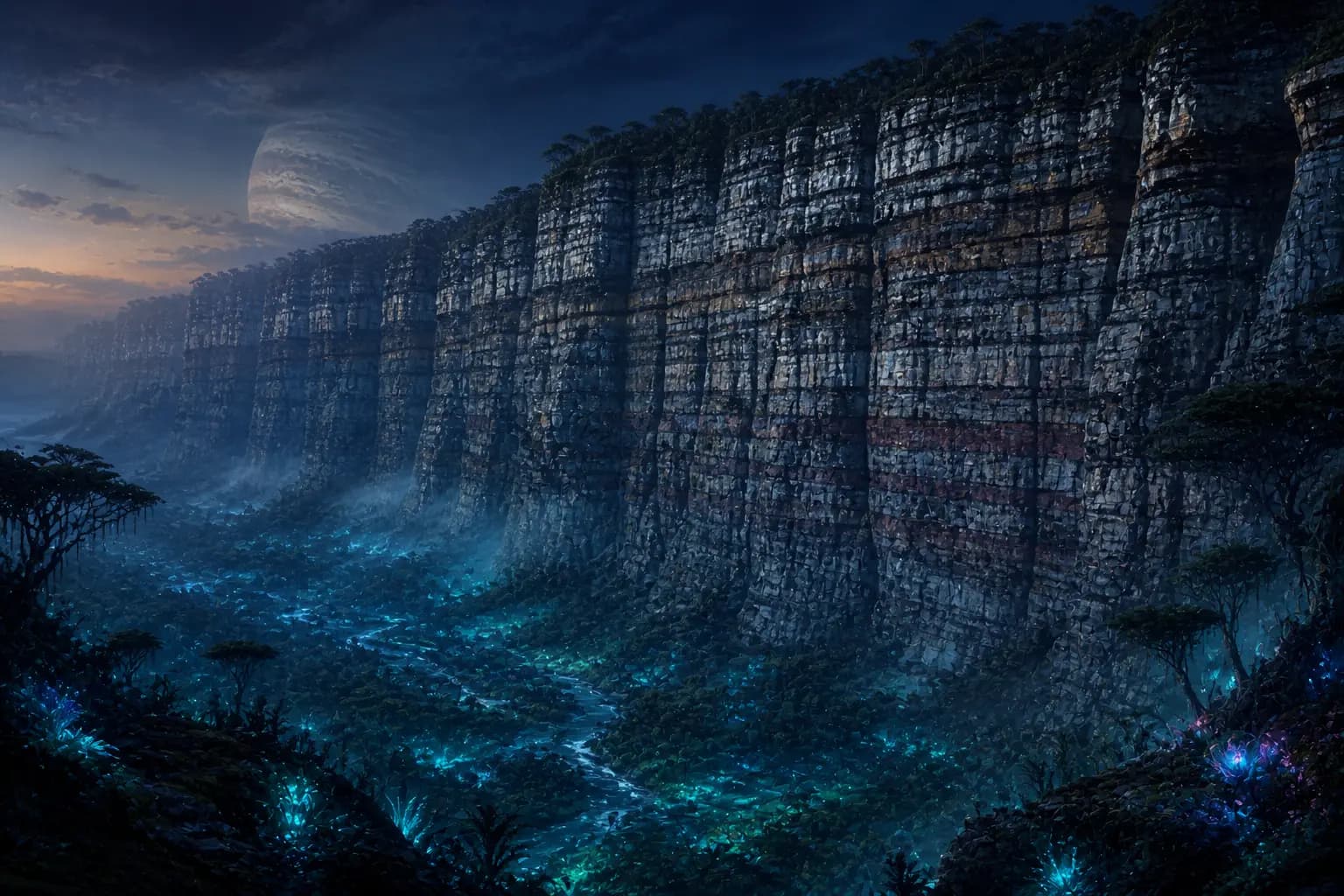
Start with a cliff.
Not the famous ones — not the mountains that hang in the air over the flux vortices, which are a magnetic story and belong to their own chapter. Look instead at the ordinary rock: the escarpments that ring the highlands, a thousand metres of bare stone standing above the canopy, banded horizontally in pale and dark layers like a sliced cake. The Na'vi treat these faces as landmarks and fly along them. Human survey crews photographed them, gave a few of them names, and moved on.
But stop in front of one and it starts asking questions.
Those horizontal bands are sediment, or lava flows, or both — layers laid down flat, one on top of another, over a very long time. They are now a kilometre in the air, and they end abruptly at a vertical face. Something lifted them. Something else cut them. And whatever it was is still going on somewhere, because a cliff is a temporary object: rain and rivers and gravity work at a rock face continuously, and left alone they will reduce it to a slope and then to a plain. A world with sheer escarpments is a world where uplift is at least keeping pace with destruction.
So: what lifted them?
On Earth the answer would be immediate and almost boring. Earth has one machine that builds nearly all of its topography, and it has had that machine for a long time. But before reaching for it, it is worth noticing how much of Pandora's geography seems to point the same way.
Four things that ought to have one cause
Set the floating mountains aside and take inventory of what canon actually shows us of Pandora's solid surface.
There are highlands and ranges — the dissected massifs beneath the Hallelujah range, cut by deep valleys; the plateau escarpments with their kilometre of relief; the great stone arches, five hundred metres across, that enclose the basin holding the Tree of Souls.
There are deep oceans, and not merely wide shallow ones. The reef clans live above shallow carbonate platforms and ring-shaped island chains, but those platforms sit at the margins of open sea, and the Metkayina speak of deep water as a different country. Where there are shallow shelves there is, by implication, somewhere for them to be shallow relative to.
There is a volcanic province: the Ashlands, tens of thousands of square kilometres of basalt plain, cinder cones, ash sheets and calderas, produced by eruptions violent enough to blanket a region and bury a clan's home.
And there is ore — the reason humans came at all. Unobtanium occurs in massive high-grade veins and stratiform lenses, concentrated enough that a corporation will cross four light years and pay for the trip out of a cargo hold. The richest bodies described in the official record sit directly beneath the largest trees, which is a piece of narrative irony and also a geological claim: the metal is not evenly smeared through the crust. It is gathered, in particular places, at extraordinary concentration.
Now the point. On Earth, those four things — mountain belts, deep ocean basins distinct from continental shelves, arcs of volcanoes, and richly concentrated ore provinces — are not four separate phenomena. They are four outputs of a single machine. Earth's crust is broken into rigid plates that move, and where they pull apart, collide, or slide past one another, you get exactly this list: ranges where they crash together, basins where new floor is made and eventually consumed, volcanic chains above the places where one plate dives beneath another, and ore where the water carried down with that diving plate comes back up hot and loaded with dissolved metal.
Find all four on a world and the inference practically writes itself: this planet has plate tectonics.
Except that nothing in the official record ever says so.
Not once. Search the films, the companion guides, the encyclopaedia entries, the production material. There is no plate. No ridge. No trench. No fault named or shown. No earthquake — and this is the strangest gap of all, because a world with moving plates has earthquakes constantly, and not one appears anywhere in the canon. The tremors we do see are made by machines: the RDA's mobile drill platforms hammering the upper crust hard enough to collapse cavern systems. The corporation surveyed Pandora with orbital magnetometers, gravity mapping, airborne electromagnetics and core drilling — every technique except the one that would have answered this question. Nobody, in-universe or out, ever put a seismometer on the ground.
Which leaves us with a genuine problem rather than a lookup. We have the outputs. We do not have the machine. And the honest way to proceed is not to assume the machine, but to ask two prior questions: how would we know, and what else could do this?
How you learn what you cannot reach
Here is a number worth carrying around. The deepest hole humanity has ever drilled is the Kola Superdeep Borehole, on the Russian side of the Arctic, which after two decades of effort reached 12,262 metres. That is a little over twelve kilometres. Earth's radius is 6,371 kilometres. The deepest we have ever physically been into our own planet is less than two-tenths of one percent of the way to its centre.
Everything else — the core, the mantle, the layers and the boundaries between them, the fact that the outer core is molten and the inner core is not — is inference. We have never seen any of it. We worked it out from the outside.
There are several independent ways in, and the fact that they agree is what makes the picture trustworthy. Weigh a planet by watching what it does to the things orbiting it, divide by its volume, and you have its mean density — enough to say whether it is rock and metal or ice and gas. Watch it wobble as it spins and you get something subtler: the moment of inertia factor, a single number describing how much of its mass is bunched toward the middle. A uniform ball gives 0.4. Earth gives 0.3307 — proof of a dense metal core, obtained without any seismology at all. Mars gives 0.365, the Moon 0.393, Io 0.378, and each of those numbers pins down a core size. Squeeze minerals between diamond anvils in a laboratory and you learn how rock behaves at pressures it will only ever meet a thousand kilometres down. And volcanoes occasionally do us the favour of bringing mantle fragments to the surface intact.
But the instrument that did most of the work is an earthquake.
An earthquake is a hammer blow to a bell, and the bell is the whole planet. It sends out two kinds of wave, and the difference between them turns out to be everything.
The first to arrive — hence its name, the P wave — travels by squeezing and stretching the rock along its direction of travel, the way sound travels through air. All it needs is a material that resists being compressed, and everything resists being compressed. P waves cross solid rock, molten rock, water, air.
The second, the S wave, moves differently. It shakes the rock sideways, across its path, distorting its shape without changing its volume. To do that it has to lean on the material's resistance to being sheared — twisted, slid, deformed. And here is the fact the rest of this section hangs from: a liquid has no resistance to shearing at all. Stir water and it simply goes where you push it. Its shear modulus is exactly zero, and since the shear wave's speed is the square root of that modulus over the density, the speed is zero too.
A shear wave cannot cross a liquid. Not slowly. At all.
Which means that if some part of a planet's interior is molten, there will be places on its surface where the shear wave from a distant earthquake never arrives — and the shape of that silence tells you the shape of the molten region.
This is exactly how it went. In 1909 a quake in Croatia's Kupa Valley delivered two sets of arrivals to Andrija Mohorovičić instead of one: a slower set that had travelled directly through the crust, and a faster set that had dived into something stiffer underneath and come back up. He had found the crust–mantle boundary, and it has carried his name ever since — the Mohorovičić discontinuity, the Moho, about seven kilometres down beneath the oceans and thirty-five to seventy beneath the continents. That difference, incidentally, is itself a major clue, and we will come back to it.
Then, between 1906 and 1914, Richard Oldham and Beno Gutenberg mapped the silences. Direct waves of both kinds reach stations out to about 103 degrees of arc from the epicentre. Past that, the geometry forces every path through the centre of the planet. And past that, the shear wave stops coming — not for a while, but for good, all the way around to the far side. The P wave has a gap too, between roughly 103 and 143 degrees, where it is bent sharply aside on entering a slower region, and then it returns. The S wave never returns.
The outer core is liquid. That conclusion, one of the most consequential in the history of the Earth sciences, rests on an absence.
Reading an interior from what never arrives
Sweep a seismometer around the planet and watch the shear wave disappear
The method kept giving. In 1936 Inge Lehmann noticed faint arrivals inside the shadow zone — energy that had no business being there — and worked out they were waves that had crossed a solid body at the very centre. Earth has an inner core, frozen by pressure despite temperatures over five thousand kelvin. Later, sharp reflectors at 410 and 660 kilometres depth turned out not to be changes in what the rock is made of, but changes in how its atoms are stacked: the same minerals, reorganised under pressure into denser structures. Laboratory work confirmed them, and in 2014 a diamond from deep in the mantle arrived at the surface carrying a fragment of one of those high-pressure minerals with water locked into its lattice — direct physical evidence of a reservoir hundreds of kilometres down.
And the method travels. Apollo left seismometers on the Moon and they recorded over twelve thousand events across eight years, giving a lunar crust thirty to forty kilometres thick and a small metal core. In 2018 NASA's InSight lander set a seismometer on the surface of Mars and listened for four years. It detected more than 1,300 marsquakes. It measured the Martian crust. It found — this is the remarkable part — a large liquid core, 1,830 kilometres in radius, by watching for exactly the shear-wave behaviour that Gutenberg had used on Earth a century before.
And it found no plate tectonics. Mars's quakes cluster along a set of extensional cracks and nowhere else. There are no plate boundaries. One instrument, four years, and a question that had been argued for decades was settled.
The engine underneath
So suppose we could put instruments on Pandora. What would we be looking for? To know that, we need the machine — and the machine is not the plates. The plates are a symptom.
Every rocky world of any size is hot inside, and heat wants out. It has two ways to travel through rock. It can conduct: atoms jostling their neighbours, passing energy along without going anywhere themselves. That is slow. Or the rock itself can move — hot rock rising because it is slightly less dense, cool rock sinking because it is slightly more — carrying its heat bodily upward. That is convection, and it is enormously faster.
The counterintuitive part is that solid rock does this. Mantle rock is not molten; the melt fraction in the layer beneath the plates is well under one percent. It is stone, and it flows anyway, the way a glacier flows or a block of road tar sags over a summer — by defects creeping through crystal lattices, one atomic step at a time, for a hundred million years. This is worth pausing on because the folk picture is so widespread and so wrong: the plates are not rafts floating on a sea of magma. The asthenosphere beneath them is solid. It just happens to be solid the way honey is liquid — a matter of how long you are prepared to watch.
Whether a layer convects at all is decided by a single number, and it is the sort of number that repays getting to know. Buoyancy drives the overturning: denser-than-average material sinking, lighter rising, scaled by gravity, by how much the rock expands when heated, by the temperature difference across the layer, and — very strongly — by the layer's thickness, which enters cubed. Against that, two things resist: the rock's viscosity, and the tendency of heat to simply diffuse away before it can lift anything. Divide the first group by the second and you have the Rayleigh number.
Below a critical value of a few hundred, nothing moves and heat trickles out by conduction. Above it, the layer overturns. Earth's mantle runs somewhere around ten million to a hundred million — four or five orders of magnitude past the threshold. Earth's mantle does not merely convect. It convects violently, and has since it formed.
The most interesting term in that expression is the viscosity, because viscosity is not a fixed property of rock. It depends on temperature exponentially. Warm mantle rock by two hundred kelvin — a modest change on a scale where the mantle spans thousands — and its viscosity drops by three or four orders of magnitude. It becomes, for practical purposes, a different substance.
That exponential is a thermostat. A hotter mantle is runnier; a runnier mantle convects harder; harder convection carries heat out faster; and carrying heat out faster cools the mantle back down. The efficiency of that transport has its own name — the Nusselt number, the ratio of heat actually delivered to what conduction alone would manage — and it scales as roughly the cube root of the Rayleigh number. A planet regulates its own rate of cooling, and it does so without any feedback mechanism more sophisticated than the temperature-dependence of rock.
Does the layer overturn, or just conduct?
One dimensionless number decides whether a mantle stirs itself
Now for the piece that makes plate tectonics comprehensible instead of magical.
If a layer is convecting, the cold material at the very top — cooled by contact with space, stiffened by that cooling into something rigid — is not a separate object sitting on the convection. It is the convection. It is the cold upper boundary layer of the circulating system, the part that has chilled enough to stop flowing and start breaking. That rigid skin is the lithosphere, and on Earth it is broken into plates.
Once you see it that way, the force balance falls out. Oceanic lithosphere thickens as it cools and ages — proportional to the square root of its age, one of the cleanest confirmations the whole theory has, because it predicts both how deep the seafloor sits and how much heat it gives off at every age, and both match. After twenty or thirty million years it is denser than the mantle underneath it. It wants to sink. Once it starts, its basalt converts under pressure to a much denser rock, eclogite, gaining another four hundred kilograms per cubic metre, and now it really wants to sink.
That sinking edge drags the rest of the plate behind it. Slab pull accounts for over eight-tenths of the force moving Earth's plates — which is why a plate's speed tracks the length of its subducting edge rather than its area, or its age, or anything else. Plates are not pushed around. They are pulled by their own dying edges.
What a world can choose
Here is the turn, and it is the part I would keep if you kept nothing else from this chapter.
A planet does not have or lack tectonics. Its mantle convects regardless — that much follows from the Rayleigh number, and any rocky body of decent size clears the threshold easily. What varies is what happens at the top, where convection meets the cold rigid lid. The question is narrow and mechanical: can the stress arriving from below break the lid, or not?
Two quantities settle it. How much stress convection delivers, which rises with the heat flux — a hotter interior means a thinner, weaker lid and a harder push. And how much stress the lid can take before it fails, which depends on whether it is wet or dry, faulted or intact, cool or baked.
Compare those two and a world falls into one of a few regimes.
If the stress wins, the lid breaks, sinks, and is continually remade. That is the mobile lid, and Earth is the only body in the Solar System that has it. Note how the requirements stack: a lid weak enough to fail, faults slippery enough to keep failing, and — the ingredient that keeps coming up — water. Water weakens rock chemically by getting into the crystal lattices of mantle minerals. Water lubricates faults, turning them into serpentine and talc and other soft minerals that slide instead of gripping. Water raises pore pressure, prising rock apart from inside. Earth's crust is wet and pervasively broken, and it fails at something under a couple of hundred megapascals.
Intact rock, by contrast, is strong past a gigapascal — five to ten times more than convection typically delivers. Which raises a problem the field has not fully solved: it is genuinely hard to break an unbroken lid in the first place. How subduction ever started remains an open research question, and when it started on Earth is argued across a range from the Hadean to less than a billion years ago, depending on which evidence you weight. That argument is worth knowing about, because it means plate tectonics may not even be a permanent property of Earth. It may be a phase.
If the stress loses, you get a stagnant lid: convection continuing below, the surface locked in a single unbroken shell, heat escaping by slow conduction through it plus whatever volcanoes punch their way out. This is the ordinary outcome. Mercury has it, wrinkled by its own contraction. The Moon has it. Mars has it — and Mars is instructive, because a stationary lid over a long-lived hot upwelling builds absurd volcanoes. Olympus Mons is twenty-two kilometres high and six hundred across, precisely because the crust above the hotspot never moved off it.
But Venus is the case that should unsettle anyone tempted to think of plate tectonics as normal.
Venus is Earth's size — ninety-five percent of the radius, eighty-two percent of the mass — with essentially the same complement of heat-producing elements. If planetary size and heat budget determined tectonic style, Venus would be Earth's twin. Radar mapping found the opposite: no global ridge system, no plate mosaic, no subduction network. Its surface averages only a few hundred million years old and is dotted with a thousand circular volcanic features found nowhere else. The leading explanation is water — or its absence. A runaway greenhouse boiled Venus's oceans away and desiccated its lithosphere, and dry rock is strong. Its five-hundred-degree surface doesn't help either: a hot surface flattens the temperature gradient through the lid, and a shallower gradient means less thermal stress to work with.
Earth and Venus are the same planet twice, and only one of them has moving plates. The difference appears to be an ocean.
Which kind of crust does a world end up with?
Heat flowing out, against the strength of the lid it has to escape through
And then there is the fourth regime, which is where this chapter has been heading.
Io builds mountains, and Io has no plates
Push the heat flux high enough and the whole stress-versus-strength comparison becomes irrelevant, because conduction through a lid stops being how the heat gets out. Melt takes over.
When there is more heat than a lid can conduct, rock melts in volume, and molten rock is buoyant and mobile. It rises through narrow conduits, erupts at the surface, spreads, cools, and radiates its heat straight to space. Then the next flow buries it. Then the next. Layer after layer accumulates on top, and the older material is carried steadily downward by simple burial. This is the heat-pipe regime, and it has a lovely paradox at its centre: because cold surface rock is continually being buried, the lid ends up colder, thicker and stronger than it would otherwise be, even while the interior beneath it is melting furiously.
Io is the living example. Jupiter's innermost large moon vents something like a hundred terawatts, giving a surface heat flux around 2.4 watts per square metre — over twenty times Earth's. It has more than four hundred active volcanic centres. It resurfaces itself at roughly a centimetre a year, which sounds trivial until you work out that it means Io has no impact craters at all: every one has been paved over. Io is the youngest surface in the Solar System.
Io also has mountains up to seventeen and a half kilometres tall. Boösaule Montes is twice the height of anything on Earth.
And Io has no plate tectonics whatsoever. No ridges. No arcs. No trenches. Nothing subducts anywhere on it.
So where do the mountains come from? The answer is one of the most elegant results in comparative planetology, and it depends on Io being a sphere.
Bury the crust and it sinks. But as it sinks, it moves to a smaller radius — and the surface area of a sphere goes as the radius squared. A shell of crust that fits comfortably at the surface does not fit at twenty kilometres down; there is measurably less room. The material has nowhere to go but into itself, which means it is squeezed sideways, hard. That horizontal compression climbs as burial deepens, and it climbs fast: on a body of Io's radius, twenty kilometres of burial generates hoop stresses well past a gigapascal, far more than the lithosphere can bear. So it fails, along deep faults that slice clear through, and slabs of crust are shoved bodily into the sky.
Io's mountains are fault-bounded blocks, thrust up by the geometry of a shrinking shell. They are not folded. Nothing collided. The tallest peaks in the Solar System outside a plate-tectonic planet were built by burial.
Two ways to raise a mountain
Bury a crust deep enough and the sphere itself squeezes it upward
Contrast that with how Earth does it, because the difference is diagnostic. Earth's ranges float. Continental crust is lighter than the mantle beneath, so a thickened pile of it rides high the way an iceberg does — and, like an iceberg, hides most of itself below. The arithmetic of isostasy is simple and the result is startling: a five-kilometre peak requires a root of about twenty-eight kilometres. Roughly six parts of a mountain underground for every one part visible.
Which gives us a test that does not require waiting for an earthquake. Measure a range's gravity. If there is a deep low-density root beneath it, the range is buoyant, made of light crust thickened by collision. If there is no root, the range is being held up by force, and something else built it.
There is a second, sharper test hiding in that continental crust. Granite is not something you can make by melting dry mantle rock — not in any quantity. To produce it you have to remelt basalt with water involved, and the setting that does that at planetary scale is a volcanic arc above a subducting plate. A continent is therefore not just a kind of terrain. It is a statement that a world has water and a crust that recycles. Find granite in quantity and you have found evidence of subduction, whether or not you ever see a trench.
Pandora's own numbers
So which is Pandora? We can at least narrow it, because canon gives us enough to compute with.
The official figures put Pandora's radius at 5,724 kilometres — a bit under nine-tenths of Earth's — and its mass at 4.30 × 10²⁴ kilograms, about seventy-two percent of Earth's. Divide one by the other and you get a mean density of 5,473 kilograms per cubic metre.
That number is worth a moment. Earth's is 5,514. Pandora's is within one percent of it. Whatever else is uncertain about this moon, its bulk is settled: it is a rock-and-metal world with an Earth-like proportion of iron, thoroughly separated into core, mantle and crust. Not an ice moon. Not a Ganymede or a Titan. Something built like the planet we are standing on. (Those same figures give a surface gravity of 8.76 metres per second squared — 0.89 g — which is a little higher than the "about 0.8 g" that circulates in tie-in material, and it is the self-consistent value.)
Now bring in the one result we already have. The tidal machinery that keeps this moon volcanically alive delivers, on the accounting worked out for it, somewhere in the range of a hundred to several hundred terawatts into Pandora's interior. Pandora's surface area is 4.12 × 10¹⁴ square metres. Divide and you get the number that matters here: a surface heat flux of roughly 0.24 to 0.73 watts per square metre.
Set that against the reference points. Earth: 0.087. Io: 2.4.
Pandora sits three to eight times above Earth, and comfortably below Io. It is in between — and worse, it is in between across a range wide enough to cross regime boundaries. Run those numbers through the Rayleigh expression, using a mantle around 2,800 kilometres thick and any plausible viscosity, and you get something like 10⁷ to 10⁸. That part is not ambiguous. Pandora's mantle convects, and convects hard. There is no version of this moon where the interior sits still.
What that convection does when it reaches the crust is another matter entirely, and here the honest answer is that canon does not give us enough to say.
We know Pandora is wet — extravagantly wet, with oceans, dense river networks, and an atmosphere thick with cloud. That argues for a weak, hydrated lithosphere, which argues for a mobile lid. But we do not know how faulted that lithosphere is, how thick, how hot at its base, or whether its water has ever actually made it down into the mantle. The heat flux argues both ways at once: high flux delivers more stress to the lid, which favours breaking it, but high flux also keeps oceanic lithosphere young, thin and warm — and young thin warm lithosphere is not dense enough to sink well. Slab pull needs a cold heavy slab. Give Pandora too much heat and its slabs may simply be too buoyant to subduct, or tear apart when they try.
That is why the figure earlier drew Pandora as a rectangle instead of a dot. The rectangle is the honest shape of what we know.
Why the mining question is a tectonics question
There is one more line of evidence, and it comes from an unexpected direction: the reason humans are on Pandora in the first place.
Ore is a statistical outrage. Most metals occur in ordinary rock at parts per million, sometimes parts per billion. A deposit worth mining is a hundred to a hundred thousand times richer than that. Something has to have gone to the trouble of gathering the metal up, and every mechanism that does so is a specific physical process with specific requirements.
Some are undemanding. Let a large body of magma cool slowly and the crystals that form first can sink, sorting the melt and concentrating certain elements into layers — this is how Earth got the platinum reefs of the Bushveld and the nickel-copper of Norilsk. That process needs a magma chamber and time. Any volcanic world can manage it.
The rich ones are pickier. Porphyry copper deposits, which supply most of the world's copper, form where water dragged down with a subducting plate is released into rising magma, then bursts out through the overlying rock, hydrofracturing it and plating metal into the cracks. Volcanogenic massive sulfides form where seawater circulates through hot young crust at a spreading ridge and precipitates metal at black smokers. Orogenic gold forms where a continental collision cooks water out of buried rock and channels it up through deep fault networks.
Read that list again and notice what it has in common: an arc, a ridge, a collisional belt. All three are plate boundaries. All three need water. This is why terrestrial ore does not occur at random but in belts you can predict from a tectonic map — and it is why the Moon and Mars, for all their volcanism, have nothing resembling Earth's hydrothermal ore provinces. Their crusts never moved and their water never circulated.
Where ore comes from — and what it needs
Five routes from ordinary rock to a deposit worth mining
So what does unobtanium tell us?
Canon describes it occurring in massive high-grade veins and stratiform lenses at specific, richly concentrated locations. Vein-hosted, high-grade, strongly localized — that is the signature of a hydrothermal system, of hot fluid moving through fractured rock for a long time and dumping its load in particular places. On Earth, a body like that would be an unremarkable inference: someone would point at the nearest ancient plate margin.
But this is inference, and it should be labelled as such, because there are two honest caveats. Unobtanium is not a terrestrial mineral and we do not know its chemistry; canon calls it a compound in one place and labels it as element 120 in a graphic elsewhere, and its formation is nowhere explained. And magmatic segregation can produce concentrated stratiform bodies without any plate boundary at all. The ore is a hint that Pandora's crust has hosted long-lived fluid circulation. It is not proof that the crust moves.
Still, it is a hint pointing the same way as the ranges, the deep basins, and the water. Four independent clues, all consistent with a mobile lid, none of them decisive.
Honest edges
Let me be clear about what this chapter has and has not established.
The physics is not in question. Seismic waves, the shear-wave shadow, the Rayleigh number, the regime spectrum, the burial-compression mechanism on Io, the isostatic root beneath a floating range, the tectonic setting of ore provinces — all of that is ordinary solid-Earth and planetary science, tested against real bodies with real instruments.
What canon actually states is much narrower: that Pandora has highlands with a kilometre of relief, a volcanic province, deep oceans, abundant surface water, high-grade ore, a strong magnetic environment, and a mass and radius implying an Earth-like differentiated interior. That is all.
Everything connecting those facts to a tectonic regime is inference, and the gaps are large enough that I am not going to pretend to a verdict.
What the record does not contain
No official source says so, and none says otherwise. No ridge, trench, transform fault or plate boundary has ever been named, mapped or shown. The four clues this chapter opened with make plate tectonics a reasonable reading. They do not make it a necessary one — Io demonstrates that a tidally heated world can raise enormous relief with no plates whatsoever.
Not in the canon. Every tremor depicted is biological or industrial — the RDA's drill platforms shaking the ground hard enough to collapse caverns. The corporation surveyed with magnetometry, gravimetry, airborne electromagnetics and core drilling, but nowhere is there a passive seismometer array, a travel-time curve, or a focal-depth distribution. The one measurement that would settle the question was never taken.
Unknown, and this is the most tractable of the gaps. Earth's surface elevations fall into two distinct populations because it has two crust types of different density; Venus and Mars have one population because they have one. Nobody has published a Pandoran elevation distribution. A single orbital topography and gravity pass would resolve it.
Canon confirms the Ashlands as a volcanic province but never maps volcanism globally, and the distribution is what carries the diagnosis. Volcanoes in linear arcs mean subduction. Volcanoes in rifts mean extension. Isolated giant shields mean a stationary lid over a hot spot. Volcanoes everywhere mean a heat pipe. Without a map, the Ashlands are consistent with all four.
The distinction matters more than it sounds. A self-generated field requires a convecting liquid metal core, which constrains how much heat is escaping the core and therefore how the mantle above it behaves. A field merely induced by the gas giant's magnetosphere constrains almost nothing. Canon describes intense fields and flux concentrations without settling their origin.
This is the sharpest tension in the whole picture. Pandora's heat budget is high enough that an Io-style heat pipe is not absurd — but a world resurfacing at centimetres per year buries its own ecosystems, and that is very hard to square with old-growth forest, deep soils, and a biosphere described as continuous and ancient. Something must localize the violence. Nothing in canon says what.
If I had to characterize the state of play: convection is certain, the regime is open, and the range of Pandora's plausible parameters is wide enough that it spans several answers. That is an unsatisfying place to stop, and it is where the evidence stops.
One instrument
Go back to the escarpment.
It is still standing there, a kilometre of layered rock with a flat top and a sheer face, and we still do not know what lifted it. But we now know exactly what we do not know, which is a better position than it sounds, because it tells us what to bring.
Not a drill. The RDA drilled, and drilling told them where the ore was and nothing about the planet. Not a camera — the images we have are the reason the question is interesting and not the reason it is answerable.
Bring a seismometer. Three of them, ideally, spread wide, left running for a year.
Then wait for a quake, and read the arrivals. If shear waves vanish past a hundred degrees, there is a molten outer core, and the moon has a working dynamo. If a dipping sheet of earthquakes descends past a hundred kilometres beneath a coastline, that is a slab going down, and Pandora has plate tectonics, and the argument is over. If the deep quakes are absent and the shallow ones cluster along thrust faults with no dipping plane anywhere, the crust is not subducting, and the escarpment was heaved up by something else — burial, or a plume, or a lid slowly failing under its own weight. If there are almost no quakes at all, the lid is stagnant and the answer is Venus.
One instrument. One year. A question that four films, a shelf of companion books and an entire mining occupation left standing.
That is not a limitation of Pandora. It is how this always goes. Mohorovičić got the crust–mantle boundary from a single Croatian earthquake in 1909, working with paper drums and a pencil. Gutenberg got a molten core out of the silences five years later. Lehmann found a solid inner core in 1936 by taking faint arrivals seriously when everyone else called them noise. And in 2018 a lander set one seismometer down on Mars, listened for four years, and resolved a debate about that planet's interior that had run for half a century — including the finding that Mars's crust does not move.
The tools are not exotic. They are old, and they are patient, and they work on any world you can land on. The reason we do not know what lifted Pandora's cliffs is not that the question is hard. It is that nobody thought to listen.